








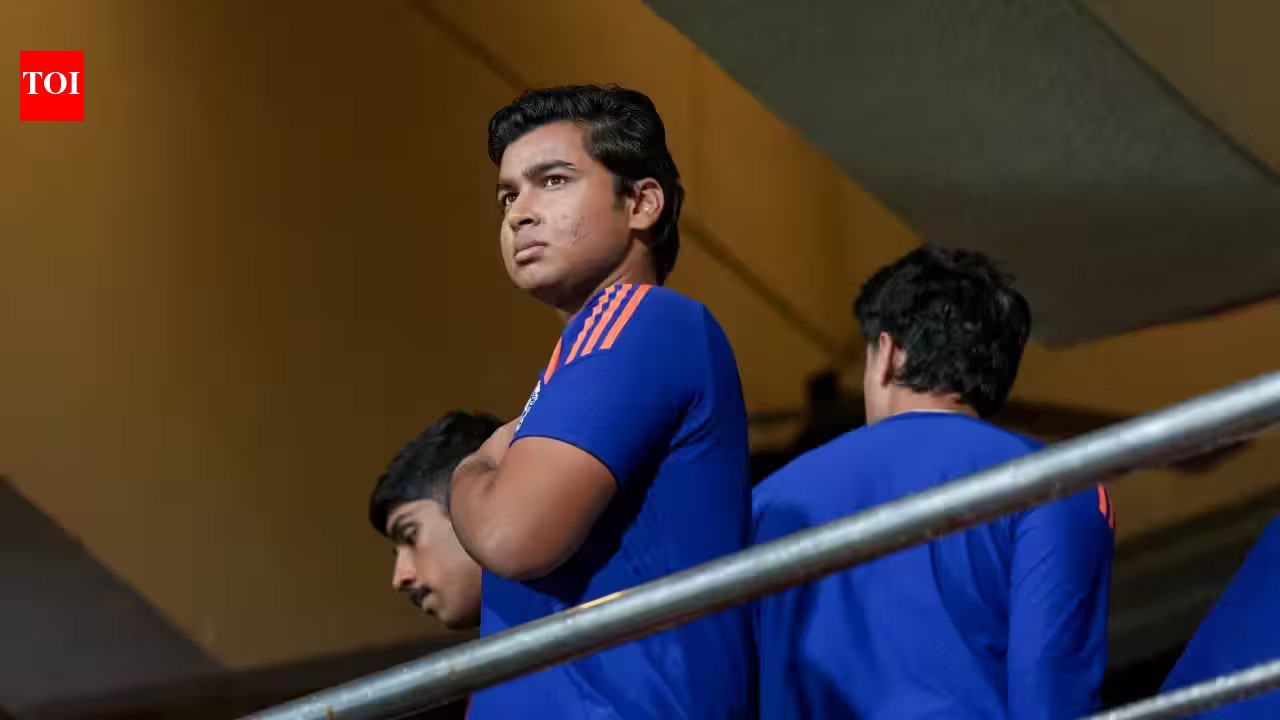
CRICKET’S RISING prodigy Vaibhav Sooryavanshi finds himself at a precarious crossroads in his fledgling international career. Despite being touted as one of the most exciting talents in the country, the 15-year-old remains confined to the sidelines of the Indian T20I setup. As the team prepares for the upcoming five-match series against New Zealand starting November 22, the debate regarding whether the youngster is being groomed or merely stagnating has reached a fever pitch.
Former India opener and respected cricket analyst Aakash Chopra has stepped into the discourse, offering a pragmatic, albeit harsh, assessment of the teenager’s situation. According to Chopra, the issue plaguing Sooryavanshi is not a lack of talent, but a lack of logistical space within a high-performing Indian top order.
The Logistical Impasse
The frustration surrounding Sooryavanshi’s omission reached a boiling point following the conclusion of the home series against the West Indies, which ended in a 2-2 draw. Despite the squad rotation that often accompanies such bilateral encounters, the teenager failed to register a single minute of game time.
“Vaibhav Sooryavanshi isn’t getting chances because a place isn’t getting created for him,” Chopra remarked during a discussion on his YouTube channel. “In whose place should you play him? To be fair, he can play only in place of Sanju Samson, Abhishek Sharma, or Ishan Kishan. When three people are doing well, you can’t get a chance suddenly. I know it is heartbreaking, but there is no other way.”
Chopra’s analysis highlights the cruel reality of the current Indian cricket hierarchy. With established power-hitters like Samson and Sharma occupying the top-order slots, the team management is hesitant to disrupt the momentum of a functioning unit. While Chopra advocated for a rotation policy—suggesting that all four batters, including Sooryavanshi, be given equitable opportunities to showcase their skills—he admitted that his suggestion has failed to gain traction among the selectors and coaching staff.
The Case for Domestic Experience
Recognizing that sitting on the bench provides diminishing returns for a 15-year-old in the developmental phase of his career, Chopra proposed a radical alternative. He argues that if the team management has no intention of utilizing Sooryavanshi during the New Zealand series, they should immediately release him to compete in the Ranji Trophy.
“If he remains on the bench, it serves little purpose,” Chopra asserted. “He should be released to play in the domestic circuit. Experience in the Ranji Trophy would be far more beneficial for his growth than watching the game from the dugout.”
Sooryavanshi’s record, though brief, supports the argument that he is ready for higher levels of competition. In eight matches, he has amassed 246 runs at a staggering strike rate of over 186, complemented by two half-centuries. His ability to clear the ropes with ease has generated significant hype, but as Chopra points out, international consistency requires playing time that he is currently being denied.
Defending Tilak Varma
Amidst the clamor for Sooryavanshi to be thrust into the playing XI, some fans and critics have suggested that the teenager should replace vice-captain Tilak Varma, citing the latter’s recent form as justification. Chopra, however, was quick to dismiss these claims, labeling the criticism of Varma as unwarranted.
“If you say Tilak Varma doesn’t perform at all, then what you are saying is slightly wrong,” Chopra stated firmly. He pointed to Varma’s impressive versatility, noting that the middle-order batter recorded two centuries when positioned at No. 3 before transitioning into a finisher’s role.
Chopra credited Varma for his contributions during the Asian Games and his consistent output in the lower-middle order, even when he was hampered by injury concerns leading into the World Cup cycle. “The World Cup didn’t start well, but after that, he has done a good job. The fact is that he has been doing really well in the middle order and the lower-middle order. So, I feel shooting arrows at Tilak Varma is not right.”
What Lies Ahead?
The dilemma surrounding Vaibhav Sooryavanshi serves as a microcosm of the “good problem” India currently faces: a wealth of batting talent that far outweighs the number of available positions in the XI. However, for a player as young as Sooryavanshi, the risk of “bench burnout” is real.
As the series against the Black Caps looms, all eyes will be on the final team sheet. Will the selectors heed Chopra’s advice and provide the teenager with a rotational opportunity, or will they continue to prioritize the tried-and-tested veterans? For now, the cricket world waits to see if Sooryavanshi will get the chance to translate his domestic promise into international reality, or if he will be sent back to the grind of the Ranji Trophy to further hone his craft away from the spotlight.
Disclaimer: This content is auto-generated for informational purposes only.
Source: Read Original News