







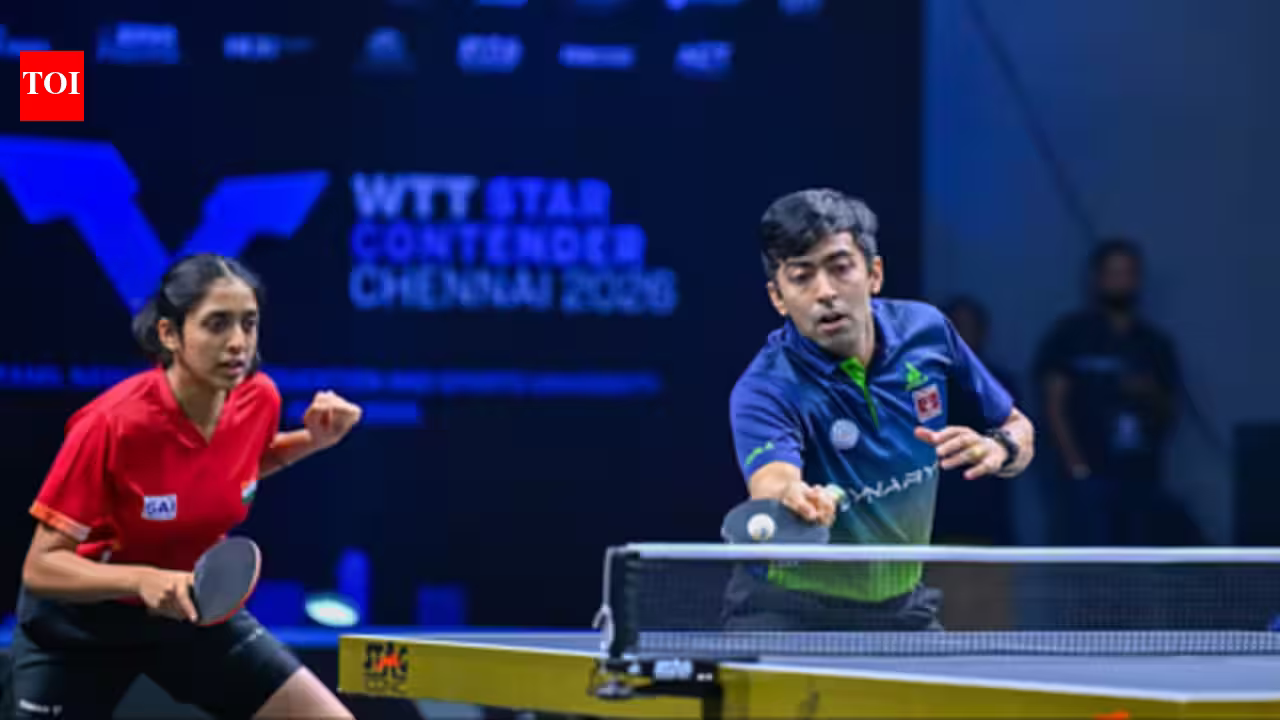
TASHKENT — The history books are being rewritten in Uzbekistan. In a breathtaking display of skill, precision, and nerves of steel, India’s Harmeet Desai and Yashaswini Ghorpade have officially punched their ticket to the semifinals of the Asian Table Tennis Championships, guaranteeing the nation its first mixed doubles medal in 72 years.
The duo’s progression to the medal round, secured on Friday following a gritty 3-2 quarterfinal victory over South Korea’s Park Ganghyeon and Lee Daeun, serves as a watershed moment for a sport that has been surging in popularity and competitiveness across the Indian subcontinent.
A Historic Breakthrough in Tashkent
The magnitude of this achievement cannot be overstated. For over seven decades, the podium at the Asian Table Tennis Championships has remained largely elusive for India in the mixed doubles category. The last time an Indian pair stood amongst the continent’s elite in this specific event was back in 1954.
Against the South Korean pair, Desai and Ghorpade showcased a level of tactical maturity that dismantled their opponents’ rhythm. The match was a rollercoaster of momentum shifts, requiring the Indian pair to remain unflappable under the immense pressure of a knockout quarterfinal. By sealing the fifth game, they not only advanced to the final four but also etched their names into the annals of Indian sporting history.
“This is a massive hurdle we’ve crossed,” noted members of the coaching staff, emphasizing that the result is the culmination of months of intense preparation and tactical refinement. The victory confirms a bronze medal at the very least, but for this ambitious pair, the goal has clearly shifted toward a higher tier of glory.
The Road Ahead: A Japanese Test
With the semifinals looming, the challenge for Desai and Ghorpade is set to intensify significantly. They are scheduled to face the formidable Japanese duo of Sora Matsushima and Miwa Harimoto.
Matsushima and Harimoto represent the tactical brilliance and lightning-fast reflexes that have come to define Japanese table tennis on the global stage. For the Indian pair, this semifinal matchup will be the ultimate litmus test. A victory would propel them into the gold medal match, potentially allowing them to upgrade their historic bronze to either silver or gold.
While the celebration is warranted, the focus within the Indian camp remains razor-sharp. Having already tasted the pressure of deep-tournament runs, Desai and Ghorpade are well-versed in the demands of such high-stakes encounters.
Mixed Fortunes for the Indian Contingent
While the story of the day was the historic success of Desai and Ghorpade, the quarterfinal round also highlighted the sheer difficulty of competing at the Asian level. India’s secondary pair, Payas Jain and Syndrela Das, faced a formidable wall in the form of China’s Yi Chen and Huang Youzheng.
Despite a spirited effort, Jain and Das were unable to find a way past the clinical precision of the Chinese duo, falling in straight sets, 0-3. While their exit marks the end of their tournament run, the experience of competing at the highest level of Asian table tennis is expected to be invaluable for the young pair as they continue to develop.
Redemption After Asian Games Heartbreak
For Harmeet Desai and Yashaswini Ghorpade, this medal run acts as a potent form of redemption. Both athletes arrived in Tashkent carrying the lingering disappointment of the recent Asian Games, where, despite flashes of brilliance, they struggled to translate potential into podium finishes.
In Hangzhou, the path was grueling. Desai, who competed across three different categories, saw his men’s team run halted by South Korea in the round of 16, and he and Ghorpade suffered a narrow exit at the hands of the dominant Chinese pair, Lin Shidong and Kuai Man, in the mixed doubles quarterfinals. Similarly, Ghorpade’s individual campaign in the women’s singles and her doubles partnership with Diya Chitale were cut short by stiff competition from Japan and China, respectively.
However, the turnaround in Tashkent has been nothing short of inspiring. By clearing the quarterfinal hurdle that haunted them just weeks ago, Desai and Ghorpade have proven their resilience. They have demonstrated that they are not just capable of competing with the giants of the sport, but of conquering them when the stakes are at their highest.
As the semifinals approach, the entire Indian sports fraternity turns its eyes to the table in Tashkent. Whether they secure the bronze or push on to fight for gold, one thing is certain: Harmeet Desai and Yashaswini Ghorpade have ended a 72-year wait and signaled that India is a force to be reckoned with in the world of professional table tennis.
Disclaimer: This content is auto-generated for informational purposes only.
Source: Read Original News