








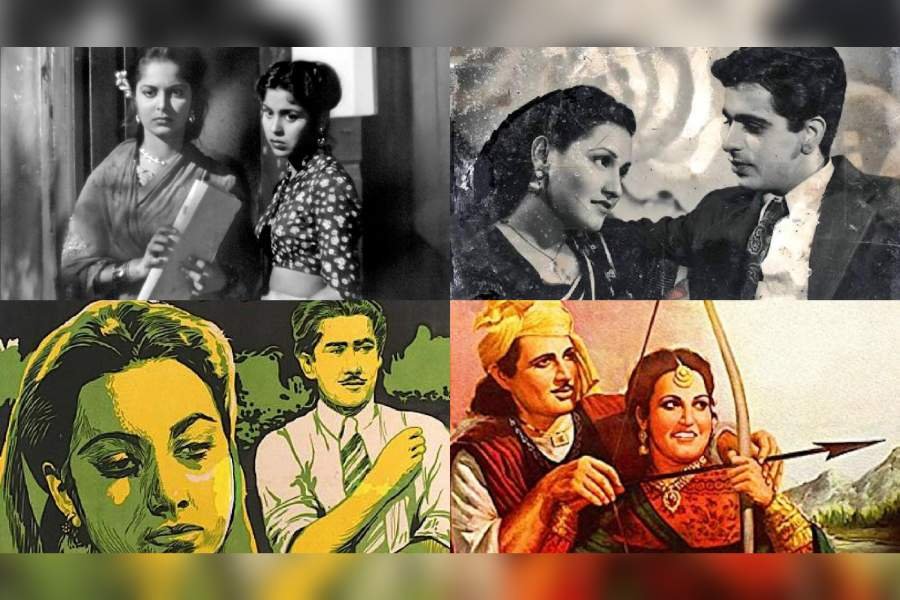
In the momentous year of 1947, as India celebrated its newfound independence and simultaneously grappled with the tumultuous shadows of Partition, the vibrant world of Hindi cinema offered a captivating escape. Even amidst the national upheaval, movie theaters in Bombay were bustling, drawing audiences to a selection of films that would ultimately define the year’s box office success. Five particular cinematic triumphs emerged from this pivotal period: Jugnu, Do Bhai, Dard, Mirza Sahiban, and the notably successful Shehnai.
Released on the very day of India’s independence, August 15, 1947, Shehnai premiered at Bombay’s Novelty cinema and quickly became one of the year’s most significant hits. Directed by P.L. Santoshi, this musical comedy-drama featured Rehana, Nasir Khan, V.H. Desai, and Indumati, telling the story of a family deeply embedded in the entertainment industry. A critical component of its widespread appeal was its groundbreaking music. C. Ramchandra’s score, infused with discernible Western influences, was considered remarkably modern for its era. The song "Aana meri jaan meri jaan Sunday ke Sunday," featuring the voices of Shamshad Begum, Meena Kapoor, and Chitalkar, achieved sensational popularity. This film’s enduring success was such that it reportedly enjoyed a remarkable 25-week run in numerous cities across the nation.
Earlier in 1947, another film, Jugnu, marked a significant turning point for the legendary Dilip Kumar. Directed by Shaukat Hussain Rizvi, it paired Kumar with Noor Jehan, who was already a colossal star throughout undivided India. The film’s musical compositions were central to its widespread acclaim, with Feroz Nizami’s score including the memorable duet "Yahaan badla wafaa ka," performed by Noor Jehan and a nascent Mohammed Rafi. Jugnu ultimately soared to become the year’s highest-grossing film, providing Dilip Kumar with the commercial breakthrough that would lay the foundation for a decades-long illustrious career.
Filmistan’s Do Bhai also achieved considerable success in 1947. This production house, founded by former associates of Bombay Talkies, was rapidly establishing itself as a dominant force in the Bombay film industry. Starring Kamini Kaushal and Ulhas, the film is particularly remembered for its exceptional music. S.D. Burman, still solidifying his presence in Bombay, composed the score, and Geeta Roy’s rendition of "Mera sundar sapna beet gaya" became an iconic part of the film’s lasting musical legacy.
A.R. Kardar’s Dard found its box office triumph largely due to its remarkable soundtrack, composed by Naushad. The film featured the voices of Suraiya, Shamshad Begum, and Uma Devi, with the latter, later known as the celebrated comedian Tun Tun, making one of her early appearances as a singer. Starring Munawwar Sultana and Suraiya, Dard proved to be a breakthrough for Suraiya, who emerged as a major singing sensation following its success. Her renditions of songs like "Beech bhanwar mein aan phansa hai," "Dil dhadke aankh meri phadke," and "Hum thay tumhare tum thay humare" garnered immense praise. Uma Devi’s "Afsana likh rahi hoon" also attained significant popularity.
Finally, Mirza Sahiban captivated audiences by chronicling one of Punjab’s most renowned tragic romances. Starring Noor Jehan and Trilok Kapoor, this adaptation of a beloved folk tale became another of the year’s biggest hits. Its success underscored the power of bringing familiar cultural narratives to the silver screen. Noor Jehan’s presence was again instrumental, as by 1947, she had firmly established herself as a formidable screen presence and vocalist, her popularity transcending the linguistic and geographical divisions of the then-undivided India.