








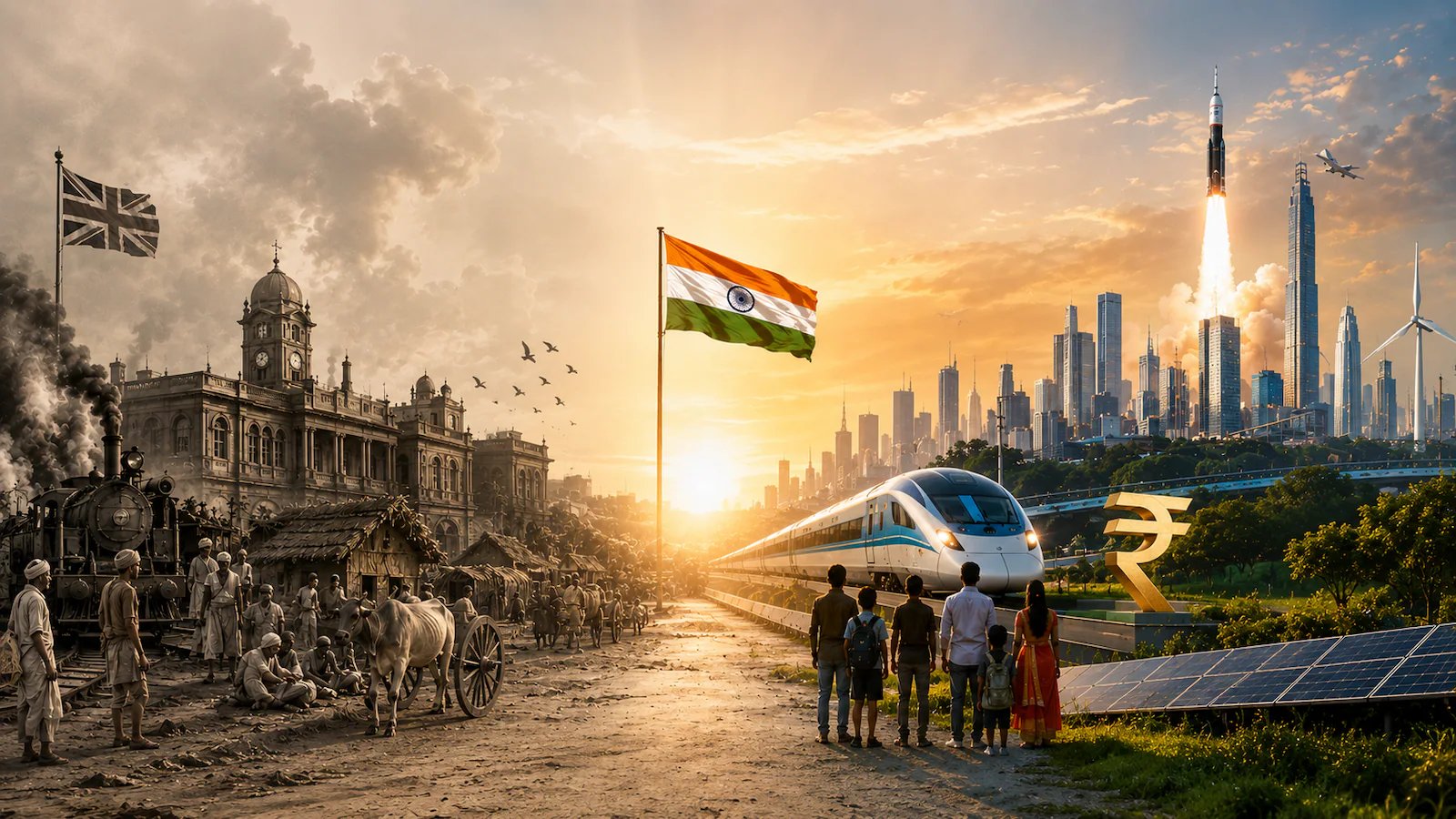
India’s economic trajectory has undergone a remarkable transformation since gaining independence from British rule. Before the onset of the British Raj, India’s standard of living was largely comparable to the global average. However, the subsequent decades witnessed a steep decline in the nation’s economic well-being. According to the Maddison Project Database 2023 by the University of Groningen, India’s GDP per capita, which stood at 83% of the global average in 1820 during the late Mughal period, plummeted to 55% by 1870 and further to a mere 32% by 1940. This stark regression highlights the profound impact of colonial exploitation on the country’s economic vitality.
Following the hard-won Independence, the Indian economy faced numerous challenges, including the widespread disruptions caused by Partition and the intricate complexities of nation-building. Consequently, income levels remained subdued for several decades. A pivotal moment arrived with the economic liberalisation reforms initiated in the early 1990s. These transformative policies acted as a catalyst, unleashing higher growth rates and fostering greater integration with the global economy. By 2025, a significant recovery was evident, with India’s GDP per capita rebounding to 46% of the global average, as reported by Our World in Data.
Today, India stands out as the world’s fastest-growing major economy. Projections from the IMF’s July 2026 World Economic Outlook estimate India’s GDP growth at an impressive 6.4% in 2026, surpassing major economic powers like China (4.6%), Brazil (2.4%), and the United States (2.3%). This sustained growth trajectory underscores India’s increasing dynamism on the global stage.
Furthermore, India’s footprint in the global economy has expanded significantly over the past four decades. From contributing a modest 1.6% to the world economy in 1980, India now accounts for approximately 3.3% of global GDP, with IMF projections indicating a rise to over 4% by 2030. This expanding economic influence is translating into greater leverage in global trade negotiations, geopolitical discourse, and international policymaking.
In terms of sheer economic size, India has solidified its position among the world’s largest economies. The IMF’s April 2026 estimates reveal India’s nominal GDP reached $4.15 trillion in 2025, securing its spot as the sixth-largest economy globally. This places it marginally behind Japan ($4.38 trillion) and the United Kingdom ($4.26 trillion), highlighting its formidable economic power.
The new millennium has also witnessed a robust surge in India’s export performance. The nation has diversified its export portfolio, moving beyond traditional goods to become a significant supplier of essential items like PPE kits and medicines during the Covid-19 pandemic. India is also rapidly emerging as a crucial global hub for manufacturing and services. Its share of global merchandise exports, which languished below 1% until 2003, has now climbed to 2.52% from a mere 0.61% in 1970, signifying a dramatic transformation in its international trade capabilities. Government initiatives such as Atmanirbhar Bharat, Startup India, and production-linked incentive (PLI) schemes have been instrumental in bolstering India’s export ecosystem and fostering this growth.
Nearly eight decades post-independence, India has not only overcome the severe economic setbacks inflicted by the colonial era but has also emerged as a vital engine of global economic growth. As its share in global GDP, trade, and investment continues to expand, India’s economic resurgence is an undeniable force. The crucial next step for India is to effectively translate this rapid economic growth into higher incomes and broader prosperity for all its citizens, ensuring that the benefits of its economic success are widely shared.