








Sikh Community Defies Indian Government’s Ban on Film Exposing Police Abuses
AMRITSAR, India – In an extraordinary display of defiance against government censorship, the Sikh community across Punjab is rallying behind the film "Satluj," a biopic exposing alleged extrajudicial killings by security forces. The film, which was denied a theatrical release certificate and pulled from a streaming platform, has become a symbol of resistance against what many perceive as attempts to suppress historical narratives and silence dissent.
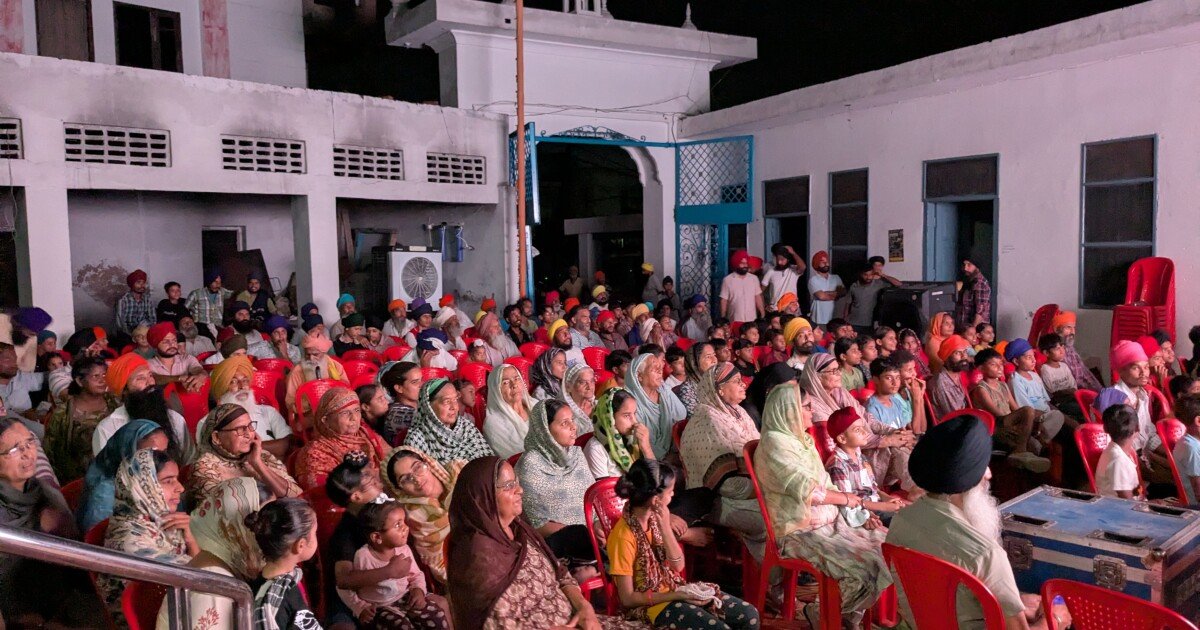
On a humid monsoon evening in the northern Indian village of Bandala, farmers, after a day tending to their rice and sugarcane crops, gathered at the local Sikh temple. Men and women settled into plastic chairs, while children buzzed with excitement, for an impromptu screening of "Satluj." This scene is being replicated across Punjab, where Sikh religious bodies and political groups are hosting community-led screenings in temple courtyards, community halls, and village squares, with attendance swelling at each event.
The film, titled "Satluj," is based on the real-life story of Jaswant Singh Khalra, an activist who was murdered after uncovering widespread extrajudicial killings perpetrated primarily by the Punjab police. These abuses reportedly occurred in the aftermath of the violent separatist movement that ignited in 1984, following the Indian army’s controversial storming of the Golden Temple, a revered Sikh shrine. The subsequent decade was marked by significant bloodshed, including the assassination of former Prime Minister Indira Gandhi by her Sikh bodyguards, and a surge in killings of civilians, militants, and state officials.
While the Indian government has not publicly disclosed its reasons for blocking "Satluj," its actions align with a growing trend of censoring or demanding modifications to films that challenge the official narrative. However, the ban on "Satluj" has backfired spectacularly, triggering rare defiance against Prime Minister Narendra Modi’s Hindu nationalist government.
Sikh leaders in cities and villages throughout Punjab have urged their communities to watch the film. In Amritsar, the spiritual capital of the Sikhs, activists and political parties have staged rallies condemning the ban. Beyond organized screenings, bootleg copies of "Satluj" are being widely downloaded and shared on WhatsApp and YouTube, ensuring its reach to a broader audience.
Sanjay Srivastava, a sociologist at SOAS University of London, notes the unusual nature of this pushback. "It does reflect a genuine feeling on the ground that the issues covered in the film have not been entirely resolved," he stated, highlighting the unresolved historical grievances that the film addresses.
The Shadow of the Militant Movement and State Excesses
"Satluj" is set in the 1990s, a period when the Sikh separatist movement had turned militant. Thousands of Sikhs died in clashes with Indian security forces, and many sought asylum abroad, particularly in countries like the U.S. and Canada.
Sarabjit Singh Verka, a lawyer with the Punjab Human Rights Organisation in Amritsar, has represented numerous victims of the violence. He recounts confessions from police officers on trial, who privately admitted to having a "bullet for bullet" policy, permitting them to kill militants. This carte blanche, Verka explains, stemmed from civilians’ reluctance to testify against militants, leading to many being acquitted. However, he also revealed a darker side: "Some officers turned this into an extortion racket. They would kidnap young men and demand ransom from their families. Some also staged shootouts and cremated bodies to cover up the evidence."
Amidst this turbulent era, Amritsar resident Jaswant Singh Khalra resigned from his bank job to meticulously document these killings. Portrayed by acclaimed Indian actor Diljit Dosanjh in "Satluj," Khalra used municipal and crematorium records to compile a list of approximately 2,000 youths allegedly killed by police in his home district. He subsequently petitioned the Punjab High Court and the Supreme Court, estimating the total number of victims across Punjab could be as high as 25,000.
While Verka believes Khalra’s figure might be an exaggeration, he asserts, "The government should’ve nevertheless set up a truth and reconciliation commission to ascertain the truth. They didn’t."
In 1995, months after he made these explosive allegations, Khalra vanished from his home; his body was never recovered. A decade later, an Indian trial court convicted six police officers for his abduction and murder. "And while the government compensated some victims, most perpetrators got away," Verka added, emphasizing that Indian authorities appeared unwilling to address state excesses then, a sentiment that seems to persist today.
Censorship and the Power of Cinema
The filmmakers of "Satluj" faced significant hurdles, with director Honey Trehan revealing that India’s film certification board stalled their release for nearly four years. Trehan recounted an exchange with a board official, where his argument that the film was based on news reports and court testimonies was met with the dismissive response, "’Who speaks the truth so loudly in today’s times?’"
Despite the lack of a theatrical certificate, "Satluj" was released online in July. However, within two days, the streaming platform Zee5 removed it, citing "current developments" in a cryptic Instagram post. As bootleg copies began circulating, Zee5 later stated it was "doing everything" to reinstate the film, which currently remains unavailable on the platform.
Jagmohan Singh Raju, general secretary of the ruling BJP in Punjab, articulated the authorities’ concern: that the film’s depiction of police violence could reignite sentiments of Sikh separatism. This concern is amplified by escalating tensions with overseas Sikh diaspora communities and recent international incidents, including U.S. charges against an Indian intelligence agent for allegedly conspiring to kill Sikh separatist Gurpatwant Singh Pannun in New York, and Canadian charges against four Indian nationals in connection with the murder of Hardeep Singh Nijjar.
Analysts suggest that Indian authorities perceive historical narratives like "Satluj" not merely as films, but as potential security risks, fearing that international activism could trigger unrest within India.
While Raju conceded that one film wouldn’t instantly radicalize an audience, he expressed concern about its long-term psychological impact. "It doesn’t happen overnight that a crowd will gather and they become separatists," he said. "But it would trigger that kind of thinking. This first seeps into your mind, gets into your psychology, then someone plays on that psychology. It’s a long game."
Film journalist Anna M.M. Vetticad critiques the government’s reaction, stating it reflects their understanding of cinema’s power. "This government clearly considers cinema as a way of influencing mindsets, as a means of propaganda," she asserted, pointing to a trend of Islamophobic and pro-BJP films in Hindi cinema. Vetticad argues that the notion of the film inciting separatist feelings misses its core message: "It is focusing on human rights violations by those in authority. And when an individual investigated it, he was murdered for doing so."
Preserving Memory: A Quest for Justice
For the audiences watching "Satluj" in Bandala and other villages, the public screenings serve a profound purpose beyond entertainment – they are about preserving memory and seeking justice.
Ranjit Singh Babbar, now an adult, was only three years old in 1990 when his farmer father, Sardar Atma Singh, was detained by Punjab police. Babbar firmly believes his father had no militant ties, yet the police demanded a hefty ransom of $12,000 for his release. "My family sold land, gold and put it together. But when they returned with the ransom, the police said it was too late," he recalled, a raw pain evident in his voice.
Babbar carries a passport-sized photograph of his father in his wallet – a young man with a lush beard and a gray turban. "That’s the only memory of my father today," he said. "The government never issued his death certificate. We couldn’t even do his funeral rites. Police killed him and threw his body into a river."
For Babbar and many like him, Jaswant Singh Khalra’s courageous fight for justice represented a beacon of hope in India’s democracy. The blocking of his biopic, he says, sends a chilling message. "It makes us Sikhs feel like second-class citizens." The widespread defiance seen across Punjab, however, suggests that this feeling is far from being silently accepted.