







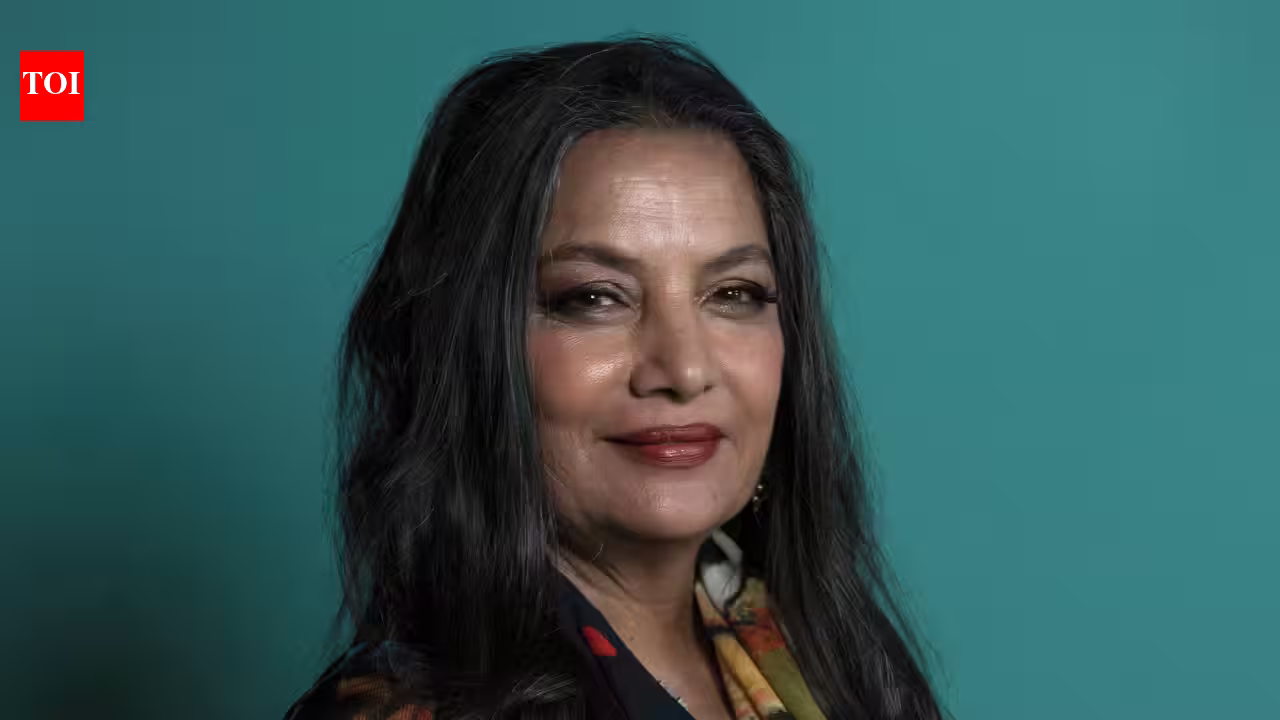
In the high-stakes arena of Indian public discourse, few voices carry as much weight—or ignite as much scrutiny—as Shabana Azmi’s. A powerhouse of parallel cinema, an activist, and a woman who has never shied away from the sharp edge of a controversy, the veteran actor recently waded into one of the country’s most contentious battlegrounds: the burqa debate. In a candid appearance on Usha Kakade’s podcast, Azmi didn’t just offer a soundbite; she offered a masterclass in the nuanced intersection of personal liberty, religious interpretation, and the limits of the state.
The debate over the burqa, which has frequently paralyzed legislative bodies and polarized communities, is often framed as a binary struggle between tradition and progress. Azmi, however, chose to strip away the political scaffolding to address the root of the matter: choice. Her stance is characteristically defiant, rooted in a staunch belief that the moment an external authority—be it the state or a fundamentalist group—attempts to dictate what a woman puts on her body, the conversation is no longer about religion; it is about autonomy.
## Reclaiming the Narrative on Religious Text
At the heart of the controversy is the persistent claim that religious mandates require the burqa. Azmi, speaking with a measured authority, pushed back against these interpretations. She clarified that the Quranic concept of modesty is broad and, crucially, universal. “It’s nowhere mentioned in the Quran that you should wear a burqa like this,” she argued. “It’s just written that there should be modesty in your eyes. That modesty is for both women and men.”
By reframing the conversation, Azmi dismantled the justification often used by gatekeepers of faith. Her point was clear: when religious texts are weaponized to control female presence in public spaces, it is often a matter of human-made patriarchal custom masquerading as divine law. For Azmi, the misinterpretation of these texts serves to diminish the agency of women, turning a personal expression of faith or modesty into a visible symbol of restriction. By calling out this misreading, she aligns herself with progressive scholars who have long argued that the spirit of the text has been lost in the rigidity of contemporary social control.
## The Paradox of Choice: Why “Forced Unveiling” is a Trap
Perhaps the most striking moment of the conversation came when Azmi addressed the hypocrisy found on both sides of the aisle. She made it explicitly clear that her personal preference is not to wear a burqa, but she drew a firm line in the sand regarding the right of others to choose differently. Her rhetoric was provocative and intentionally uncompromising: “If someone tells me I can’t wear a burqa, I’ll wear three of them. Who are you to tell me that?”
This statement encapsulates the core of the liberal paradox. In the name of secularism, there is a recurring temptation to enforce a “liberation” that looks suspiciously like coercion. Azmi rightly points out that freedom is not just the freedom to conform to secular norms; it is also the freedom to adhere to religious ones. By highlighting that one cannot fight religious fundamentalism by adopting the tactics of a secular fundamentalist, she forces the listener to confront a difficult truth: true secularism must provide the space for the burqa just as it provides the space for a Western suit or a saree. Her warning against hiding “fundamentalism under the veil of secularism” serves as a sharp reminder that state intervention in personal sartorial choices—regardless of the motivation—is a slippery slope toward authoritarianism.
## The Domestic Dialogue: Life with Javed Akhtar
While the public debate is fraught with tension, Azmi’s private life appears to be a mirror of the very discourse she navigates publicly. Her relationship with her husband, the legendary lyricist and staunch atheist Javed Akhtar, provides a unique lens through which to view these cultural frictions. The couple is known for their intellectual honesty, and Azmi’s account of their home life—where banter often replaces bitter conflict—reveals a deep mutual respect for divergent worldviews.
She shared an anecdote about her tendency to use phrases like “mashallah” and “inshallah,” which occasionally draws the ire of Akhtar. His challenge to her—“What if someone says ‘prabhu ji ki marzi’ all the time, how will you feel?”—is a quintessential example of the intellectual rigor both bring to their relationship. Yet, Azmi’s defense is equally telling: it is a part of her language, her cultural shorthand, and her heritage. This domestic friction highlights the broader national struggle to balance cultural identity with rationalism. For Azmi, being a Muslim is a cultural tether to her roots, while for Akhtar, it is a category he has opted out of entirely. The fact that they can exist in such a space—and even thrive—suggests that coexistence in India is not only possible but perhaps most vibrant when lived in the spirit of open, non-coercive dialogue.
## Faith as a Private Sanctuary
Ultimately, Azmi’s message is one of privatization. In a landscape where faith is increasingly synonymous with public performance and identity politics, she makes a strong case for pulling back. She admits that she does not read namaz and does not participate in religious rituals, yet she maintains a deep appreciation for the cultural architecture of her upbringing.
“The state shouldn’t get involved. It’s a private matter,” she stated, solidifying her position that the government’s role should be limited to maintaining order, not policing the spirit or the wardrobe. By framing religion as a private comfort, she effectively demystifies the “threat” often associated with religious expression in the public square.
In a career spanning decades, Shabana Azmi has played everything from a revolutionary to a victim, from an activist to an aristocrat. Yet, in this latest turn as a commentator on the shifting winds of Indian culture, she remains what she has always been: a fierce defender of the individual. Her comments on the burqa aren’t just about a piece of cloth; they are a manifesto for the right to define oneself, free from the heavy hand of the state and the judgmental gaze of society. In a time when the noise of the public debate is deafening, Azmi’s call for modesty of the eyes and liberty of the choice feels like a necessary, sober correction.
Disclaimer: This content is auto-generated for informational purposes only.
Source: Read Original News