







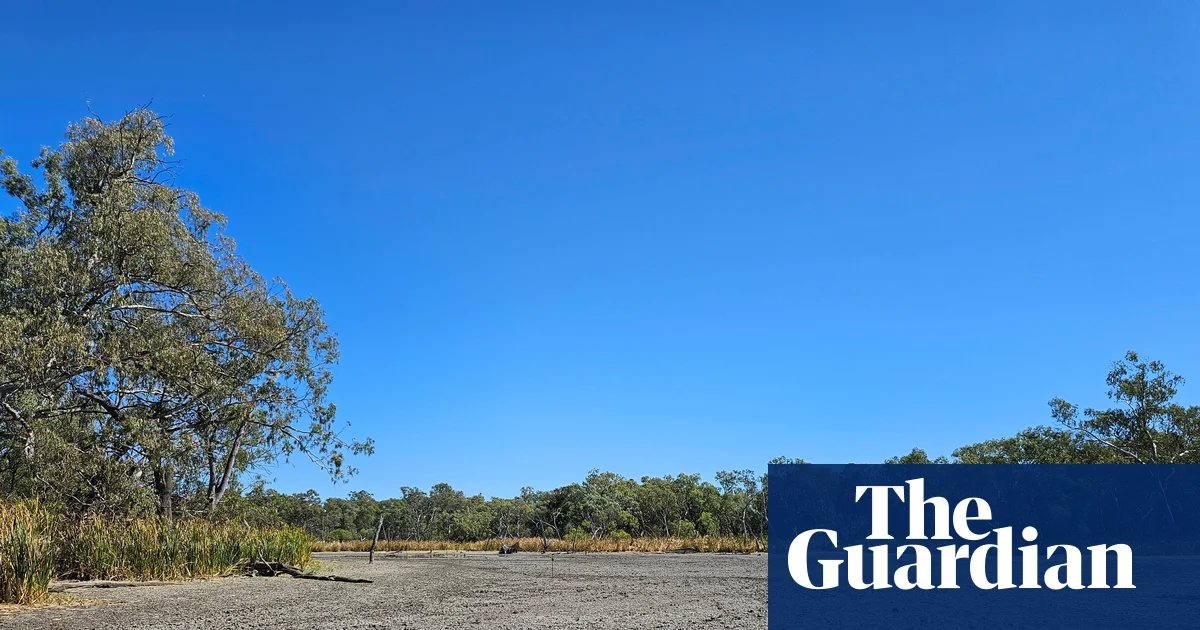
An “incomprehensible” disaster is unfolding at wetlands in New South Wales after the state water agency abruptly stopped environmental flows in the state’s north-west, leading to the deaths of turtles, waterbirds, frogs and sheep.
Researchers from the University of New England (UNE) have been desperately trying to help more than 300 turtles they say have been left to die in the Gwydir wetlands near Moree after WaterNSW stopped environmental flows following a complaint from a landholder.
Environmental flows refer to water released by the government from dams and tributaries into rivers and ecosystems to restore their health.
Video shows scientists digging to reach a large female broad-shelled turtle stuck under boggy mud in the Gingham watercourse after water dried up.
Dozens of others are in the same predicament, and some have already died. The affected animals include older female turtles that were carrying eggs and hoped to nest.
The UNE conservation biologist Prof Deb Bower called the scene a “disaster”.
“These deaths are incomprehensible, given there is environmental water sitting in the dam. This could save the turtles, but WaterNSW is just not allowing its release,” she said.
The Gingham watercourse supports four internationally important Ramsar-listed sites in the Gwydir wetlands region near Moree. Wildlife in the area relies on rain and floods, as well as environmental flows managed by state and federal governments in support of the Murray-Darling basin plan.
Flows to the area were meant to continue until mid-to-late April but were abruptly stopped by WaterNSW in early March, which Guardian Australia understands followed a landowner complaint about overflow on their property. The water flow had commenced in early summer.
Bower said the dead and dying turtles were merely the most visible sign of wider ecosystem impacts.
She said in a “perverse” outcome, her team had been asked by the NSW government to rescue remaining living turtles when the water that could save them was being held in Copeton dam.
“We rescued 40 turtles over the last four days, 39 of which have gone to Taronga [zoo] in Dubbo,” Bower said.
“We had to dig them out of the mud; we were thigh deep when we were wading through it.”
She added: “It’s ludicrous that the state government is paying to relocate these turtles to Taronga Zoo when the same state government is withholding water that could save those animals and all the other wildlife.”
Jonathon Guyer, a grazier and conservationist who manages separate wetlands on his nearby property, told Guardian Australia the sudden cessation of flows by WaterNSW had resulted in the deaths of many native animals that relied on the wetlands to survive.
He said this included fledgling chicks and eggs abandoned after native birds fled their nests, and “90% of frogs” within the wetlands. Endangered migratory species including Australasian bitterns and painted snipes had also fled.
“It’s an incredible injustice to the environment and the Australian people,” he said.
Guyer’s family have farmed in the region for generations and conserved the wetlands for decades.
He told Guardian Australia he had received no notice from either the state environment department or WaterNSW about the decision to suddenly stop the environmental flow. He said he worked out something had happened when he heard crows one morning and travelled out to the wetlands area and found more than 100 bogged sheep. He said he had to euthanise 56 older ewes that had been attacked by crows while trapped in the mud.
“The devastation of it all is heartbreaking,” he said.
“I know what these wetlands are like when they’re alive, and they’re so incredibly beautiful.
“To see them now in such a state and knowing what has been lost is devastating.”
Cate Faehrmann, a Greens member of the NSW legislative council, took the video footage at the Gingham watercourse site after visiting the area this week.
“An environmental catastrophe is happening right now under this government’s watch. These wetlands should be thriving at this time of year, supporting thousands of migratory shorebirds and waterbirds, turtles and fish,” she said.
Faehrmann said the protection of ecological values like the wetlands was “deliberately prioritised” in the state’s water laws.
“The water minister must issue an urgent directive that environmental water flows be restarted immediately, otherwise hundreds of turtles are going to die,” she said.
The NSW water minister, Rose Jackson, said she and the environment minister Penny Sharpe were aware of the situation.
“WaterNSW has temporarily suspended environmental water releases that inundate private land,” she said.
“We are working to identify pathways to reinstate those deliveries while managing liability as soon as possible.”
She said urgent work had been undertaken to relocate as many turtles as possible, with 39 turtles now in care at Taronga Western Plains Zoo. She said they would be returned to the Gingham waterhole “after it has refilled”.
“WaterNSW is working with the environmental water holders to continue delivering water in rivers, including the Gwydir, by maximising flow rates while keeping water within the river channel. The majority of environmental water releases remain unaffected,” she said.
WaterNSW directed Guardian Australia to Jackson’s statement.