








The correspondent filing this dispatch is a law student in Mumbai who must remain anonymous.
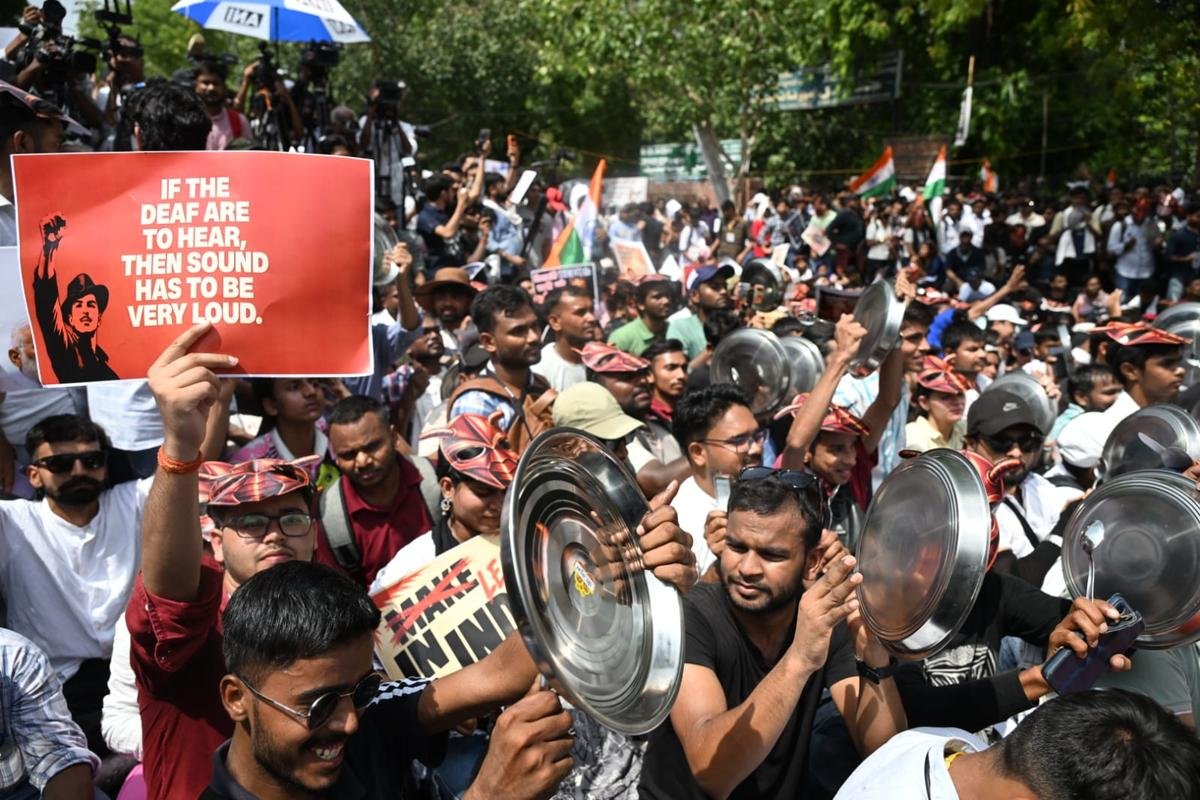
As India’s student march enters its third consecutive day, the national capital of Delhi has been swarmed by thousands of “cockroaches.” The term is evocative, having been reclaimed by India’s younger generation in response to remarks made by Chief Justice of India Surya Kant about people he called “unemployed youths and activists who attack the legal system,” comparing them to “cockroaches and parasites.” The comment was met with widespread outrage as a part of a largely social-media-driven movement in the wake of the leak of questions of the National Eligibility cum Entrance Test (NEET), the national medical entrance exam for prospective undergraduate students. This social media movement took to the streets of Delhi and other major metropolitan cities this week, only to be met with intense repression by Delhi Police officers.
The images and videos emerging from the protests are by now familiar. Students coughing through tear gas, protesters bleeding from baton injuries, political leaders being detained, roads transformed into police cordons and thousands of young people confronting perhaps the largest display of police force many of them have witnessed in their lives. In a series of social media posts and statements, Delhi Police officers maintained that they acted in accordance with their official duties, and that reports of police brutality are false and misleading. Officers said protesters breached barricades, defied prohibitory orders, and injured police personnel, requiring them to use crowd-control measures. Protesters and civil society organisations, however, have characterised the response as disproportionate and punitive.
The matter was heard by the Delhi High Court yesterday, despite the bench’s earlier obiter dictum to not “drag the Court into this matter.” However, the matter is scheduled for September 2026, without any immediate remedy or redressal for protestors. Moreover, Justice Surya Kant has also declined to urgently list a plea before the Supreme Court, stating that it would be a “waste of time,” and that the Apex Constitutional Court of the Country, as the Guardian of Fundamental Rights, had “no time to watch videos” of clashes between protestors and Delhi Police officers.
Indian constitutional jurisprudence has consistently recognised that the existence of statutory powers does not automatically justify their exercise. In Joginder Kumar v. State of Uttar Pradesh, the Supreme Court observed that no arrest should be made merely because it is lawful to do so. Similarly, D.K. Basu v. State of West Bengal established that constitutional protections assume their greatest significance precisely when citizens encounter the coercive capacities of the State. The common underlying thread across these cases upholding fundamental rights is that the end cannot justify the means in the context of abuse of police power.
These principles are further supported by the Delhi Police’s own regulatory framework. A Delhi Police Standing Order articulates the importance of police personnel on duty being in appropriate uniform, including name plates and badges. However, protesters claim that officers in plain clothes and without name plates undertook crowd control measures, including beating dissenters with “lathis,” or wooden batons. After intense backlash, the Delhi Police directed all police personnel to wear proper uniform while on duty.
The Ministry of Home Affairs’ Code of Conduct for the Police in India describes concepts such as necessity, procedural compliance, and minimum force to regulate police conduct. The National Crime Investigation Bureau’s FAQs reiterate this governing principle, providing that police may only use force as a “last resort in controlling a crowd.” Specifically, it states, “if [police force] must be used at all, it must be minimal, proportionate to the situation and discontinued at the earliest possible moment.”
Police officers are not vested with an unrestricted licence to disperse assemblies through coercive means. No instrument better illustrates the fraught relationship between policing and dissent than the “lathi.” From colonial policing practices to a contemporary measure, the baton has frequently become the State’s most visible response to public demonstrations. The Delhi High Court has circumscribed the use of lathis by the police, ruling that it can exclusively be used to disperse an unlawful assembly. Earlier this year, the Supreme Court affirmed that lathis have the potential to be lethal weapons when used on vital parts.
Reports emerging from the “Chalo Sansad” protests indicate that police force was used against demonstrators attempting to march towards Parliament, resulting in injuries to both protesters and police personnel. If accepted as true, such circumstances raise difficult questions concerning the distinction between what constitutes dispersal and punishment. The use of force must remain directed towards neutralising imminent threats to public order rather than deterring the exercise of constitutional freedoms themselves. Moreover, protesters have alleged that both electric batons and lathis with fitted nails were deployed against protesters.
The reported use of tear gas during the protests is equally significant, precisely because it represents an escalation beyond ordinary policing measures. Its use necessarily assumes circumstances sufficiently grave to justify chemical dispersal methods. The Supreme Court’s observations in Ramlila Maidan Incident v. Home Secretary, Union of India remain particularly relevant in this context. Here, the Court emphatically recognised that the maintenance of public order must remain compatible with constitutional guarantees of liberty and dignity. Even where restrictions upon assemblies may ultimately prove justified, State authorities continue to remain constitutionally bound by the requirements of proportionality and procedural fairness. The preservation of public order cannot become a constitutional trump card that permits the abandonment of these obligations.
Particularly troubling are allegations concerning the treatment of female protesters during crowd-control operations. Indian law deliberately affords heightened procedural safeguards to women interacting with law enforcement authorities, recognising both India’s historical experience with custodial violence and the centrality of dignity under Article 21 of the Constitution of India. If reports concerning the physical handling of female protesters by male police personnel are accepted as true, they constitute a serious dereliction of duty. This is magnified by Delhi’s position at the centre of India’s discourse surrounding women’s safety.
Democratic participation is frequently inconvenient, and constitutional rights are often disruptive, with neither characteristic automatically transforming peaceful dissent into a public order emergency warranting increasingly coercive methods of dispersal. Ultimately, the constitutional difficulty presented by recent events in Delhi does not lie in the existence of police powers themselves. Rather, it lies in the increasingly expansive conception of what constitutes public order and the correspondingly diminished space afforded to democratic dissent. The Delhi Police is entrusted not merely with maintaining public order, but with upholding the rights of citizens granted by the Constitution. The distinction between the two may ultimately determine whether the right to protest remains a meaningful constitutional guarantee or gradually becomes an activity exercised only at the sufferance of the State.
Opinions expressed in JURIST Dispatches are solely those of our correspondents in the field and do not necessarily reflect the views of JURIST’s editors, staff, donors or the University of Pittsburgh.