







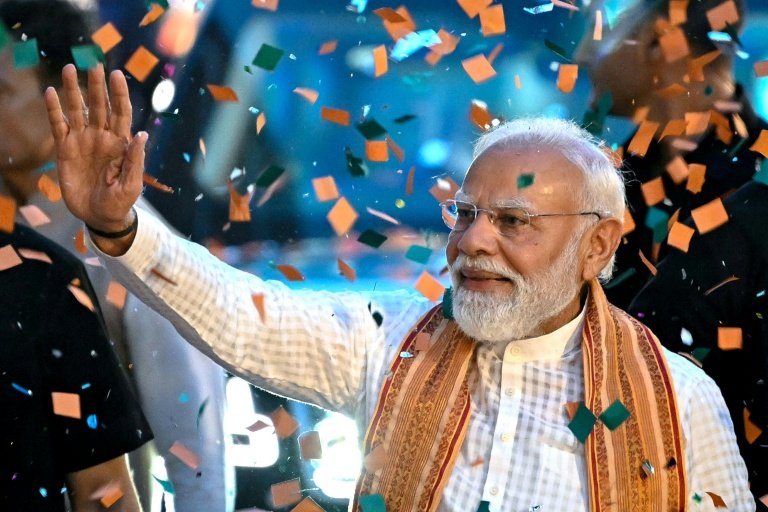
Indian Prime Minister Narendra Modi has dominated national politics for years, but analysts say this week’s election victory in opposition-held West Bengal state could mark a watershed moment for his party’s Hindu nationalist agenda.
Modi’s Bharatiya Janata Party (BJP) swept polls in the key eastern state of more than 100 million people, winning 206 of the 294 assembly seats, according to results announced Monday, for its first-ever victory in West Bengal.
Analysts say the BJP’s victory is one of its most significant since Modi was first elected prime minister in 2014, expanding its dominance beyond the Hindi-speaking heartland of north and central India.
While many voters were drawn by a campaign that focused heavily on development and employment, the election also caps a determined party push to win over Indians apprehensive about Modi’s nationalist agenda, fearing it would come at the expense of minority groups.
“It’s a consolidation of the BJP in the east of India,” political analyst Sushila Ramaswamy told AFP.
“It… establishes the BJP as the dominant party. No doubt about that.”
Other election results announced on Monday gave the BJP a thumping win in northeastern Assam state and another term in power in the small coastal territory of Puducherry, representing a “spectacular comeback” after failing to secure a majority in the 2024 general election, according to Rasheed Kidwai, a visiting fellow with the Observer Research Foundation think-tank.
“Since then, they’ve gotten their alliances right, the issues right,” he told AFP.
The results should put Modi on a stronger footing as he battles a series of economic and foreign policy challenges, including a pending US trade deal, ahead of a general election in 2029.
– ‘Huge boost’ –
West Bengal, a largely Bengali-speaking state, had been ruled by Modi’s fierce critic and adversary Mamata Banerjee since 2011.
Banerjee, leader of the regional All India Trinamool Congress (TMC), also lost her own seat in Monday’s vote, a steep downfall for the once formidable leader.
The three-time chief minister relied on a strong support base of women, Muslims and urban Hindu residents to hold on to power.
In the last state polls in 2021, the BJP made a major dent in the TMC’s majority, but not enough to unseat it.
Eyeing power in West Bengal, 75-year-old Modi has made regular visits and attacked Banerjee in fiery speeches on the campaign trail.
He promised large cash transfers to the poor and expanded welfare benefits, as well as development and employment for the youth.
For Modi, this win could embolden him to further widen his Hindu nationalist agenda, including plans for a uniform civil code to replace religious laws — an initiative that has fuelled tensions and fears, especially among Muslims who say it would infringe on their freedoms.
Political analyst Nilanjan Mukhopadhyay said clinching West Bengal would push the BJP’s vision of “Hindutva” — the belief that Hindus represent not only a religious group but India’s true national identity.
“This is a huge boost to Modi and the BJP,” he told AFP.
– ‘The last piece’ –
The party won “in a state where you have a fairly large, almost 30 percent Muslim population… and has been able to correctly harness the anti-incumbent sentiment and whatever shortcomings there were in Banerjee’s regime”, said Mukhopadhyay.
Partha Tripathi, a Kolkata resident, said the TMC lost in West Bengal because of the “massive unemployment, corruption and lawlessness” in the state.
“Aspirational youth wanting jobs and more economic opportunity voted for the BJP. They wanted a change, change for a better life,” Tripathi, 35, told AFP.
Another key issue was the revision of electoral rolls, formally intended to remove duplicate or ineligible voters.
But Banerjee called it a “mass disenfranchisement exercise” affecting minorities, especially Muslims and migrant workers in districts bordering Bangladesh.
The BJP said it had benefitted from the TMC’s failures — not the revision.
Political scientist Neelanjan Sircar wrote in The Hindustan Times that “the cultural and political impact of this victory for the BJP will be profound”.
“Bengal was the last, and most important, piece of the Hindu nationalist project in the east,” he added.
“A little more than a decade ago, who would have imagined that the major states of eastern and northeastern India — Assam, Bihar, Odisha, and West Bengal — would all be under the BJP?”
asv-ash-abh/pjm/ami