









India’s Nuclear Deterrent: Modernizing the Triad for Strategic Stability
New Delhi: India has solidified its position as a major nuclear power with a robust, multi-layered strategic deterrent, according to a recent assessment by the Bulletin of the Atomic Scientists (BAS). The report estimates that India’s stockpile has reached approximately 190 nuclear warheads, yet it emphasizes that the true strength of this arsenal lies in its sophisticated delivery mechanisms across air, land, and sea.
While New Delhi continues to adhere strictly to its “No First Use” policy, the ongoing modernization of its delivery systems serves as a clear signal of its commitment to an assured second-strike capability. By expanding its nuclear triad, India ensures that it retains a punishing retaliatory response, regardless of any potential adversary’s attempt to neutralize its defenses.
A Maturing Nuclear Triad
The cornerstone of India’s nuclear strategy is a balanced triad designed for survivability and precision. The air-based leg of this deterrent is currently anchored by the Mirage 2000 and Jaguar aircraft, with the French-origin Rafale expected to play an increasingly central role as older platforms are phased out.
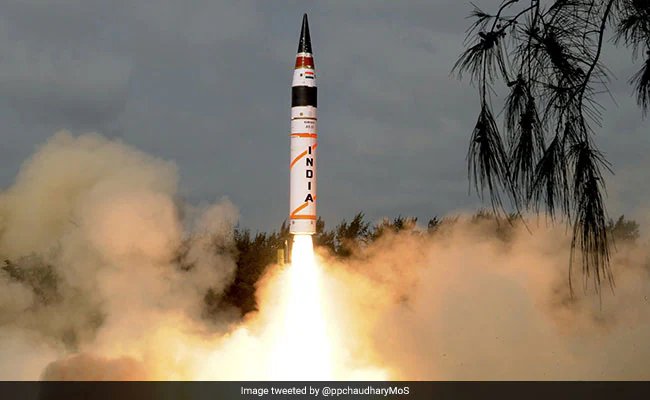
However, it is the land-based Agni missile family that forms the backbone of India’s strategic posture. Developed indigenously by the Defence Research and Development Organisation (DRDO), the Agni series has evolved from short-range tactical assets to the intercontinental-range Agni V. Capable of reaching targets across virtually the entirety of Asia and parts of Europe, the Agni V’s canisterized design allows for rapid deployment and shortened reaction times, significantly enhancing its tactical utility.
Furthermore, the report highlights the technological leap represented by the Agni V’s Multiple Independently Targetable Re-entry Vehicle (MIRV) capability. This advancement allows a single missile to deliver multiple warheads to different targets, effectively complicating any defensive countermeasures an adversary might employ.
The Sea-Based Deterrent: Ensuring Survivability
Perhaps the most critical evolution in India’s nuclear posture is its growing submarine fleet. The commissioning of INS Aridhaman in April 2026, alongside the existing INS Arihant and INS Arighaat, marks a turning point for India’s naval deterrent.
Nuclear-powered submarines equipped with ballistic missiles are considered the most survivable component of a nuclear triad. By operating hidden in the depths of the Indian Ocean for extended durations, these vessels ensure that even if land-based infrastructure were targeted, India would maintain the capacity to launch a devastating counter-strike. The ongoing development of long-range submarine-launched ballistic missiles like the K-4 further cements this underwater capability.
Strategic Opacity and Future Readiness
A key finding in the BAS study is India’s intentional strategic opacity. By not publicly disclosing the precise capabilities, deployment patterns, or exact operational ranges of its weapons, India prevents adversaries from accurately calculating the limits of its deterrent. This ambiguity serves as a psychological layer of defense, forcing potential aggressors to assume the highest possible capability.
Despite the modernization of its arsenal, India’s doctrine remains grounded in deterrence rather than provocation. The country’s commitment to avoiding nuclear escalation while maintaining the readiness to respond to aggression creates a stable, albeit watchful, regional security environment. As global and regional tensions persist, India’s transition from developing to operationalizing a fully integrated nuclear triad serves as a powerful instrument of national security, ensuring that any strategic gamble by an adversary is met with the certainty of a calculated, massive response.
Disclaimer: This content is auto-generated for informational purposes only.
Source: Read Original News