









India’s Russian Crude Imports Shatter Records Amid Sanctions, Fueling Global Refined Product Trade
New data reveals India’s deepening reliance on discounted Russian oil, while Indian refineries become key exporters of refined products to nations sanctioning Moscow.
India’s appetite for Russian crude oil reached an unprecedented level in July, marking the second consecutive month of record-breaking imports. Data compiled by the Centre for Research on Energy and Clean Air (CREA) highlights India’s persistent preference for discounted Russian supplies, even as Western nations tighten sanctions on Moscow’s energy exports.
This surge in imports occurs amidst evolving geopolitical pressures. The US sanctions waiver on Russian crude has lapsed, and a looming threat of up to 100% tariffs could materialize if the Trump administration’s proposed Russia sanctions bill, granting the American president powers to impose such tariffs on major oil importers from Moscow, passes.
The dramatic shift in India’s energy sourcing began after Russia’s invasion of Ukraine in February 2022. Western sanctions and the withdrawal of European buyers compelled Moscow to offer crude at significant discounts, making it an increasingly attractive option for Asian refiners.
India Buys Record High Oil from Russia
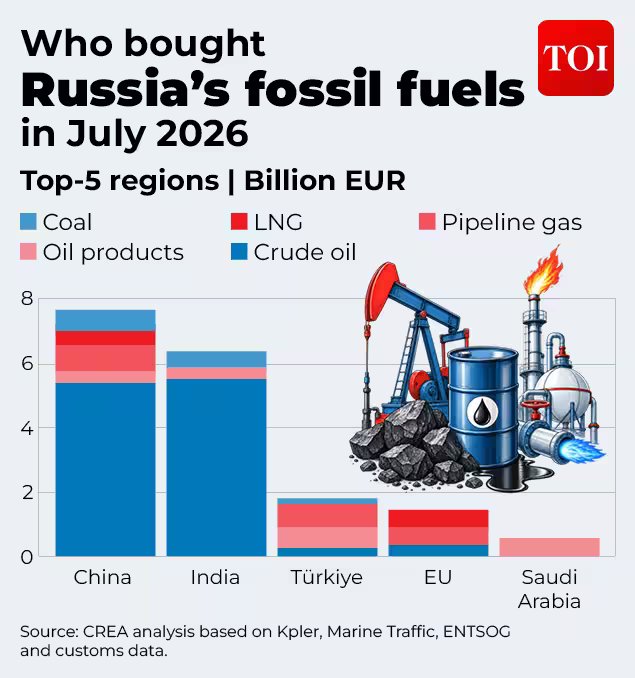
CREA’s analysis reveals India imported Russian crude valued at 5.5 billion euros in July, representing a 2.1% increase over June’s volumes. During this period, Russian crude constituted a staggering 87% of India’s total fossil fuel imports from Russia. This compares to June, when Russian crude accounted for approximately 83% of India’s 5.5 billion euros in overall Russian fossil fuel imports.
Who bought Russia’s fossil fuels in July 2026?
According to the US Energy Information Administration, Russia supplied less than 100,000 barrels per day (bpd) of crude to India in 2021, accounting for just 2.5% of the country’s crude imports. This figure surged to around 740,000 bpd in 2022 and further escalated to nearly 1.8 million bpd in 2023, establishing Russia as India’s largest crude supplier with a 39% share of total imports.
This deepening reliance has continued unabated. In July 2026, Indian refiners imported a record 2.8 million bpd of Russian crude, making up approximately 55.5% of India’s total crude imports of just over 5 million bpd. This represents a significant increase from the average of about 1.8 million bpd seen during 2024.
“India was the second-largest buyer of Russian fossil fuels in July 2026, importing a total of 6.4 billion euros worth of Russian hydrocarbons,” CREA stated. “Crude oil constituted 87% of India’s purchases, totalling 5.5 billion euros. Coal (512 million euros) and oil products (341 million euro) constituted the remainder of their monthly Russian imports.”
For further reading: 100%
tariffs: Why India may ignore Trump threat and continue buying Russian crude oil
Where is Russian Crude Headed in India?
The record increase in India’s Russian crude imports in July was largely driven by higher volumes arriving at smaller ports, rather than the nation’s two largest receiving terminals, Jamnagar and Paradip.
Imports handled through HMEL’s Mundra terminal witnessed a 58% increase from June, while deliveries at Indian Oil’s Vadinar SMPL terminal rose by 35%. Mumbai also reported a 37% surge in Russian crude arrivals. In contrast, volumes at Jamnagar, one of the world’s largest refining hubs, remained unchanged, and imports through Paradip declined by 22%.
Consequently, India’s highest-ever monthly intake of Russian crude was achieved without any increase in supplies through its two largest import terminals. Higher receipts at several other ports more than compensated for the decline in volumes at Paradip.
Since Russia’s full-scale invasion of Ukraine, India has emerged as the second-largest purchaser of Russian crude, accounting for 37% of Russia’s crude oil exports during the period analyzed by CREA. China remains the largest buyer with a 50% share.
CREA noted that the average price of Russia’s Urals crude decreased by 3% in July to $60.22 per barrel. Despite this decline, the price remained significantly above the G7 and EU price cap of $44.10 per barrel, which came into effect in February 2026.
India a Big Exporter of Refined Crude
India’s role in Russia’s oil trade extends beyond crude imports. Indian refineries processing Russian oil are now significant exporters of refined petroleum products to countries that have imposed sanctions on Moscow.
CREA reported that refineries in India, Turkey, Brunei, and Georgia, which processed Russian crude, exported refined oil products worth a combined 633 million euros to sanctioning countries in July. Of this, 214 million euros went to the European Union, 184 million euros to Australia, and 234 million euros to the United States. The think tank estimated that products worth 284 million euros were refined from Russian crude.
India was a leading source of these refined-product shipments. During July, five cargoes from Indian refineries processing Russian crude were discharged at ports in the European Union, despite the bloc’s prohibition on imports of oil products refined from Russian crude, which took effect on January 21.
The United States also received refined petroleum products from India’s Jamnagar refinery, where Russian crude continues to constitute a substantial portion of the feedstock. According to CREA, Russian crude made up approximately 35% of Jamnagar’s feedstock during the three months ending in July.
Beyond Jamnagar, the United States also received refined-product cargoes from Turkey’s STAR refinery and Georgia’s Kulevi refinery during July.
These figures underscore India’s expanding and multifaceted role in Russia’s oil trade, not only as one of the largest direct purchasers of Russian crude but also as a crucial refining and trading hub through which Russian oil, in its refined form, reaches international markets.