









India’s combined merchandise and services trade deficit experienced a significant expansion in July, reaching $15.03 billion, marking a 31.5% year-on-year increase. This widening gap was primarily driven by imports growing at a faster rate than exports, as revealed by data from the commerce ministry. While exports of goods and services saw a commendable rise of 13.3% to $80.14 billion in July 2026, up from $70.72 billion in the same month of the previous year, imports surged by a quicker 15.8%, totaling $95.16 billion compared to $82.16 billion a year prior. This disparity propelled the overall trade deficit upwards from $11.43 billion recorded in July 2025.
Merchandise exports played a pivotal role in boosting overall exports during the month, jumping by an impressive 19.63% to $44.24 billion from $36.98 billion in July 2025. The commerce ministry highlighted that July’s merchandise exports were the highest ever recorded for that specific month, surpassing the previous peak of $38.34 billion observed in July 2022. However, this export growth was accompanied by a substantial increase in merchandise imports, which climbed 17.52% to $76.22 billion in July, compared with $64.86 billion a year earlier.
Services also contributed to the overall trade picture. Services exports were estimated at $35.89 billion in July 2026, an increase from $33.74 billion in July 2025. Similarly, services imports also experienced growth, reaching an estimated $18.94 billion from $17.30 billion.
The expanding monthly deficit contributed to a more pronounced increase in the cumulative trade gap during the initial four months of the 2026-27 fiscal year. India’s overall exports during April-July rose by 13.16% to $316.42 billion from $279.63 billion in the corresponding period of the previous year. However, overall imports escalated at a higher rate of 17.28% to $365.85 billion from $311.94 billion. Consequently, the cumulative overall trade deficit broadened significantly to $49.43 billion from $32.32 billion, representing a substantial 52.97% increase. Within this period, merchandise exports grew by 17.04% to $173.78 billion, while merchandise imports saw an even higher rise of 19.27% to $292.38 billion. India notably recorded higher merchandise exports to both China and the US during April-July, with exports to China increasing to $7.78 billion from $5.72 billion a year earlier, and shipments to the US also rising to $34.49 billion compared with $33.48 billion in the corresponding period last year.
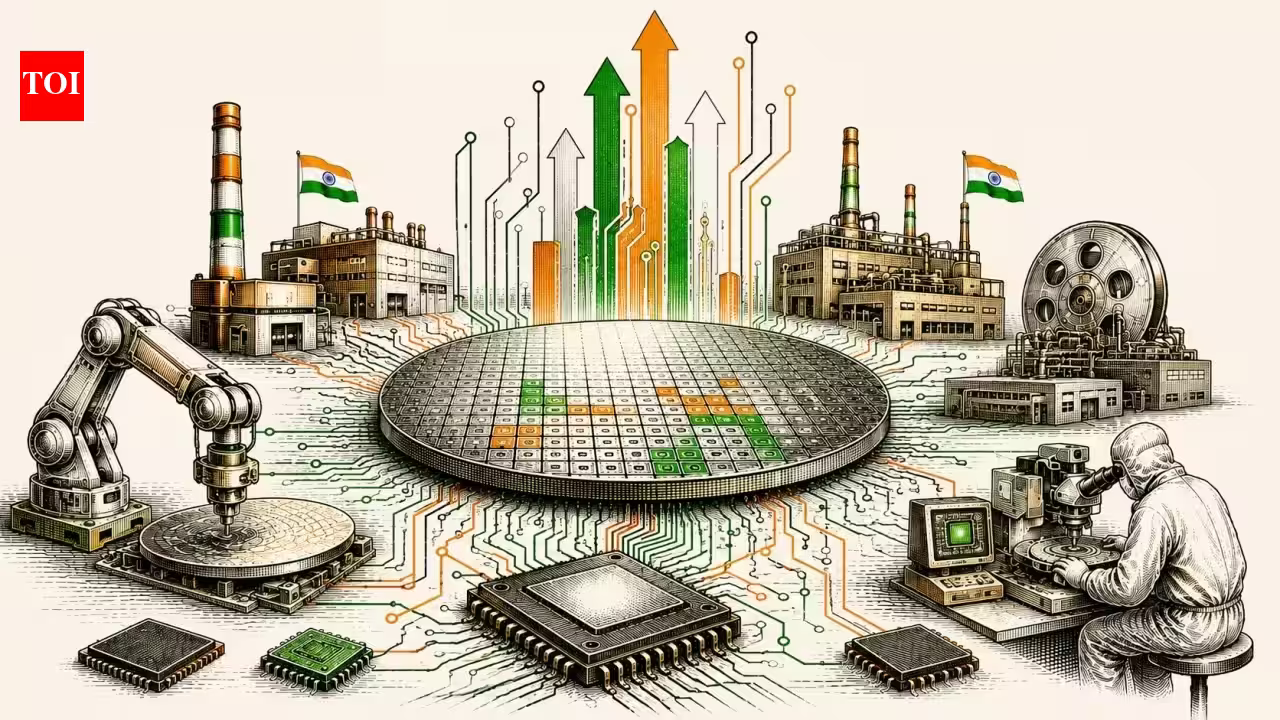
Alongside these detailed trade figures, government data underscored the rapid expansion of India’s electronics manufacturing and exports, positioning it as a significant driver of economic growth. Electronics exports experienced an astonishing surge of more than 11-fold, reaching Rs 4.24 lakh crore in FY2025-26. A noteworthy aspect of this growth is the increasing participation of women, who now constitute nearly 30% of the workforce in the broader electronics manufacturing ecosystem. The government emphasizes that India’s digital economy now contributes up to 14% of the country’s Gross Domestic Product. This remarkable progress is supported by various government initiatives, including the Production Linked Incentive (PLI) Scheme, the Electronics Components Manufacturing Scheme (ECMS), the India Semiconductor Mission (ISM), and Modified Electronics Manufacturing Clusters (EMC 2.0), all designed to bolster domestic manufacturing capabilities.
The impact of these initiatives is clearly visible: “Electronic goods have now become India’s third-largest export category, with exports reaching USD 47.96 billion in FY 2025,” the government stated, adding that “Electronics exports grew from Rs 38,000 crore to Rs 4.24 lakh crore” during the same period. Furthermore, India has emerged as the world’s second-largest mobile phone manufacturer. Mobile phones have dramatically ascended the ranks of India’s export items, transforming from the 153rd-largest export product in FY 2014-15 to the country’s largest export product in FY 2025-26. The production value of mobile phones surged from Rs 18,000 crore in 2014-15 to Rs 6.27 lakh crore in 2025-26. This exponential growth also extended to mobile phone exports, which increased an astonishing 165-fold over the period, climbing from Rs 1,500 crore to Rs 2.59 lakh crore. This flourishing sector has also been a significant job creator, generating 12 lakh jobs, with women comprising nearly 70% of the workforce in mobile manufacturing, highlighting the sector’s crucial role in empowering women economically.