






Moving on to India, the global rights group Human Rights Watch—also known as HRW—has accused Indian authorities of forcibly expelling ethnic Bengali residents. The group says most of those expelled from West Bengal state to Bangladesh are Muslims, and that they are being removed without due process.
HRW stated on Wednesday that actions by India’s Border Security Force, combined with efforts by Bangladesh’s Border Guard to block their entry, have left dozens of families stranded in the “zero line” area between the two nations.

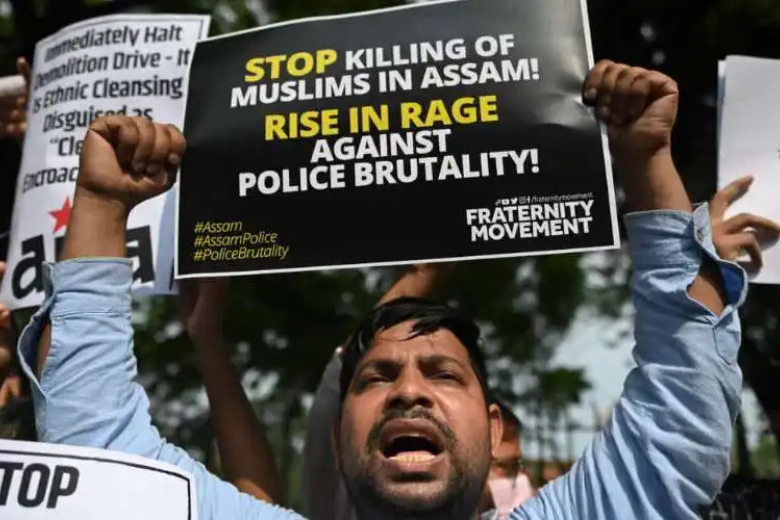
In this 2021 file photo, a protester chants slogans during a rally in New Delhi denouncing the violent eviction of Bengali Muslims from their villages in Assam state, in India. (Photo: Sajjad Hussain/AFP/Getty Images)
Bangladeshi border guards report they have foiled 21 attempts by the BSF since June 1, trying to push more than two hundred people—including children—into Bangladeshi border districts. The West Bengal government, which took office after the Hindu nationalist Bharatiya Janata Party won the recently held state election, said officials had detained hundreds of “Bangladeshi infiltrators” and forced nearly 5,000 people “to go back” under a strict “detect, delete, and deport” policy.
The New York-based rights group interviewed nine witnesses. They claim Indian border guards brought groups to the frontier at night, pushing them through cuts in the barbed-wire fence into Bangladeshi territory. In several cases, the guards later allowed the people to return after Bangladeshi authorities denied them entry.
Looking up north to China, authorities are currently holding two leaders of the prominent Protestant Early Rain Covenant Church. A rights group reported on Tuesday that the detentions followed a police raid on a weekend service. This marks the latest incident in an ongoing crackdown against unofficial Christian organizations. The congregation is one of China’s unregistered “house” or “underground” churches, where some Christians choose to worship instead of attending state-sanctioned, government-regulated ones.
According to a church statement shared on its Telegram channel on Monday, dozens of police and government officials raided a Sunday gathering in the city of Jiangyou. The church says more than 30 members were taken to a local detention center for questioning before most were released on Sunday night.

This photo taken on September 12, 2018 shows Jin Mingri, head pastor of the Zion church, posing in Beijing days after authorities shut down one of China’s largest “underground” Protestant churches. (Photo: AFP)
China’s ruling Communist Party has historically viewed organized religion with suspicion, and under President Xi Jinping, it has tightened its watch over unofficial groups.
Early Rain has caught the attention of authorities before. Back in 2019, its leader, Wang Yi, was sentenced to nine years in prison for “incitement to subvert state power,” a move that drew heavy condemnation from the United States. Rights groups point out that this year alone, Chinese authorities have broken up gatherings or detained the leaders of several unregistered churches across the country.
On Monday, the forum announced it had documented and verified five new cases of violence against Christians in Faisalabad, located in Punjab, the country’s most populated province. Through its dedicated helpline, the group has also recorded nationwide cases involving discrimination and a severe lack of protection for marginalized Christian communities.

In this file image, a Pakistanti sanitary worker inspects an overflowing sewerage line. (Photo: Daniyal Yousaf/Amnesty International)
The forum highlighted horrifying incidents, including the murder of sanitary workers, families enduring repeated intimidation and violence, and extreme exploitation and abuse. In one deeply alarming report, a brick kiln worker allegedly had his kidney removed without his knowledge or informed consent, all under the pretense of receiving medical treatment.
The rights forum is strongly urging both federal and provincial governments to step up immediately and protect these vulnerable communities.
Heading south to Sri Lanka, the Archdiocese of Colombo is pushing back against what it calls a coordinated smear campaign. The target? The Church and Cardinal Malcolm Ranjith.
The archdiocese stated on Wednesday that politicians and loyalists tied to ousted former President Gotabaya Rajapaksa are behind the attacks.
Recently, the Sri Lankan Church and Cardinal Ranjith have faced a wave of baseless allegations across parts of the media and social media sites. Pro-Rajapaksa figures are reportedly spreading completely fabricated claims.

Cardinal Malcolm Ranjith speaks to media in Colombo, Sri Lanka, on April 17, 2024. (Photo: Ishara S. Kodikara/AFP)
They allege that Cardinal Ranjith influenced government appointments to spark a fresh investigation into the 2019 Easter Sunday attacks. They also claim he received special government security and intentionally sowed discord between Buddhists and Christians in the country.
Perhaps the most serious claim made by them is that the Cardinal—who leads the Archdiocese of Sri Lanka—had prior information about the imminent attack on April 21, 2019. The archdiocese firmly rejected all these allegations as false, urging the public to simply ignore them.