








Alien invasive species are any organisms that become established in a natural environment outside their normal geographic range, and cause economic or environmental harm. For example, vigorous non-native plants can smother slower growing natives and even displace wildlife that relies on those natives. Invasives are one of the five major drivers of global biodiversity loss identified by the Intergovernmental Science-Policy Platform on Biodiversity and Ecosystem Services (IPBES).
In the EU, alien invasives are estimated to have an annual economic cost of around €12 billion, and the Biodiversity Strategy for 2030 recognises their spread as a major threat to Red List species. Measures to control them are set out in the Invasive Alien Species Regulation (1143/2014), including steps to prevent introductions, promote early detection and eradication, and manage established populations.
Not all non-native species become invasive when introduced to a new environment. It is therefore useful to understand the mechanisms by which certain species become invasive. In the case of plants, research has shown that colonisation by invasive species often increases the total amount of plant growth in an ecosystem, also termed ‘net primary productivity’ (NPP). This is considered an ecological anomaly, as naturally evolved communities are expected to make optimal sustainable use of available resources (sunlight, water, nutrients), to generate the maximum growth possible in any given ecosystem without degrading it.
This ability to outperform native species productivity – or ‘break the rules’ that should determine growth limits – is therefore of great interest in understanding how invasive species become problematic. Hypotheses as to why invasives are so successful in their non-native ranges include that they may avoid beating consumed by consumers such as herbivores or underground biota, they access more nitrogen than natives, or that they consistently colonise the most productive microhabitats. Studies measuring productivity may also have looked at disproportionately large-growing species or cultivars.
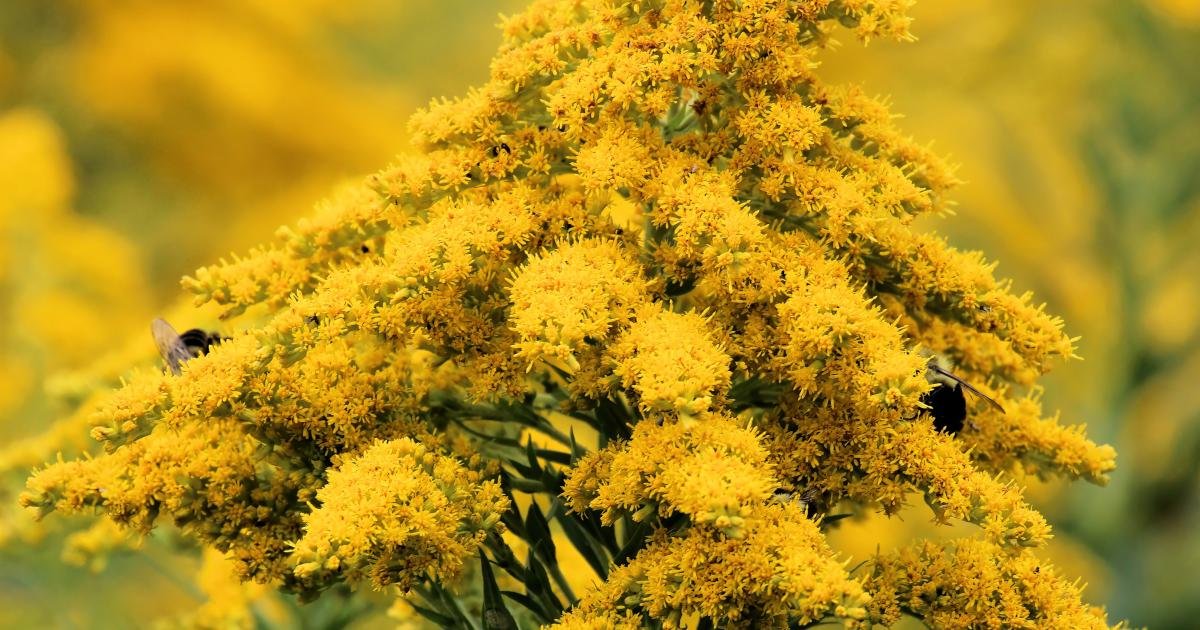
To investigate whether invasives are actually more productive in their non-native ranges than in their native ranges, researchers from Germany and the USA conducted a carefully constructed set of field experiments in both countries. They looked at five plant species: Linaria vulgaris, Hypericum perforatum, Tanacetum vulgare, Leucanthemum vulgare (all Eurasian natives, invasive in North America) and Solidago canadensis (native to North America, invasive in Germany). At field sites in Saxony-Anhalt and Montana, they located plots containing the non-natives, and paired each of these plots with a second nearby plot in which the species were absent. They also established garden plots in which the species were present and absent in both locations, to compare results from more controlled environmental conditions.
At the peak of the growing season, they harvested all the aboveground biomass (plant material) from 50 x 25cm quadrats in the paired plots and recorded its dry weight – a common method for indirectly measuring productivity. In the non-native ranges, the researchers found that field plots containing the target species had substantially greater biomass than those where they were absent. Overall, productivity in the presence of the invasives was 91% higher than native-only samples. This was true for all the non-native species. In the garden plots, this figure was 107%. In native ranges, meanwhile, the average difference in biomass between plots containing the target species and those that didn’t, was less than 5% in the field and insignificant in garden plots. In the native ranges, the other plants growing in the plots were of similar size – so the result is not due to the target plants being inherently large, say the researchers.
The results indicate that the ability of invasive plant species to increase overall productivity in an ecosystem is specific to how they function in non-native habitats and is not due to them being found in more productive positions in the landscape. This could be because they escape negative or competing factors present in their native ranges like herbivores or inhibitory soil biota (e.g. bacteria, fungi), propose the researchers. Exotic invaders may also rapidly evolve greater individual size in these conditions. Importantly, the researchers do not suggest that the intentional introduction of invasives could be seen as a way to improve biomass production within a habitat; such a non-sustainable action would degrade the ecosystem and its services over time, negatively impacting the resilience, competitiveness, and health of native species.
The researchers note a key limitation of the study, in that primary production was evaluated through a proxy measurement (aboveground biomass), not accounting for any growth that has been removed from the plant (for instance by herbivorous animals). If the invasive plants experience less herbivory than native ones (for instance due to being unpalatable to native fauna) this would be recorded as greater productivity, although it could be due to similar levels of productivity but less removal of biomass from the invasives. They were also unable to make inferences from soil sampling to look at differences in available nitrogen (to see if invasives promote increases in soil nitrogen). Nevertheless, it contributes to the understanding of how invasives may behave differently in their non-native ranges.
Source:
Callaway, R. M., Pal, R. W., Schaar, A., Hooper, D., Auge, H., Hensen, I., Kožić, K., Lekberg, Y., Nagy, D. U., Selke, J. A., Thoma, A. E., Träger, S. and Rosche, C. (2025) Exotic Invasive Plant Species Increase Primary Productivity, but Not in Their Native Ranges. Ecology Letters 28 8:e70187. https://doi.org/10.1111/ele.70187
To cite this article/service:
“Science for Environment Policy”: European Commission DG Environment News Alert Service, edited by the Science Communication Unit, The University of the West of England, Bristol.
Notes on content:
The contents and views included in Science for Environment Policy are based on independent, peer reviewed research and do not necessarily reflect the position of the European Commission. Please note that this article is a summary of only one study. Other studies may come to other conclusions.