







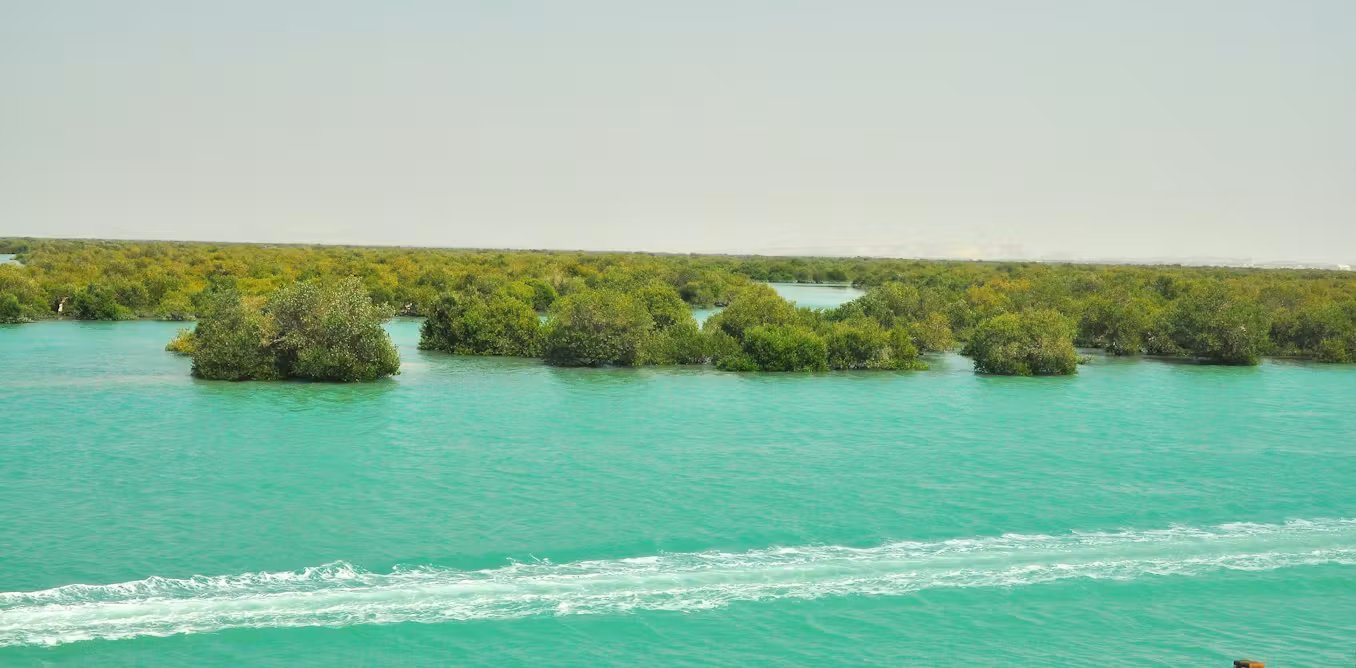
Oil slicks, a stark reminder of escalating tensions, are currently threatening the delicate ecological balance of Iran’s southern coast, having reached the invaluable Hara mangrove forests on Qeshm Island. While Iranian authorities are diligently assessing the full extent of this environmental catastrophe and investigating the source of the oil pollution, the incident is far from isolated. A troubling pattern of oil spills has emerged across the region since the commencement of the conflict between the US and Iran, painting a grim picture of environmental degradation amidst geopolitical strife.
The Hara forests, a UNESCO tentative World Heritage site, are nestled within the Khuran Strait, a vital waterway separating Qeshm Island from mainland Iran. This strait itself is in close proximity to the Strait of Hormuz, a geographical choke point universally recognized for its strategic importance as a marine corridor. Discussions surrounding the Strait of Hormuz typically revolve around the lexicon of geopolitics: the flow of oil barrels, intricate shipping lanes, fluctuating energy prices, and the intricate web of global trade. However, beneath this visible geopolitical landscape lies a less acknowledged, yet equally critical, ecological map. The Strait of Hormuz and its surrounding waters are a vibrant tapestry of life, home to thriving mangrove ecosystems, intricate coral reefs, expansive seagrass beds, productive fisheries, and resilient coastal communities. Furthermore, these waters are the lifeblood for some of the world’s most water-stressed societies, providing the very seawater upon which their existence depends. The Strait of Hormuz is thus not merely an energy chokepoint but also an ecological one, and prolonged conflict inevitably exposes the vulnerability of both simultaneously.
An oil slick on the open ocean is undeniably a grave pollution incident. However, the infiltration of oil into a mangrove ecosystem presents a problem of an entirely different magnitude. Mangroves, by their very nature, occupy the dynamic interface between land and sea. Their dense, intricate root systems are exquisitely adapted to slow water movement and trap sediments, making them extraordinarily productive ecosystems. Ironically, these same characteristics render them exceptionally efficient traps for pollutants. While surface oil can often be removed with varying degrees of success, oil that permeates shorelines and fine sediments becomes significantly more challenging to remediate. This contamination can directly affect the vital roots and nascent seedlings, exposing a myriad of organisms living within or feeding upon these sediments to persistent pollution. The ripple effects extend far beyond the visibly stained trees, impacting fish and bird populations through complex ecological pathways.
The plight of Qeshm Island cannot be viewed in isolation. Earlier in the ongoing conflict, another significant oil slick was detected and meticulously tracked near Kharg Island in the northern Persian Gulf. Satellite imagery from that incident revealed a disturbing trajectory: currents were carrying the contamination directly through the Khuran Strait, towards the very mangroves now under threat. Researchers, leveraging sophisticated satellite observations, have additionally reported a significant surge in both the frequency and sheer extent of oil pollution across the Persian Gulf since the onset of hostilities. This escalating pattern underscores how the environmental ramifications of prolonged conflict transcend any single spill, accumulating into a broader, more devastating impact.
The immediate priority for Qeshm must be focused on robust containment efforts. Preventing further ingress of oil into the delicate mangrove habitats is demonstrably more effective than attempting to extract it once it has permeated such a complex inter-tidal environment. However, containment, while crucial, is insufficient on its own. Authorities must embark on a comprehensive investigation to definitively establish the source and precise chemical characteristics of the contamination. This must be coupled with meticulous mapping of its spatial extent, integrating on-the-ground field observations with advanced satellite monitoring. Furthermore, rigorous sampling of water and sediments is imperative. To accurately assess the long-term impact, it is essential to establish baseline conditions in both affected and unaffected areas and to continuously monitor the health of the mangrove ecosystem, aquatic organisms, and other critical ecological indicators over an extended period.
Such vital efforts, however, are often severely constrained by the very conflict that precipitates them. War inherently limits the ability of scientists, environmental agencies, and emergency-response teams to access the areas where their intervention is most urgently required. Moreover, any response must be meticulously planned to avoid exacerbating the existing damage. The cautionary tale of the 1989 Exxon Valdez oil spill off the coast of Alaska serves as a stark reminder: while high-pressure hot-water washing effectively removed stranded oil, it inadvertently caused substantial additional harm to sensitive shoreline organisms and their habitats. In mangrove ecosystems, where roots and sediments are exceptionally vulnerable to physical disturbance, similarly aggressive interventions can paradoxically inflict more harm than good. Crucially, the monitoring of the Hara mangrove forests cannot cease once the coastline appears visually clean, as hidden damages can persist for years.
There is a prevalent, yet deeply flawed, tendency during wartime to relegate environmental damage to a secondary concern, something to be addressed only after military strategy, diplomatic intricacies, energy supply, and economic losses have been fully tackled. This hierarchical approach is increasingly difficult to justify. Environmental systems are, in essence, critical infrastructure. Mangroves actively protect coastlines and sustain diverse marine ecosystems. Thriving fisheries underpin livelihoods and ensure food security. Fertile soils support agricultural production. Aquifers serve as vital water reservoirs, and coastal waters are indispensable for desalination plants. Healthy ecosystems provide a fundamental form of resilience that becomes even more, not less, critical during periods of profound political and economic instability. Therefore, their destruction or degradation creates long-term liabilities that can endure long after military operations have concluded. Unlike a bridge, a pipeline, or a building, an ecosystem cannot simply be reconstructed. A mature mangrove forest, for instance, is the product of intricate biological processes unfolding over decades. Lost ecological functions may take years to recover, and some alterations may prove utterly irreversible.
This is precisely why the unfolding situation at Qeshm demands attention that extends far beyond the borders of Iran. The immediate question is not whether this specific oil contamination represents an ecological catastrophe; the evidence to make such a definitive judgment is still being gathered. The more profound and urgent question is what this event is unequivocally communicating to us. It is unequivocally telling us that in a region characterized by immense volumes of hydrocarbons, dense maritime traffic, critically important water infrastructure, and exceptionally fragile coastal ecosystems coexisting within the same confined geographical space, environmental risk and geopolitical risk are inextricably intertwined.
Should the Iran conflict persist, the probability of further accidents, extensive infrastructure damage, widespread pollution, and severe disruptions to essential environmental management efforts will inevitably escalate. Some consequences, such as burning vessels, visibly blackened coastlines, or expanses of dead vegetation, will be immediately apparent and shocking. However, many others will accumulate silently, insidiously – within sediments, soils, groundwater, intricate food webs, and increasingly stressed ecosystems. It is these insidious, hidden consequences that may ultimately prove far more challenging and costly to repair. While all wars eventually reach an end, their profound environmental scars do not necessarily adhere to the same finite timetable.