





CHAMPAIGN, Ill. — For most urban dwellers, graphic design in the built environment is limited to the functional and the static: a crosswalk signaling when to walk, a mural acting as aesthetic decoration, or a lane line keeping traffic in order. However, a new book by University of Illinois Urbana-Champaign faculty argues that these visual elements are far more than passive indicators.
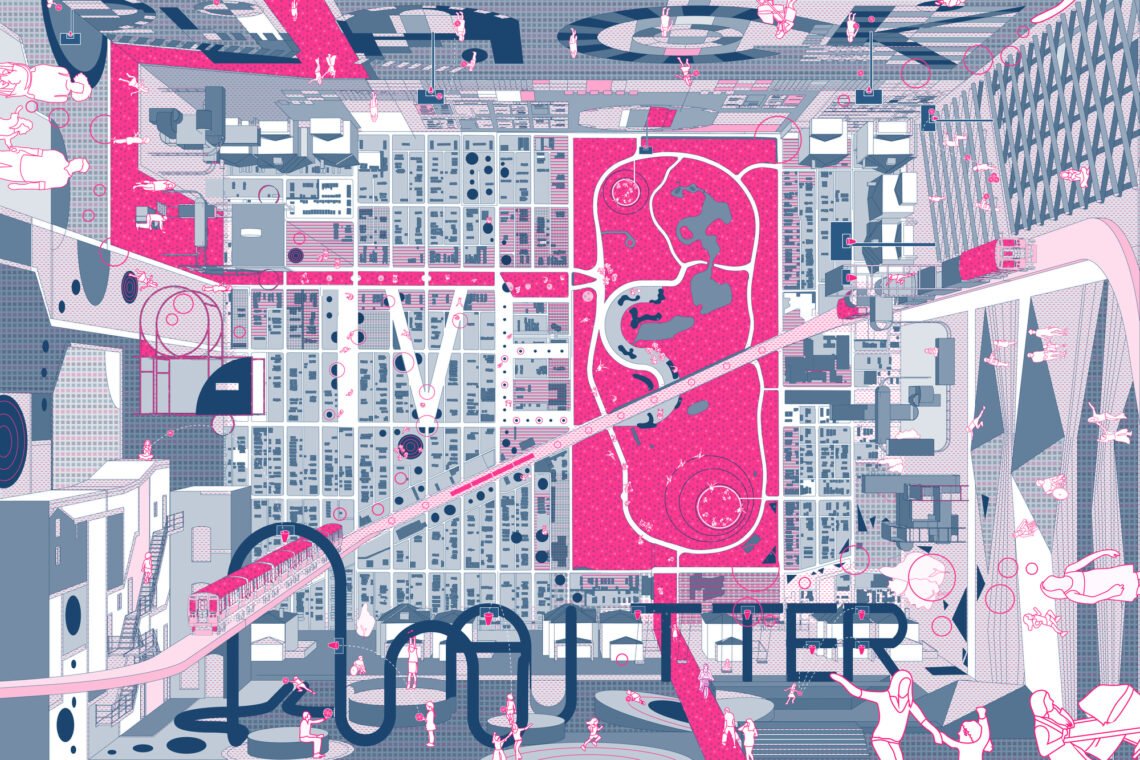
In Supergraphic Landscapes: From Public Art to Urban Design, architecture professor Joseph Altshuler and graphic design professor Nekita Thomas propose that when graphics “bleed” beyond the traditional boundaries of walls and signs to inhabit the ground and the space between structures, they become powerful tools for social organization, community building, and environmental transformation.
“Graphics do not simply convey information — they construct environments,” the authors write. “They shape how space is remembered and felt, how belonging is established and how power is visualized.”
The book, published by Applied Research and Design, builds upon the authors’ previous collaborative work, including the Chicago Sukkah Design Festival. By analyzing how temporary installations can foster long-term community development, Altshuler and Thomas developed a framework that views graphics as “world-building tools.” They define a “supergraphic” not merely by its scale, but by its capacity to transcend expected boundaries—for example, a design that climbs a wall and extends across the pavement to define a new, interactive landscape.
The authors draw inspiration from movements like the Black Lives Matter street murals, which redefined the public realm by forcing pedestrians to walk upon and physically inhabit the text, effectively turning the street into a site of communal engagement rather than just a vehicle thoroughfare.
“Seeing words on the street in the public realm is really different to seeing them on a wall,” Altshuler said. “To walk and tread and inhabit the letters rather than reading them on a wall, it’s something you can experience all around you. It’s a landscape, not a sign.”
To illustrate these concepts, the book explores three thematic pillars: play, which organizes movement; care, which softens and makes infrastructure more inclusive; and action, which utilizes space to challenge historical narratives and promote collective memory. Using case studies from Chicago neighborhoods such as North Lawndale, Albany Park, and South Chicago, the book maps out how everyday sites—from bus stops and alleys to sports courts—can be reimagined.
In North Lawndale, the authors investigate how the lines typically relegated to basketball courts could be expanded to encourage communal play across the entire city. In other instances, they examine how “Pac-Man-style” characters on the ground can serve as traffic calming measures, making intersections safer for cyclists and pedestrians by visually commanding the space.
The researchers also emphasize that graphics need not be limited to paint and ink. They point to the dyeing of Chicago’s Buckingham Fountain during political protests as a striking example of how public infrastructure can be repurposed into a graphic statement, turning water itself into a medium for protest and reflection.
At a time when technology is rapidly altering how we navigate and perceive cities, Thomas argues that moving beyond transactional design is essential for fostering empathy and critical thinking. By offering these alternative models, the authors hope to challenge architects, designers, and residents to reconsider the values embedded in their own neighborhoods.
“We have to ask: What are our values? Are they working? What else can we do?” Thomas said. “It’s how to help people imagine new futures.”
The book launch for Supergraphic Landscapes will take place on Sept. 29 at 5:30 p.m. at Baker Space in Champaign, featuring a moderated discussion by art professor Jorge Lucero, readings, and a short animated film based on the book’s concepts.
Disclaimer: This content is auto-generated for informational purposes only.
Source: Read Original News