








The Parallels Between Die On This Hill and Debate and Switch
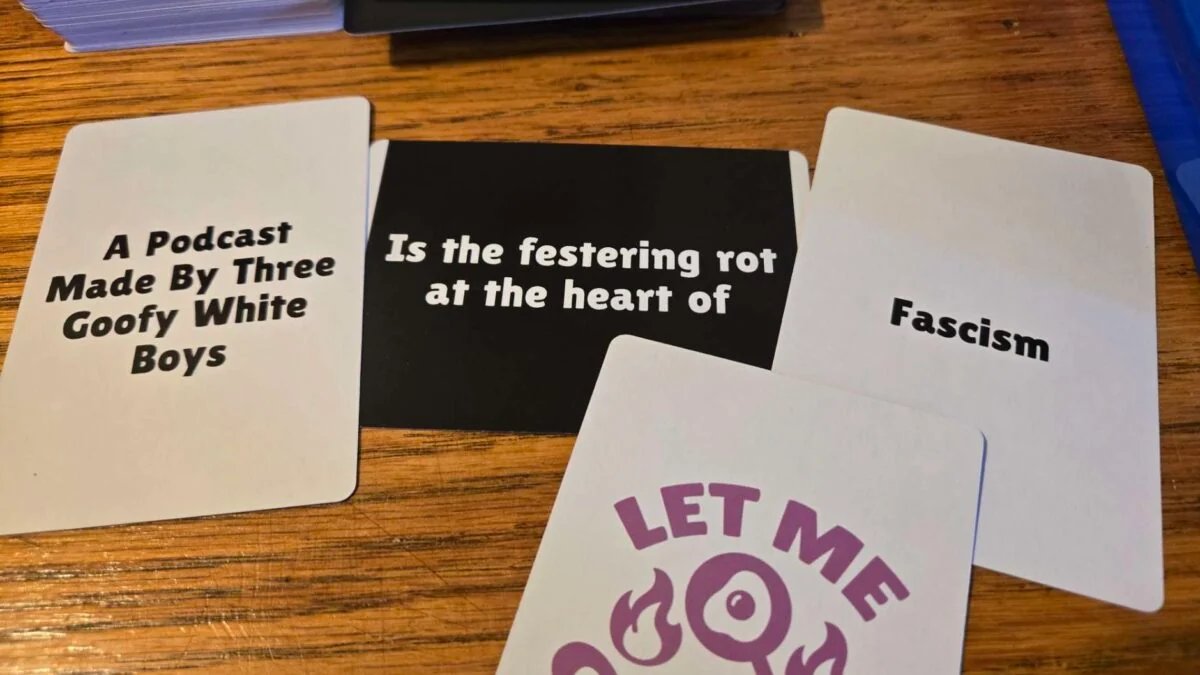
Solo game developer Sam Greszes has publicly identified significant mechanical and thematic similarities between his own board game, Die On This Hill, and Debate and Switch, a new entry within the recently released Jackbox Party Pack 12. Both titles function as social party experiences centered on structured, humorous arguments. The core gameplay loop in both involves players assembling phrases using word cards to create nonsensical debate topics, which are then defended or attacked in head-to-head rounds.
Beyond the base premise, both games employ an audience-voting mechanic that allows non-participating players to influence the outcome. Furthermore, both systems include a feature that permits players to swap out individual words within a prompt, effectively altering the direction and meaning of the argument mid-game. These shared design choices have led to questions regarding the development process, as Greszes had previously engaged in direct communication with Jackbox Games regarding his own project.
A Timeline of Communication and Pitching
The path to this discovery began in 2024, following a professional transition for Greszes. During his development of Die On This Hill, he envisioned the board game as a potential digital product that could reach a broader audience. Having been a longtime follower and player of the Jackbox Party Pack series, he viewed the company as an ideal partner. He contacted the organization, leading to a series of two formal meetings in early 2025.
During these discussions, the parties explored the financial logistics of a licensing agreement, including the necessity of pricing a digital version of the game lower than the physical board game edition. Although Greszes expressed flexibility regarding these terms and a strong desire to see his work reach a wider platform, no formal contract was finalized. During this period, Jackbox requested a demo of the game. When Greszes proposed an agreement that would guarantee his involvement if the company decided to pursue a game based on his concept, the company declined, citing standard policy. He eventually sent a physical copy of his game to the company in March 2025 after its successful crowdfunding campaign.
The Silence Following the Submission
After sending the demo copy, communication between the developer and the company largely ceased. Greszes states that he followed up multiple times throughout the spring and winter of 2025 to request feedback or thoughts on the design. Each time, he was informed that staff members had not yet found the time to evaluate the submission. Eventually, the correspondence stalled, leading the developer to conclude that the company had no interest in pursuing a collaboration.
Greszes noted that he harbored no negative feelings at the time, viewing the attempt as a long-shot endeavor. He remained appreciative of the company’s history and his own history as a consumer of their products. It was not until over a year later, while viewing promotional material for Jackbox Party Pack 12, that he encountered footage of Debate and Switch. The discovery of the game’s mechanics, which mirrored his own pitch, came as a significant surprise to the developer.
Industry Standards and Convergent Evolution
The situation highlights the complex landscape of game design, where concepts can often overlap without explicit copying. In the gaming industry, mechanics generally cannot be protected by copyright, meaning that similar features—such as Mad-Lib style prompt generation or audience voting systems—can appear in disparate projects through the process of convergent evolution. Companies often receive numerous pitches for similar types of games, and developers frequently arrive at comparable solutions for similar player-engagement problems.
However, the intersection of a direct pitch, the exchange of physical demo materials, and the subsequent release of a highly similar product often triggers scrutiny within the development community. While there is no legal evidence of impropriety, the case raises questions regarding the informal processes of idea solicitation. For independent creators, the inability to secure formal protections during early-stage discussions remains a structural hurdle that makes pitching to larger publishers a high-risk activity.
The Value of Professional Acknowledgement
Despite the frustration stemming from the similarity between the two games, Greszes has emphasized that he is not seeking financial restitution or a formal apology. His primary concern centers on professional recognition. For a solo developer, the prestige and validation of having a concept accepted—or even acknowledged—by a company he admired would have held significant weight.
Greszes stated that if the situation had been handled with transparent communication, his reaction would have been entirely different. Had the company informed him that they were developing a similar game and acknowledged his work as an inspiration, he indicated he would have felt honored. The lack of such acknowledgment is what he describes as a feeling of betrayal. As the industry continues to iterate on social party game formats, the case of Die On This Hill versus Debate and Switch serves as a reminder of the friction that can occur when the efforts of individual creators align with the internal development cycles of major studios.
Disclaimer: This content is auto-generated for informational purposes only.
Source: Read Original News