








Japan is one of the world’s most earthquake-prone countries, experiencing about 1,500 quakes a year.
The meteorological agency has warned of strong aftershocks given the shallow epicentre – 10km (six miles). Footage aired by national broadcaster NHK shows cracked roads and bridges and several buildings on fire.
The quake’s epicentre was about 20km (12 miles) south of Kumamoto, which is Kyushu island’s largest city with a population of about 700,000.
“We are still assessing the extent of injuries and property damage, but I have been informed that there have already been several injuries,” Prime Minister Sanae Takaichi said on Tuesday.
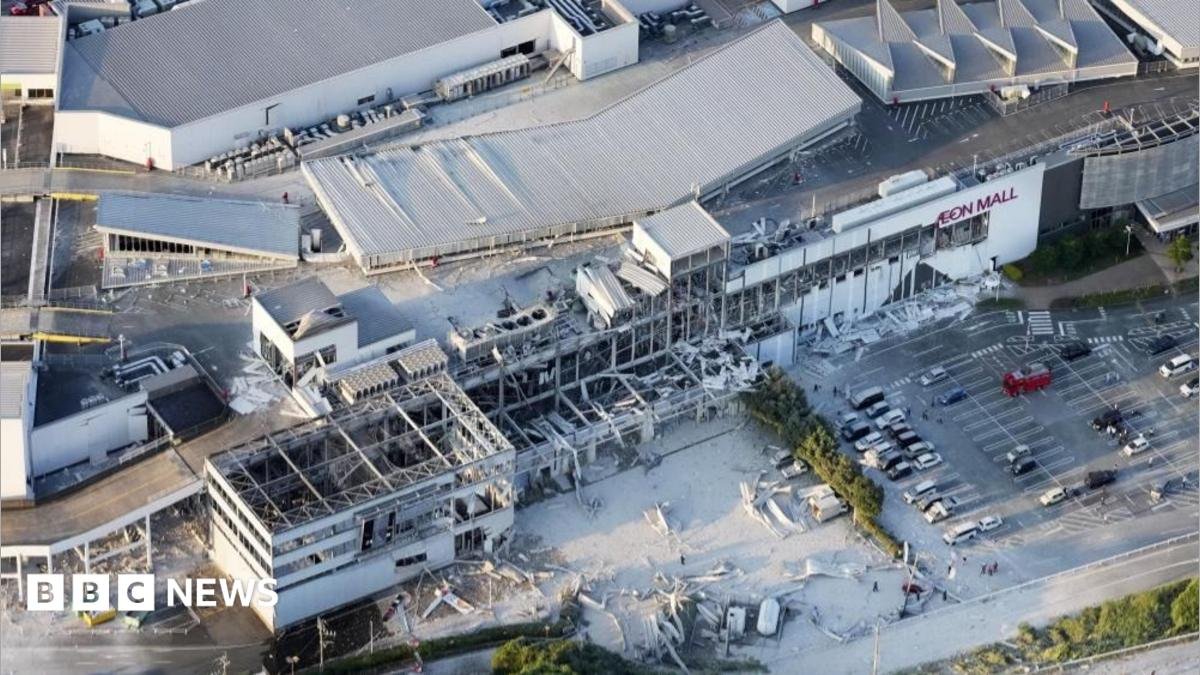
Footage of the shopping centre shows white smoke rising from the building, as people run into the carpark. Large parts of the mall’s exterior have been blown off, exposing the steel beams underneath.
Aeon Mall is a popular nationwide chain that operates about 160 centres across Japan. It holds department stores, boutiques, pharmacies and food courts.
Dozens of people were injured during the earthquake – about 10 were in an elderly care home and at least 50 people are being treated in hospital, NHK reported.
An 89-year-old man living in the city of Uki told NewsJP that the earthquake “shook violently up-and-down and side-to-side for about 10 to 20 seconds.”
Train services have been suspended and electricity has been cut off for thousands of homes.
Chief Cabinet Secretary Minoru Kihara said first responders had been deployed, including Japan’s self-defence force, fire services and coast guard.
“We urge residents in areas where the shaking was particularly severe to pay close attention to evacuation information issued by local authorities via radio, television and the internet, and to act calmly,” he said.
Takaichi said 3,600 soldiers would be deployed to help with the disaster recovery as aftershocks continued to rumble.
The International Atomic Energy Agency posted to X that the earthquake “caused no damage or safety issues at the Sendai Nuclear Power Plant, located around 100km (62 miles) from the epicentre, and that it remains in operation”.
“The IAEA will continue to monitor the situation,” it said.
A decade ago, Kumamoto was struck by a series of earthquakes including a magnitude 7 in April 2016. A total of 278 people were killed, NHK reported at the time.