




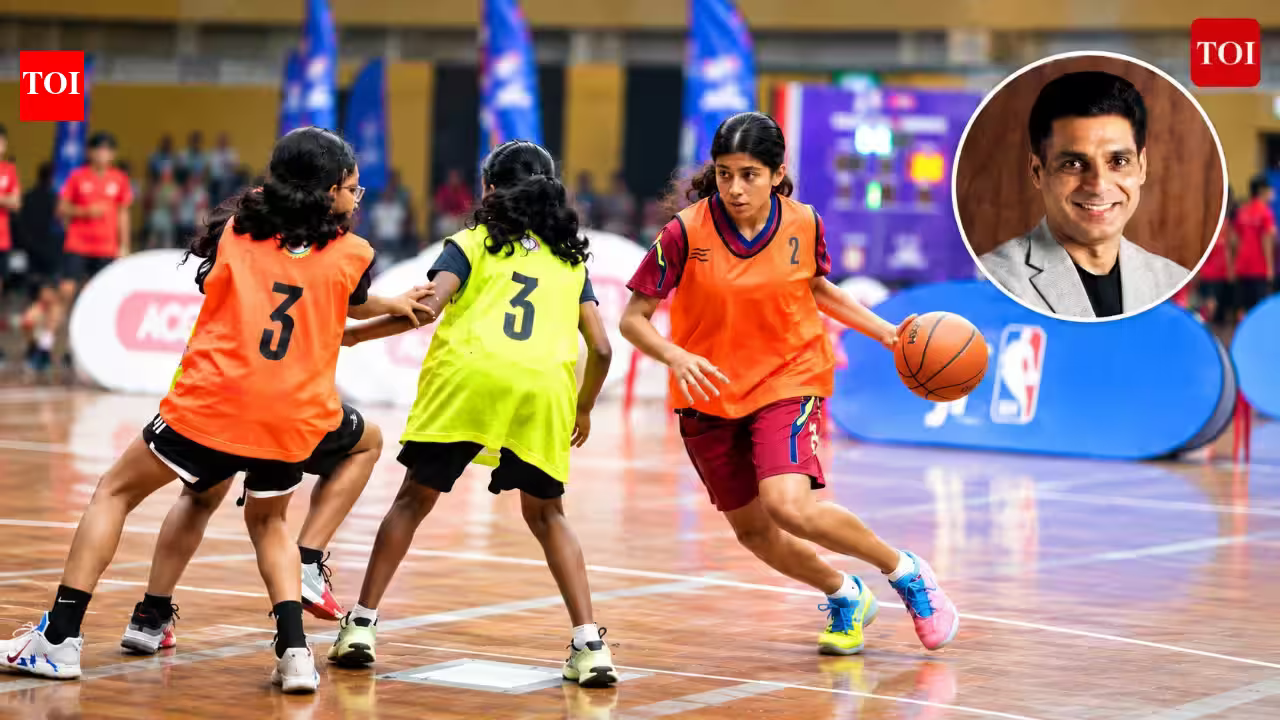
EVOLVING the competitive landscape of Indian basketball, the ACG Jr. NBA 3v3 National Tournament has marked a significant shift in its 2026 iteration, moving from the under-14 to the under-16 category. As the program enters the heat of its 10-city competition, the focus has pivoted sharply toward addressing the fundamental gaps that prevent Indian youth from competing on the global stage.
Following the return of India’s top school-level prospects from the Rising Stars Invitational in Singapore, the assessment of the national talent pool was candid. While the players showed grit, the international experience exposed critical vulnerabilities in physical conditioning.
“They said the level of competition showed us that we need to improve a lot more,” said Sunny Malik, NBA India Country Head, during the tournament’s Delhi leg. “They ended up lacking in stamina and endurance. They were losing it by the third quarter and were down by the fourth. But they are already looking ahead—they told me if they participate next year, they will work on these weaknesses to reach the semifinals.”
Better Strategy Over Physical Prowess
The ongoing Delhi leg, which saw a staggering 270 teams register across 118 schools, has served as a crucible for identifying the disconnect between schools with structured basketball programs and those that rely on ad-hoc, individual-led practice.
Observations on the court revealed that the difference between winning and losing often had little to do with raw physical stature. Instead, it came down to basketball IQ and floor spacing. In the half-court 3v3 format, where the shot clock pressures teams to act quickly, the teams with formal coaching consistently outperformed their peers by exploiting gaps and maintaining structural discipline.
“These kids are playing better not because they are bigger than the opposition,” Malik explained. “They are playing better because their strategy is better. A school with a basketball program teaches you positioning, how to pass, and how to ensure you can score within that 12-second attack window.”
Investment in the Coaching Ecosystem
Despite the success of the Jr. NBA, which has reached over 15 million youth since 2013, Malik maintains that the “missing link” in Indian basketball is the development of the coaching fraternity. He argues that even the most talented players cannot reach their full potential without high-level guidance.
“Coaches development is an area that sometimes gets ignored, but it is a very important part of the ecosystem,” said Malik. “Unless you support coaches with world-class training, how do they produce world-class talent? Every organization invested in sports should look into the coaching infrastructure.”
While the Jr. NBA brings in international experts—such as Natalia André—for coaching clinics, Malik acknowledges the limitations of short-term programs. The onus, he believes, lies on local instructors to sustain the momentum once the tournament concludes. The goal is to move from a four-month activity cycle to a year-round commitment, ensuring that players don’t just train during the tournament window, but build on their conditioning consistently.
Expanding the Pipeline for Female Talent
One of the most encouraging statistics to emerge from the 2026 tournament is the surge in female participation. In several cities, girls’ registration has hit 40-45%, a benchmark that Malik views as a landmark for Indian sports. By bringing girls into the mainstream of athletic competition, the program is effectively broadening the national talent pipeline.
To further challenge the participants, the tournament is diversifying its national footprint. After hosting finals in Delhi for two years, the organizers have selected Chennai for the upcoming December finale. Malik notes that rotating the venue is essential, as it forces young players to adapt to new environments and arenas—a necessary experience for those aspiring to play at the national or international levels.
The Future: Leagues and Pathways
As discussions regarding a potential Indian basketball league continue to surface, the conversation inevitably turns to how programs like the Jr. NBA can feed into a professional structure. While Malik remains cautious regarding the specifics of any unformed league, his stance on the role of the NBA is clear: any initiative that provides a pathway for talent to shine will receive full support.
“Some of these talents, which do well at these levels, would automatically form a part of the larger pool visible to everyone,” Malik said. “As a category, it is important for basketball to become prime time. It is important for people to watch, to play, and to participate.”
As the Delhi leg concludes and teams prepare for the road to Chennai, the message from the NBA India leadership is one of long-term vision. The tournament is more than just a series of games; it is an attempt to professionalize the habits, conditioning, and tactical awareness of the next generation. Whether these under-16 stars make the leap to a professional circuit will depend on whether they carry the intensity of these matches back to their school practice courts every single day of the year.
Disclaimer: This content is auto-generated for informational purposes only.
Source: Read Original News