








The air in the Tamil film industry is thick with anticipation, and for once, the noise isn’t just about the latest blockbuster release—it’s about a name from the past making a defiant, long-overdue return. Kamal Haasan, the man who has spent five decades redefining what an Indian actor can achieve, has finally pulled the curtain back on his latest project with director SU Arun Kumar. Titled Sandiyar, the film is already shaping up to be one of the most talked-about entries in his illustrious, ever-evolving filmography.
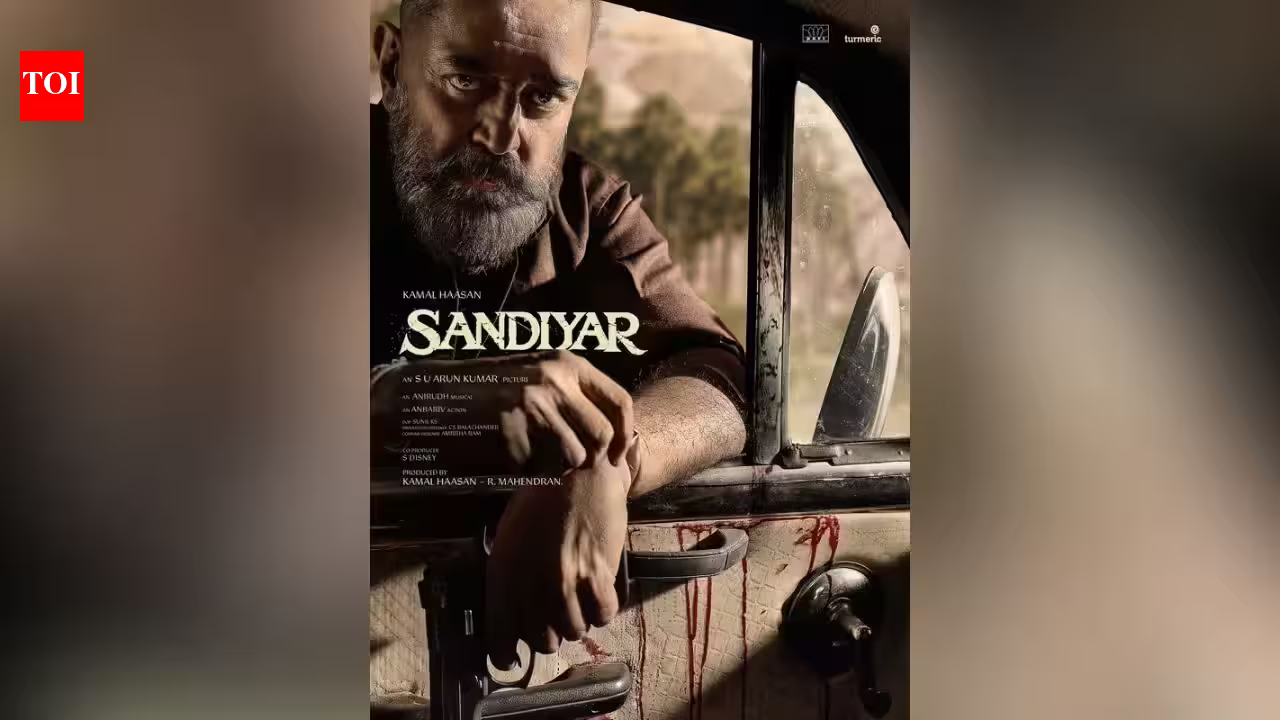
The reveal came with a first-look poster that feels like a punch to the gut—visceral, unvarnished, and unmistakably raw. Gone is the suave, globetrotting persona often associated with his recent big-budget ventures; in his place stands a figure of rugged intensity. With cropped grey hair, a thick, weathered moustache, and an expression that suggests he has seen the worst of humanity, Haasan cuts a striking silhouette. But it is the submachine gun in his hand, contrasted against the blood-stained interior of a battered vehicle, that sets the tone. The tagline, “Revenge can only be settled in blood,” isn’t just a marketing hook—it is a promise of a return to the grounded, gritty roots of rural Tamil cinema.
The Weight of a Name
The choice of the title Sandiyar is far from accidental. It is a calculated move that feels like an act of cinematic reclamation. For those who remember the landscape of Tamil cinema in the early 2000s, the name evokes a specific memory. It was the title Kamal Haasan had originally intended for his 2004 masterpiece, Virumaandi. At that time, the title became a lightning rod for controversy, sparking intense backlash from various caste-based groups who took issue with the nomenclature.
Back then, facing immense pressure and external interference, Haasan made the pragmatic choice to pivot, ultimately renaming the film Virumaandi. Two decades later, the landscape has shifted, and the man who has never shied away from challenging the status quo has decided to revisit the battleground he left behind. By opting for Sandiyar now, Haasan is not just signaling a return to a specific aesthetic; he is exerting his creative autonomy in a way that feels deeply personal and strategically defiant. It is a bold statement, confirming that at this stage of his career, he is playing strictly by his own rules.
A Perfect Pairing: The Rise of SU Arun Kumar
Behind the camera, the decision to collaborate with SU Arun Kumar is perhaps the most intriguing aspect of this announcement. Arun Kumar has built a reputation as a master of the “grounded” thriller, a filmmaker who prioritizes character psychology and atmospheric tension over the high-octane, gravity-defying stunts that have become the staple of modern Indian action cinema. His previous work has shown a keen eye for the complexities of rural life, making him the ideal partner to capture the grit of a Madurai-based revenge saga.
This pairing suggests a film that will prioritize subtext and tension over spectacle. When you combine an actor of Haasan’s calibre—who possesses an uncanny ability to inhabit the psychological state of a protagonist—with a director who knows how to craft a slow-burn narrative, you end up with a project that demands to be taken seriously. Bolstered by the musical genius of Anirudh Ravichander and the technical precision of the action choreography duo Anbariv, Sandiyar is positioned as a film that will likely bridge the gap between high-concept artistry and mainstream, blood-pumping entertainment.
A Career Recharged
Kamal Haasan’s current phase is nothing short of fascinating. After the immense impact of Vikram and the recent release of Mani Ratnam’s Thug Life, one might expect a man of his stature to rest on his laurels. Instead, he seems to be entering a period of hyper-productivity, moving seamlessly between producing, starring in, and curating massive cinematic universes.
His production house is currently making major waves with the upcoming Rajinikanth starrer Dharman, and the industry remains in a state of feverish excitement over his long-teased collaboration with Rajinikanth and director Nelson Dilipkumar. Yet, Sandiyar feels different. While the other projects are massive, franchise-building spectacles, Sandiyar feels like a “labor of love”—a project that feeds into his own legacy. It represents a return to the themes of caste, conflict, and honor that have permeated his best work throughout his life.
What to Expect from the Madurai Landscape
Set against the backdrop of Madurai—a city that has served as the stage for some of the most influential dramas in Tamil cinema history—the film is expected to be a study in vengeance. While the poster teases violence, the narrative depth usually afforded to a Kamal Haasan lead role suggests we will be getting much more than just a standard revenge tale.
We can expect a deep dive into the socio-political undercurrents of the region, the burden of history, and the moral ambiguity that defines the act of retribution. If the first-look photos are any indication, the film is stripping away the gloss that has characterized much of the commercial industry lately. It aims for a “earthy” aesthetic that will likely remind audiences why they fell in love with Haasan’s work in the first place.
As the production gears up, all eyes will remain on how Sandiyar unfolds. It is a film that wears its title as a badge of honor, serving as a reminder that the legend is not done telling the stories he wants to tell, on his own terms, and with a level of intensity that few can match. If revenge is meant to be settled in blood, then the box office is about to see a very high price paid for this cinematic journey. Whether you are a long-time admirer of his craft or a newcomer to the “Ulaganayagan” experience, Sandiyar is undeniably the film to watch as we head into the next chapter of Tamil cinema.
Disclaimer: This content is auto-generated for informational purposes only.
Source: Read Original News