








In the high-pressure world of Indian cinema, where every micro-expression during a press junket is dissected, slowed down, and repackaged for viral outrage, Keerthy Suresh has drawn a hard line in the sand. The National Award-winning actor, known for her grace and poise, found herself at the center of an unwanted social media firestorm this week following a promotional event for her upcoming courtroom drama, Sathyavan Savithiri.
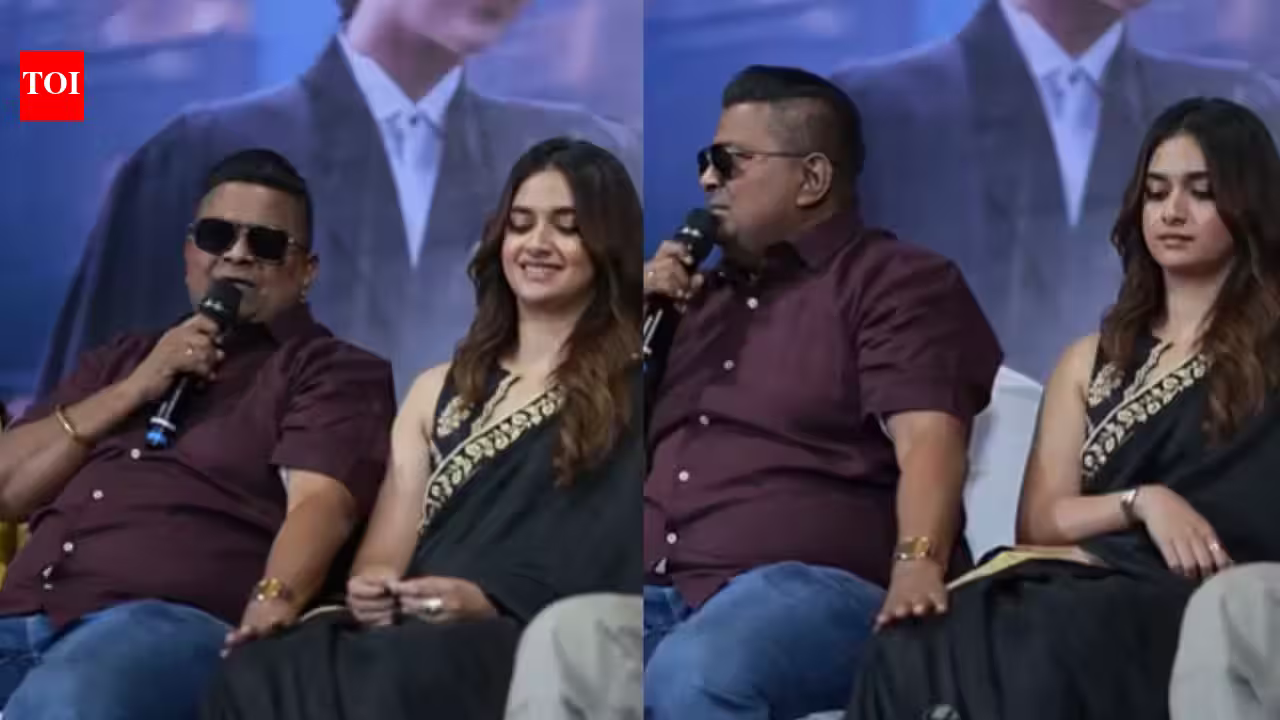
The incident, which saw filmmaker Mysskin place a hand on her knee during a candid moment on stage, was immediately seized upon by certain corners of the internet. What was intended as a celebratory press interaction quickly devolved into a debate about body language, consent, and the ethics of professional boundaries—a conversation that Keerthy decided to take by the horns rather than ignore.
The Viral Clip That Sparked a Backlash
The controversy began with a widely circulated clip from the Sathyavan Savithiri event. In the video, director Mysskin, who has been vocal about his deep respect for Keerthy’s craft, is seen speaking warmly alongside the lead actress. At one point, he places his hand on her knee—a gesture he likely intended as a display of paternal affection and admiration.
Within hours, the video was flooded with commentary. While many viewers saw a standard, albeit eccentric, moment of industry camaraderie, a vocal segment of the internet took a more cynical route. Accusations of Keerthy appearing “uncomfortable” began to surface, with users projecting their own interpretations onto her stoic expression. The discourse took a sour turn when one particular user on X (formerly Twitter) conflated the incident with the nature of acting itself, suggesting that since actors perform intimate scenes for the camera, they should be comfortable with physical contact in public spaces as well. It was this specific, predatory logic that triggered a swift and sharp rebuttal from the actor.
Keerthy Suresh Defends Her Agency
Keerthy Suresh is not one to mince words when her integrity is questioned. Eschewing the traditional “no comment” approach favored by many stars, she chose to address the troll directly, effectively dismantling the misogynistic premise of the argument.
“Firstly, where do you see discomfort on my face?” she wrote, cutting through the noise. She further clarified the context, reminding the audience that both she and Mysskin had already established their dynamic as that of a father and daughter. But it was her response to the user’s justification of public touching that resonated most with fans. “Secondly, say I was uncomfortable; you are stating that we get touched in films, so I should be okay with that in public too? You really need to get something’s right, brother.”
The takedown was surgical. By calling out the false equivalence between professional screen performance and personal boundaries, Keerthy highlighted a pervasive issue: the entitlement some netizens feel over an actor’s personal autonomy. The impact was immediate; faced with the public call-out, the user behind the provocative post issued an apology and deleted the comment, a rare instance of a troll being forced to retreat by the person they sought to diminish.
The Context Behind the “Paternal” Affection
To understand the dynamic, one must look at what actually transpired on that stage. Far from a moment of awkwardness, the event was characterized by Mysskin’s effusive, if somewhat intense, praise for Keerthy. During the interaction, the director—clearly in a high-spirited mood—bestowed upon the actress the title of Nadigaiyar Thilagam (a legendary honor meaning “Crown Jewel of Actors”).
He didn’t stop at words. In a gesture that underscored his genuine—if unconventional—reverence for her, he gifted her a gold ring, noting that he had previously done the same for other co-stars whose work had impressed him. He spoke of Keerthy with the kind of reverence usually reserved for cinema icons, describing her presence as “angelic” and “pure,” and publicly requested that future films attach the title of Nadigaiyar Thilagam to her name. For those in the room, the gesture was clearly one of an older, mentor-like figure showering a younger colleague with high praise; for those watching the edited clip online, the nuance was lost in a vacuum of out-of-context screenshots.
The Dehumanizing Trend of Digital Scrutiny
The incident serves as a grim reminder of the “gotcha” culture that currently plagues the entertainment industry. In an age where digital engagement is driven by controversy, the humanity of the subjects is often the first casualty. Keerthy Suresh’s reaction is a significant intervention in this trend. By refusing to play the victim and instead demanding a logical standard of discourse, she has reasserted a simple truth: an actor’s public life does not equate to a surrender of their personal dignity.
Critics of the viral clip were essentially trying to gaslight the subject of their criticism, telling her how she felt, how she should have reacted, and eventually, how she should be treated based on their own narrow view of her profession. Keerthy’s refusal to accept that narrative—and her subsequent victory in forcing an apology—marks a win for stars who are increasingly tired of having their boundaries policed by anonymous accounts.
All Eyes on ‘Sathyavan Savithiri’
With the noise of the controversy hopefully fading, the focus returns to the project that brought these two together. Sathyavan Savithiri is one of the most anticipated courtroom dramas of the season, scheduled for a theatrical release on November 20.
The film promises to showcase the very chemistry that Mysskin was celebrating on that stage. Despite the unnecessary drama surrounding the press meet, the professional bond between the director and his lead actress seems ironclad. For Keerthy Suresh, who has already proven her mettle in projects like the recently acclaimed Dorothy, this film represents another step in a career defined by powerful performances rather than manufactured headlines. As the release date approaches, the industry will be watching—not just to see how the film performs, but to see if the audience is capable of separating a headline-grabbing clip from the actual substance of the craft.
In a business that thrives on visibility, Keerthy Suresh has proved that sometimes, the most powerful performance isn’t in front of the camera—it’s the one where you stand up for yourself when the cameras are off.
Disclaimer: This content is auto-generated for informational purposes only.
Source: Read Original News