








AUCKLAND — The winds of change are blowing across the Indian dressing room, but as the Men in Blue navigate a challenging ODI series in New Zealand, they find themselves grappling with a recurring tactical paradox. While fans and pundits are quick to label these encounters as a crucial dress rehearsal for the 2027 World Cup in Southern Africa, the Indian team management seems to have arrived at a sobering realization: their most potent weapon for high-pressure situations is currently being miscast.
The conditions in Auckland and Wellington have been unforgiving, characterized by the kind of lateral movement and variable bounce that one might expect to encounter on the pitches of South Africa, Zimbabwe, and Namibia. In this crucible of seam-friendly cricket, the argument that India’s current blueprint needs a fundamental shift is gaining traction. The uncomfortable truth facing the selectors is simple yet profound: their best No. 5 batter is in the starting XI, but he is consistently being asked to play elsewhere.
The “Spare Tyre” Syndrome
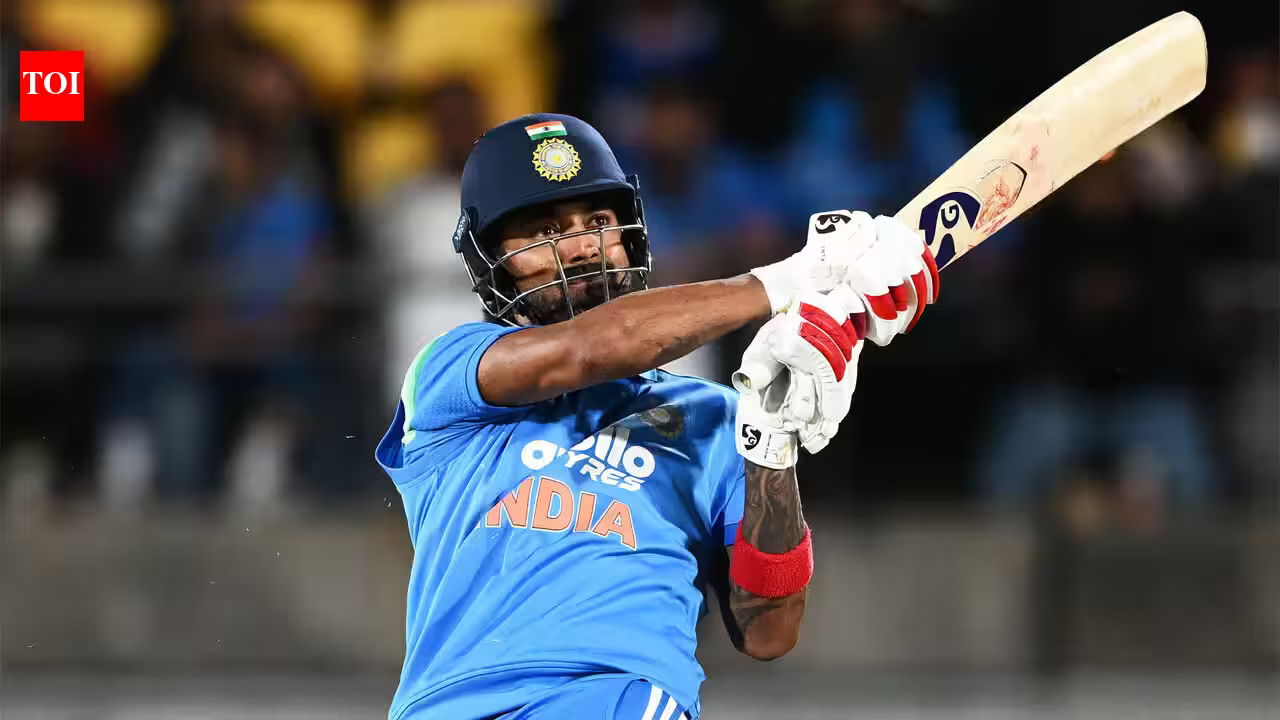
For the better part of a 12-year international career, KL Rahul has been the Swiss Army knife of Indian cricket. He has opened the batting, anchored the middle order, kept wickets, and acted as a tactical finisher. He has been the quintessential “spare tyre”—relied upon to fill any void created by injury or experiment, yet rarely afforded the luxury of a permanent, secure role.
This lack of definition has often been the architect of his own inconsistency. However, history suggests that when Rahul is given the reins, he thrives. His resurgence in Test cricket following the 2024-2025 Border-Gavaskar Trophy—where management finally backed him as a specialist opener—serves as a template. With the clarity of a fixed role came an immediate improvement in output. Now, that same clarity is required in the 50-over format.
Technical Proficiency Over Tactical Experiments
The first two ODIs against the Black Caps served as a harsh wake-up call for India’s middle-order strategy. In conditions where the ball does the talking, the reliance on aggressive intent or unconventional left-right combinations proved futile. When top-order wickets fell in both Auckland and Wellington, the team was left gasping for air.
While others faltered, Rahul and Shreyas Iyer demonstrated the value of technical discipline. Rahul’s unbeaten 26 in the second ODI might not capture headlines, but in the context of a 113/7 collapse, it was an exhibition of temperament. He absorbed pressure, silenced his ego, and provided the stability the team desperately lacked.
Contrast this with the deployment of Axar Patel. While Axar’s utility as a floater was effective on the slower, spinner-friendly tracks of the subcontinent and during the Champions Trophy in the UAE, the strategy has looked remarkably thin in New Zealand. Promoting a bowling all-rounder to the No. 5 spot when the ball is swinging is a gamble that continues to yield diminishing returns.
The Statistical Case for Clarity
The numbers offer a compelling indictment of the current rotation policy. KL Rahul boasts an exceptional record at the No. 5 position in ODIs, tallying 1,646 runs at a staggering average of 68.58 and a strike rate of over 103. By comparison, Axar Patel’s average at the same position sits at 30.41, a figure that drops below 20 when playing away from home.
The team management’s logic is understandable—they are chasing the “perfect” balance, particularly in the absence of Hardik Pandya’s seam-bowling all-rounder slot. They desire batting depth that extends to No. 8 and hope to leverage ground dimensions through match-ups. But in trying to cover the void left by Pandya, the team is inadvertently destabilizing their core.
Blueprint for 2027
If the 2027 World Cup is indeed the long-term target, the time for experimentation should be giving way to the time for solidification. The Southern African pitches will offer no sanctuary for those relying on brute force; they will demand batting units that can survive early movement and rebuild under fire.
India should move away from using Rahul as a floating solution and instead grant him ownership of the No. 5 role. This is not a dismissal of Axar Patel’s utility, but rather an appeal for his optimization. Axar remains a vital asset as a finisher and a spin-bowling option, but burdening him with the task of resurrecting a top-order collapse is a tactical misfire.
For years, KL Rahul has adapted his game to meet the shifting needs of the team. As India looks toward the next major cycle, the realization should be that the team’s success might depend on doing the exact opposite. It is time for the setup to stop asking what Rahul can do for the team, and instead lean into what he does best. If India wants to dominate in the testing conditions of 2027, they must stop looking for a “spare” and start trusting their most capable anchor in the middle of the order.
Disclaimer: This content is auto-generated for informational purposes only.
Source: Read Original News