





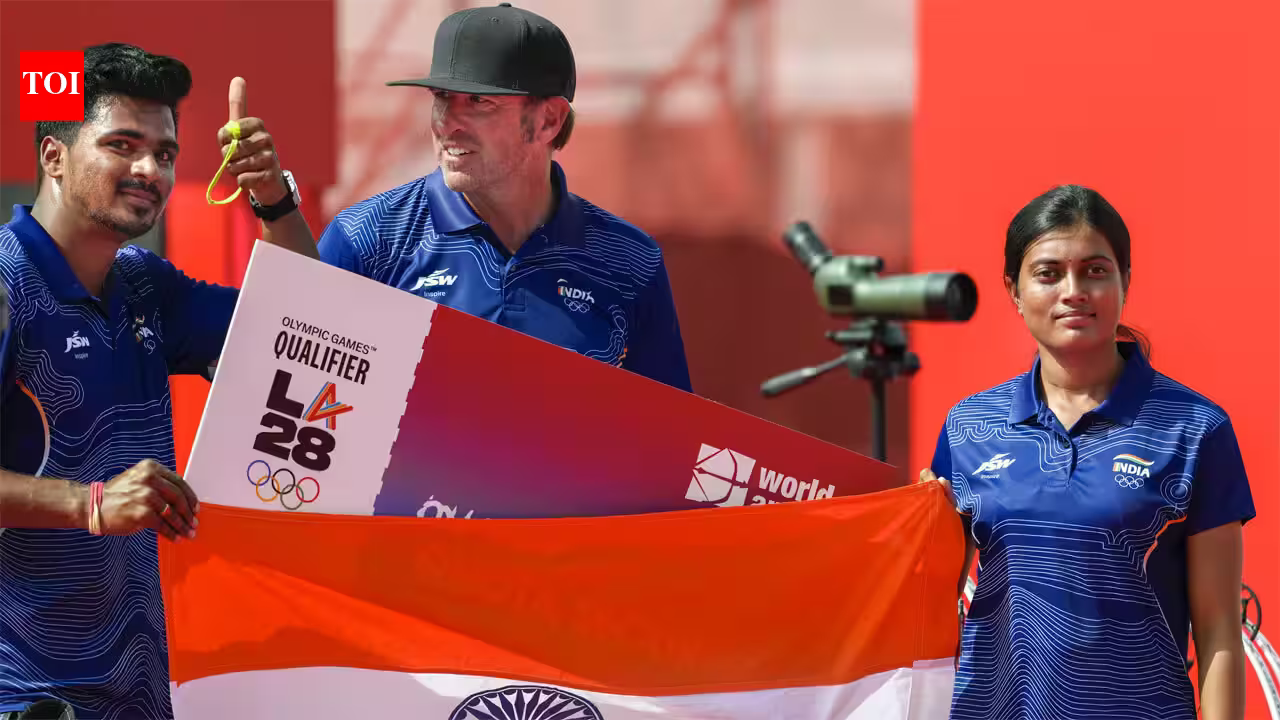
ARCHERY’S LATEST GOLDEN era has hit a jarring administrative roadblock. While the Indian compound archery contingent celebrates a watershed moment at the Aichi-Nagoya Asian Games—securing the nation’s first-ever Olympic quota in the discipline—the architect of that success, American head coach Dave Cousins, has reportedly threatened to walk away from his post.
The dispute stems from a mounting frustration over unpaid wages. Sources indicate that Cousins, who took the helm in May, has gone over three months without receiving his salary. The situation reached a breaking point this week, with the veteran coach reportedly warning officials that he would return home if the outstanding dues were not settled immediately.
## A Historic Breakthrough, But a Salary Dispute
The unrest comes at a bewildering time for Indian sports. Under Cousins’ tactical guidance, the Indian compound team has flourished, contributing significantly to a larger haul of five gold, two silver, and two bronze medals across all archery disciplines at the Asian Games. The crown jewel of this campaign was the mixed-team event, where Sahil Jadhav and Chikitha Taniparthi delivered a clinical performance, stunning South Korean favorites in a tense shoot-off.
That victory did more than just add a medal to the trophy cabinet; it locked in India’s maiden Olympic quota for compound archery, which is set to make its highly anticipated debut at the Los Angeles 2028 Games. Beyond the team success, Cousins’ individual coaching pedigree has already paid dividends, including guiding 18-year-old rising star Prithika Pradeep to a maiden World Cup bronze in Madrid.
Cousins, a former world No. 1 and dual World Archery Championship titleholder, has remained focused on the long-term vision. “The only thing we were willing to commit to is that our athletes would go prepared and that they would execute the process as best they could,” Cousins said following the Asian Games. “When the training is right, the preparation is right and the ecosystem is right, these are the results you get.”
However, for a coach whose mantra centers on the importance of an ideal “ecosystem,” the failure of that very system to provide his contractual compensation creates a significant irony.
## AAI and SAI Address the “Technical” Hurdle
The Archery Association of India (AAI) and the Sports Authority of India (SAI) have been quick to engage in damage control. AAI treasurer Dr. Joris Paulose Ummacheril confirmed the delay, attributing the lapse to administrative bottlenecks between the federation and the state sports body.
“There was some issue with the Sports Authority of India, so the payment got delayed,” Dr. Ummacheril stated. “But it has all been worked out, and it will be paid within two days.”
An SAI official in New Delhi echoed these sentiments, labeling the delay a “technical issue with the bank.” The official confirmed that the SAI has been in direct communication with the American coach, providing assurances that the funds are currently being processed. While the official stance remains that the situation is near resolution, the strain on the relationship between the national body and its high-profile foreign staff is evident. In the high-stakes world of elite international sports, such administrative lapses serve as a stark reminder of the bureaucratic hurdles that can threaten the momentum of an entire national program.
## Building Towards LA 2028
The stakes for India’s archery program have never been higher. Following the departure of former coach Sergio Pagni, under whom India dominated at the 2023 Hangzhou Asian Games, the appointment of Cousins was seen as a strategic pivot toward the rigorous demands of the Olympic stage.
The federation is currently showing no signs of slowing down its recruitment efforts, with ongoing talks to bring South Korean coaching legend Park Chae-soon into the fold to oversee the recurve program. Park, whose resume includes guiding South Korean teams to Olympic glory at the 2012 and 2016 Games, is slated to potentially join the team as early as December.
The ambition for Los Angeles 2028 is clear: India intends to move beyond being a regional powerhouse and establish itself as a global dominant force in archery. However, for that vision to materialize, the AAI and SAI must ensure that their commitment to their coaches is as precise as the archers’ performance on the field.
For now, the focus shifts to the coming days. If the payment is processed as promised, the team can return its full attention to the practice range. If not, the sport of archery in India may find itself searching for yet another lead strategist, having lost one of the most effective voices to a simple failure of payroll.
Disclaimer: This content is auto-generated for informational purposes only.
Source: Read Original News