







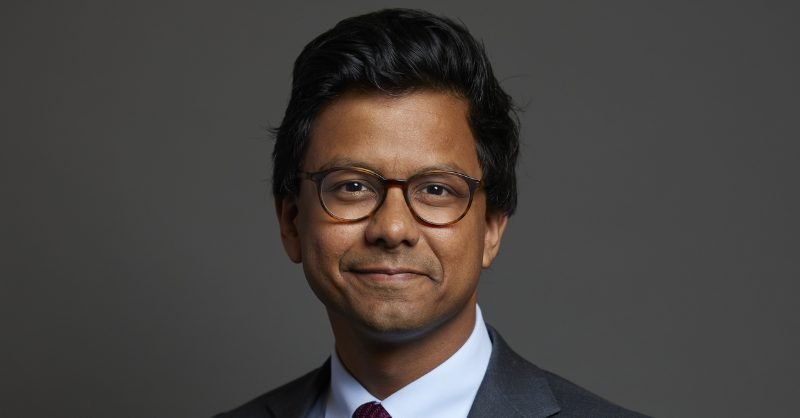
- Prime Minister Andy Burnham has promoted Kanishka Narayan to serve as the new cabinet-level Minister for AI.
- The reshuffle combines the Department for Science, Innovation and Technology with the business department.
- The UK now joins France and Canada in giving AI its own senior ministerial role.
Kanishka Narayan‘s route to the UK cabinet did not start in Westminster. It started in Bihar, India, where he was born in November 1989, and continued in a one-bedroom flat on Bedford Street in Cardiff, where his family settled when he was 12.
“We were in a modest one-bedroom flat in Bedford Street. Each morning, my brother and I walked to Cathays High School to get a good Welsh education. My mum and dad still live and work within walking distance of where we grew up,” he writes on his own website.
Nearly three decades later, new UK Prime Minister Andy Burnham has named him minister for AI, elevating the role to attend cabinet for the first time.
From a Cardiff state school to Eton on a bursary
Narayan spent a year at Cathays High School, a state school in Cardiff, before a teacher pushed him to apply for a scholarship to Eton College. He has described the moment he asked his headteacher to sign the application form while breaking up a fight on a school bus: “He seemed totally surprised. My youthful naivety ignored it.”
The scholarship came through, and Narayan went on to study philosophy, politics and economics at Balliol College, Oxford, followed by an MBA at Stanford University. He was elected MP for the Vale of Glamorgan in July 2024, becoming Wales’ first MP from an ethnic minority background.
Narayan was appointed Parliamentary Under-Secretary of State for AI and Online Safety in September 2025 under then-prime minister Keir Starmer, working within the Department for Science, Innovation and Technology (DSIT), where he led projects such as a £60 million investment in efficient AI research at Oxford and UCL.
Starmer first announced on June 22 that he would resign as party leader and prime minister, remaining as caretaker until a successor was chosen. He formally resigned to King Charles III on July 20, at which point Burnham was invited to form a new government.
That reshuffle is what elevated Narayan’s brief to cabinet level: he now works jointly across the Cabinet Office and a newly merged Department for Business, Innovation, Science and Trade, led by Jonathan Reynolds.
DSIT itself has been dissolved, with the Culture Department absorbing its former responsibility for digital transformation and online harms. When he announced the appointment on X, Narayan said it showed Burnham’s “deep commitment to AI’s importance.”
This is a major change from the department that started projects like the £500 million Sovereign AI Fund and the national AI hardware strategy aimed at $50 billion of the global chip market earlier this year.
By appointing a cabinet-level minister for AI, the UK is following the example of France and Canada, which created similar roles in the last two years. In the past year, the UK’s tech sector has seen big investments, such as AMD’s £2 billion in Cambridge and Nebius’s £1.7 billion AI expansion announced at London Tech Week.
The elevation also puts Narayan and Burnham on the hook for a live debate: officials in France and Germany have pushed for Europe to depend less on American AI models and software, a position sharpened by Washington’s willingness to restrict foreign access to frontier AI.
Burnham has said little publicly about his tech strategy so far, so tech sovereignty is likely to be an early test for the new government.