







India’s Path to “Developed Nation” Status Faces Hurdles Amid Growth Concerns
India is currently clocking economic growth rates that would be the envy of most major global powers, with estimates suggesting a expansion of more than 7% in the previous quarter. Yet, for Prime Minister Narendra Modi, this performance may not be enough to realize his central vision for the nation: achieving “developed” status by 2047, the centennial of India’s independence.
To bridge the gap between a rising emerging market and a high-income developed economy, India must navigate a complex landscape of structural challenges, cooling investor sentiment, and an urgent need for manufacturing-led job creation.
The Challenge of “Viksit Bharat”
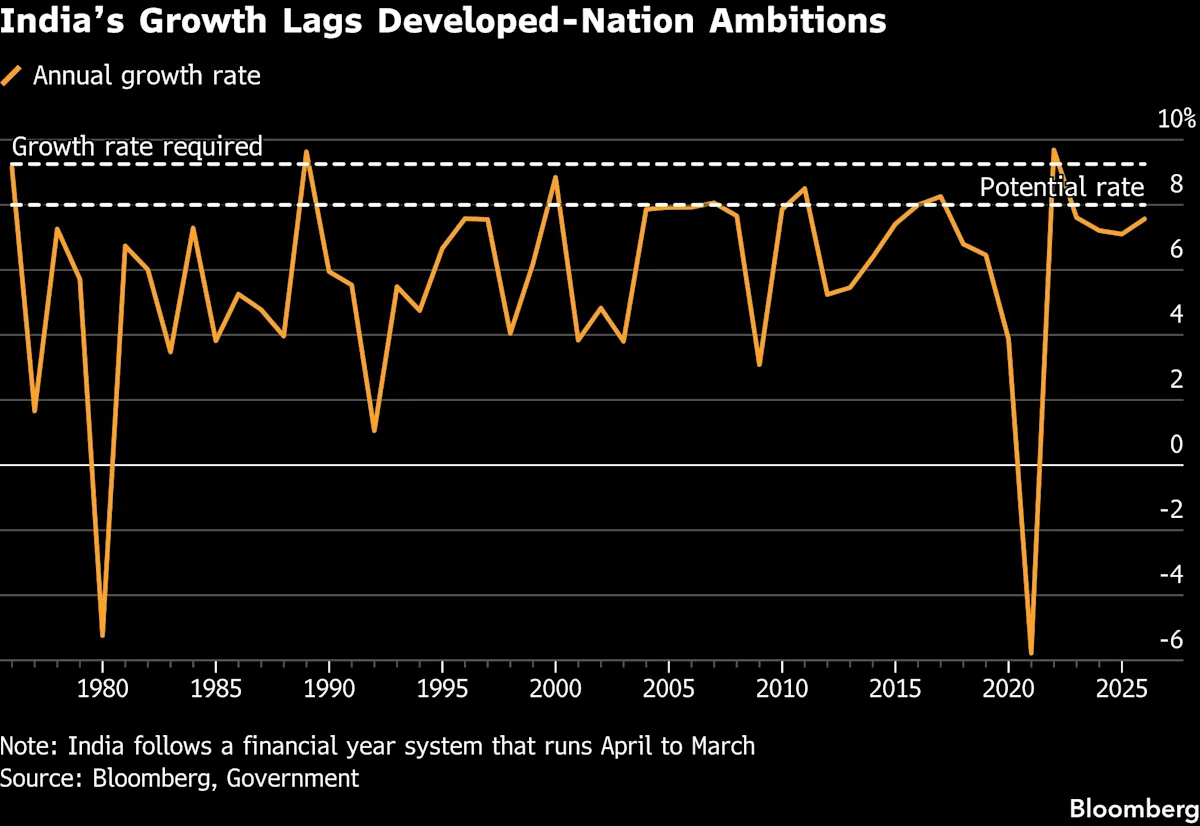
The “Viksit Bharat” (Developed India) initiative is the cornerstone of Modi’s third term. However, the math required to reach this goal is daunting. According to Ashok Lahiri, a senior official at NITI Aayog, the government’s apex think-tank, India would need to sustain an average annual growth rate of 9.25% for the next 21 years to reach that target.
Historical data suggests this is an uphill battle. Between 2000 and 2024, India’s growth averaged 6.3%, well below the 7.5%–8% potential cited by experts. In fact, the economy has only hit or exceeded the 9.25% threshold three times in the last half-century: in 1975, 1988, and 2021.
“Achieving this target would require an exceptionally strong and sustained acceleration in growth,” says Alexandra Hermann Prasad, an economist at Oxford Economics. She warns that such acceleration becomes increasingly difficult as the economy matures and the base grows larger.
The Middle-Income Trap
Economists warn that failing to maintain a growth trajectory above 8% could leave India vulnerable to the “middle-income trap.” In this scenario, rising wages begin to erode the country’s low-cost competitive advantage before its workforce has attained the productivity levels or high-end skills necessary to compete with established, wealthy economies.
The distance to the finish line is substantial. India’s per-capita income stood at approximately $2,813 in 2025. To cross into high-income territory by 2047, that figure would need to rise more than sixfold to roughly $18,000.
Fading Investor Appeal
Macroeconomic vulnerabilities—including persistent current-account and budget gaps, combined with a heavy reliance on volatile capital inflows—are raising red flags for international observers. The Indian rupee has struggled, ranking as Asia’s worst-performing currency so far this year, while recent fund manager surveys by Bank of America indicate that India has lost its standing as the most preferred stock market in the region.
To drive the necessary growth, the government is looking to expand the manufacturing sector. Currently, manufacturing contributes roughly 16%–17% to India’s GDP—a figure that has remained stagnant for over a decade, falling far short of Modi’s 25% target. Furthermore, India’s share of global goods exports remains below 2%, a stark contrast to China’s 14%.
Demographic Dividend or Burden?
Perhaps the most pressing concern is the labor market. Without a rapid expansion of high-quality jobs, India risks squandering its “demographic dividend”—a period of time where the working-age population is at its peak. Reports from NITI Aayog indicate that nearly 87 million young Indians are neither employed nor in education or training. A lack of industrial jobs has forced nearly 60% of the workforce into self-employment, often in low-productivity agricultural roles.
Shumita Deveshwar, chief economist at GlobalData.TS Lombard, highlights the fundamental friction in the current model: “Given India’s macroeconomic stability and a government that claims to be reform-oriented, the key questions to be asked are why has the investment cycle remained at nascent stages for years now and why is net FDI close to zero? Why aren’t there nearly enough jobs to cater to a young, growing workforce?”
As India pushes forward with its developed nation dream, the consensus among economists is clear: without a surge in private investment, a shift toward high-tech exports, and a significant improvement in employment quality, the leap to becoming a global industrial powerhouse will remain a difficult task.