









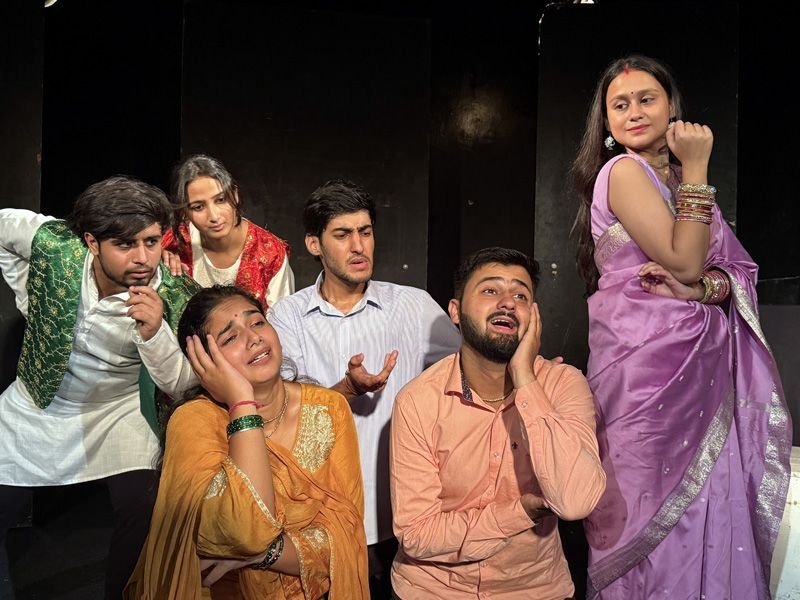
In a recent theatrical event that underscored the enduring legacy of cinematic giants, the theatre group Natrang, based in Jammu, brought to life Sagar Sarhadi’s Hindi play Yeh Kaun Aaya. This production, masterfully directed by Neeraj Kant, resonated deeply with the audience, offering both laughter and poignant reflection on the dynamics of family life.
Balwant Thakur, the esteemed Director of Natrang and a Padma Shri recipient, took the opportunity to pay homage to Sagar Sarhadi, a celebrated screenwriter whose contributions to Bollywood are indelible. Sarhadi’s genius is evident in iconic films such as Kabhi Kabhie, Silsila, Noorie, Bazaar, and Doosra Aadmi, all of which showcase his profound understanding of human relationships and societal intricacies. Thakur fondly recalled Sarhadi’s visit to Natrang in 2005, where the legendary writer expressed a heartfelt desire to see his plays performed by the group as part of their renowned ‘Sunday Theatre’ series. Over two decades later, Natrang proudly fulfilled this wish, honouring a long-standing aspiration and bringing one of Sarhadi’s insightful works to the stage.
"Yeh Kaun Aaya" is a delightful yet thought-provoking exploration of familial bonds, the inevitable misunderstandings that arise within them, the institution of marriage, and the ever-evolving attitudes of the younger generation. The narrative centers on Shyamlal and Rajkumari, a conventional middle-class couple, whose lives are disrupted by the impending marriage of Paresh, Shyamlal’s younger brother. Their quiet domesticity is dramatically altered by the sudden appearance of Neeta, a young woman who introduces herself as Paresh’s wife. This unexpected revelation leaves Shyamlal and Rajkumari utterly bewildered, as Paresh had neither informed them of his marriage nor introduced Neeta to the family.
Initially, the couple’s reaction is one of suspicion, mistaking Neeta for an intruder and even harbouring fears that she might intend to steal their belongings. However, Neeta’s genuine warmth, affectionate demeanor, and pleasant disposition gradually win them over. Her heartfelt words about Paresh, coupled with her evident admiration for his brother and sister-in-law, create a series of humorous and emotionally charged situations, transforming initial distrust into burgeoning acceptance.
The plot thickens with Paresh’s eventual arrival. Confronted by Shyamlal and Rajkumari about his alleged secret marriage, Paresh reveals that Neeta had deliberately orchestrated the surprise. He further explains his hesitation in bringing Neeta home earlier, fearing that she might struggle to adapt to his family’s simple lifestyle. Neeta, however, was resolute in her decision to integrate herself into the family through love, affection, and understanding, showcasing a profound desire for connection.
The play’s successful staging was a collaborative effort, featuring compelling performances by Palshin Dutta, Vrinda Gujral, Mihir Gujral, Aryan Sharma, Narinder Verma, and Khushboo Pandita. The technical aspects were expertly managed, with Neeraj Kant overseeing the intricate lighting design and Aadesh Dhar composing the evocative musical score. Sahir was credited for the impactful presentations, contributing to the overall immersive experience of this Hindi theatrical production.