







The Emergence of DLSS 5 Swapper
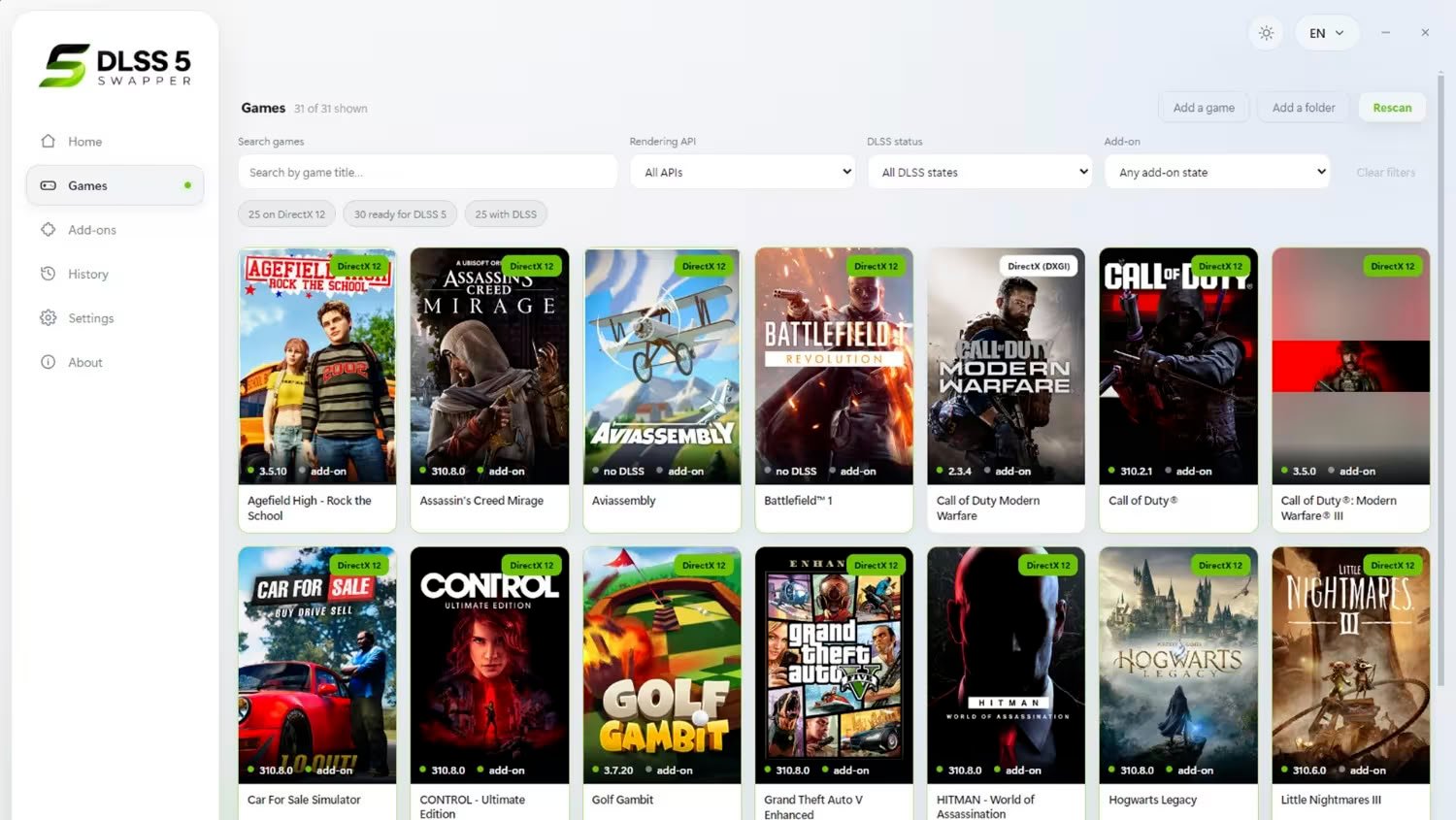
The landscape of PC gaming graphics has shifted significantly with the arrival of DLSS 5, NVIDIA’s latest iteration of its Deep Learning Super Sampling technology. While official support remains limited to the newest hardware, a developer going by the name rakanki911 has released a utility called DLSS 5 Swapper. This tool, hosted on GitHub, streamlines the process of injecting DLSS 5’s Neural Rendering capabilities into a vast array of titles, including legacy games and those that never received official support from NVIDIA. By consolidating fragmented community modifications into a single, automated interface, the tool has lowered the barrier to entry for enthusiasts who want to experiment with next-generation upscaling on older hardware.
At its core, the application simplifies the complex file replacement procedures that previously required manual directory navigation. Users can either drag and drop a game folder into the Swapper or command the software to scan their local drives for compatible installations. This user-friendly approach removes the technical friction that typically keeps casual gamers away from experimental modding, marking a significant step toward broader accessibility for advanced rendering techniques.
Under the Hood: How Neural Rendering Integration Works
The DLSS 5 Swapper operates by leveraging a combination of community-driven resources, specifically the DLSS5-Feeder mod. Neural Rendering requires specific data inputs, such as depth buffers and motion vectors, to reconstruct frames effectively. Games that were not originally designed with these features in mind lack the necessary hooks to provide this data to the GPU. To solve this, the Swapper utilizes an integration with ReShade to intercept and process the necessary visual information, effectively emulating the DLSS calls that the neural engine expects.
This bypass architecture allows the technology to function across a remarkably wide spectrum of software. It supports titles running on graphics APIs ranging from the aging DirectX 9 to the modern DirectX 12. Even more impressive is the compatibility with various console emulators, including PCSX2, Dolphin, and Xenia. By bridging the gap between the modern Neural Rendering DLL files—which recently surfaced through a leaked pre-launch build of NBA 2K27—and these diverse software environments, the tool effectively forces legacy engines to communicate with modern AI hardware.
Sidestepping Hardware Restrictions
One of the most controversial and highly anticipated aspects of the DLSS 5 release was NVIDIA’s apparent decision to limit the technology to the RTX 50-series hardware architecture. This hardware-gating strategy typically mandates specific tensor core requirements or architectural features that proponents claim are necessary for peak performance. However, the community effort surrounding the DLSS 5 Swapper has demonstrated that these limitations are largely artificial rather than strictly physical.
The tool successfully enables Neural Rendering on RTX 20-series (Turing) and RTX 30-series (Ampere) graphics cards. By modifying how the system calls interface with the GPU, the Swapper allows these older cards to process the neural rendering workload despite not having the specific silicon profile targeted by NVIDIA’s official marketing. While performance results vary depending on the game and the specific GPU architecture, the ability to run this technology on hardware several generations old proves that the software-side implementation is highly versatile. This development challenges the necessity of mandatory hardware upgrades for access to new rendering features and provides a significant life extension for older enthusiast-grade GPUs.
Use Cases and Visual Impact
The practical application of DLSS 5 Swapper extends beyond mere technical curiosity. Early tests in titles like Skyrim have shown that Neural Rendering can drastically alter character geometry, facial clarity, and environmental lighting, offering a significant visual upgrade over traditional resolution scaling methods. In legacy titles, where aliasing and poor texture filtering are common, the AI-driven reconstruction provides a modern smoothness that standard anti-aliasing techniques often fail to achieve.
For players utilizing emulators, the impact is equally profound. Emulated titles often suffer from shaky internal resolutions or issues when forced to render at high resolutions. Introducing DLSS 5 through the Swapper allows these games to benefit from sophisticated motion-based temporal reconstruction, creating a cleaner, more stable image quality that mimics modern remastering efforts. This represents a new frontier for archival gaming, where the latest AI advancements are used to preserve and enhance the visual fidelity of historical digital assets.
Security and Future Implications
Because DLSS 5 Swapper is an unofficial, community-managed project, it carries inherent risks that are not present with signed, first-party software. The tool functions by modifying game files and injecting code into execution paths, which can occasionally trigger anti-cheat software in online multiplayer environments. Users are strongly advised to limit their use of this tool to single-player games to avoid potential account sanctions or bans. Furthermore, because the files are distributed via community hubs, it is essential for users to verify the integrity of the source material to avoid downloading malicious variants of the mod.
The existence of this tool highlights a growing tension between manufacturer-imposed software limitations and the demands of the enthusiast community. As modders continue to refine the DLSS5-Feeder implementation, the tool will likely evolve to include more robust compatibility profiles. Until NVIDIA moves to integrate broader hardware support officially or addresses the underlying logic of its deployment, the DLSS 5 Swapper will likely remain the primary method for users to access Neural Rendering. It stands as a testament to the power of open-source collaboration in an era where software features are increasingly treated as exclusive, hardware-locked assets.
Disclaimer: This content is auto-generated for informational purposes only.
Source: Read Original News