








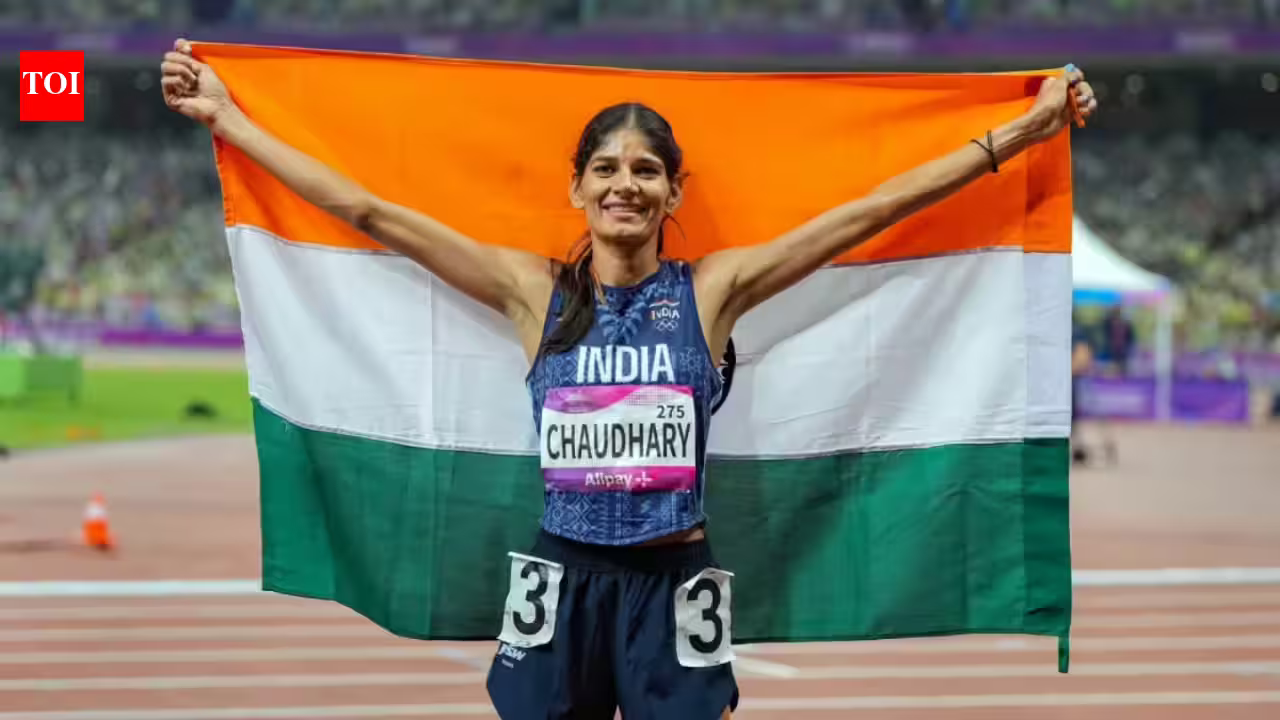
AICHI-NAGOYA — The track at the Aichi-Nagoya Asian Games bore witness to a masterclass in endurance and tactical precision this Sunday, as India’s Parul Chaudhary etched her name into the record books once again. In a thrilling women’s 3000m steeplechase final that pushed the boundaries of the field, Chaudhary secured a hard-fought bronze medal, punctuating her performance with a blistering new national record.
Clocking an impressive 9:08.67, Chaudhary shattered her previous personal best, proving that her trajectory remains firmly on the rise. This latest podium finish follows her silver-medal performance at the Hangzhou Asian Games in 2023, solidifying her status as a titan of middle-distance running in Asia.
## A Tactical Battle for the Ages
The race itself was a high-octane affair, dominated by the world-class pace of Bahrain’s Winfred Yavi, who successfully defended her dominance to claim gold with a time of 9:04.36. Kazakhstan’s Norah Jeruto Tanui, a formidable competitor, navigated the hurdles with clinical efficiency to take silver, finishing at 9:06.82.
While Yavi and Tanui held the top two spots, the contest for bronze was a testament to Chaudhary’s grit. Facing intense pressure, the Indian athlete maintained her focus, navigating the technical barriers and water pits with a rhythm that brought her home in 9:08.67.
The depth of Indian talent in this discipline was further underscored by Ankita, who, despite missing out on a podium finish, delivered the performance of a lifetime. Ankita crossed the line in 9:19.24, establishing a new personal best and highlighting a promising future for India’s steeplechase contingent.
## Near Misses and Silver Linings
While the morning was highlighted by Chaudhary’s record-breaking run, the atmosphere in the Indian camp was a mix of pride and the sharp sting of “what could have been” as other medal hopefuls narrowly missed the top spot.
In the field events, Sarvesh Kushare’s high jump campaign saw him tantalizingly close to the gold. In a nail-biting showdown, Kushare found himself in a tactical struggle after failing to clear 2.25m on his initial attempt. Chinese Taipei’s Chao Hsuan-Fu seized the momentum, clearing the bar on his first try. Although Kushare successfully cleared the height on his second attempt, the difference in efficiency forced him to settle for a well-earned silver.
The women’s long jump saw a similar dramatic conclusion. Ancy Sojan looked poised to secure gold after a magnificent fifth-round leap of 6.53m. However, the final round proved unforgiving; China’s Huang Yingying produced a decisive jump of 6.55m, snatching the gold from Sojan’s grasp in the dying moments of the competition.
Adding to the tension, Shaili Singh, who was in the hunt for a podium finish, saw the bronze slip away in the final moments of the event. China’s Mengyi Tan produced a clutch 6.46m on her final attempt, leapfrogging the Indian athlete, whose best effort remained 6.42m.
## Sprinting Success on the Track
The track events also provided a significant boost to the Indian tally, headlined by Harita Bhadra’s performance in the women’s 200m final. In an incredibly tight finish, Bhadra demonstrated immense closing speed to capture the bronze medal with a time of 23.20 seconds, edging out Japan’s Ido Abigeirufuka by a mere 0.01 seconds.
The gold in the 200m went to Singapore’s regional superstar Shanti Pereira, who clocked a blistering 22.78s, with China’s Chen Yujie taking the silver at 22.93s. Unnathi Aiyappa Bolland also put in a valiant effort for India, finishing sixth with a time of 23.48s.
## Looking Forward
As the dust settles on these events, the narrative surrounding the Indian athletics team is one of resilience and growth. Parul Chaudhary’s ability to constantly refine her own limits—moving from silver in Hangzhou to a bronze-medal-winning national record in Aichi-Nagoya—serves as the flagship story of the Games thus far.
With the medal tally continuing to climb, the Indian contingent has proven that they are not just participating in the regional spotlight but are actively shaping the standard of competition across the continent. For athletes like Chaudhary, Kushare, and Sojan, these Games are more than just a search for hardware; they are a clear indicator that Indian track and field is evolving, becoming more competitive and more clinical under the intense pressure of the international stage.
As the remaining events approach, the focus shifts to whether this momentum can be sustained, but one thing is certain: the record books have been rewritten in Aichi-Nagoya, and Indian athletes are the ones holding the pen.
Disclaimer: This content is auto-generated for informational purposes only.
Source: Read Original News