








A Hollywood Icon’s Sustainable Legacy: The Story of Orchid House
In the high-stakes world of Hollywood real estate, where the goal is often to build the biggest, flashiest glass box to flaunt wealth, Pierce Brosnan and his wife, Keely Shaye Smith, chose a different path. They opted for a legacy that felt less like a monument to ego and more like a love letter to the environment. Known to the public as the “Orchid House,” their 13,000-square-foot sanctuary in Malibu has stood for over two decades as a beacon of sustainable luxury. But as the couple prepares to finally part ways with the compound, the story of how it came to be—and why they are leaving—offers a poignant look at the life of one of cinema’s most enduring leading men.
From Mid-Century Ranch to Eco-Mansion
The journey began back in 2000, a time when the “celebrity eco-home” was hardly the industry standard it is today. Brosnan and Smith dropped $5.1 million and $2.25 million, respectively, to acquire two sprawling adjacent plots of land in Malibu. The existing mid-century ranch house on the property—charming, perhaps, but certainly not the vision the couple held—was swiftly demolished.
They weren’t looking for a quick flip. They were looking for a home that reflected a shift in their own consciousness. Inspired by his time filming the Bond classic Tomorrow Never Dies in 1997, Brosnan developed a profound affinity for the architecture and soul of Thailand and Bali. Over the next twelve years, the couple poured their energy, their finances, and an obsessive attention to detail into the construction. What emerged was a tropical, oceanfront compound that felt like a sanctuary, a seamless blend of Southeast Asian design aesthetics and California coastal living.
Living in Harmony with the Coast
To walk into the Orchid House is to experience light. With 117 feet of prime ocean frontage, the main house and guest quarters were designed to prioritize natural illumination. Wide-plank teak flooring stretches across the rooms, and soaring scissor-truss ceilings create a sense of scale that feels airy rather than imposing.
However, the true “Bond-level” ingenuity lies behind the walls. The house is a masterclass in modern sustainability, decades ahead of its time. When the couple built the property, they integrated an on-site water recycling plant, an absolute necessity for mindful living in the drought-prone hills of Malibu. They installed low-flow fixtures throughout the compound and utilized custom, energy-saving lighting that minimized the carbon footprint of such a sprawling square footage.
Perhaps most impressive is the solar integration. The entire property is wired with solar panels that don’t just handle the lighting; they power the heating for the pool and the guest cabana. In a stroke of brilliant efficiency, the system is designed to feed unused energy back into the local power grid, making the house a net producer of power rather than a drain. Even the waste management was automated—the property features a self-turning, solar-powered compost system that turns kitchen waste into fuel for their lush, native-inspired landscaping.
A Valuation Reflection of Changing Times
In 2020, the Orchid House made headlines for a staggering reason: it was listed for a cool $100 million. It was a price tag that reflected the unique craftsmanship, the prime Malibu location, and the incredible investment of time and money the Brosnans had poured into the estate. Yet, despite the buzz, the property failed to secure a buyer at that astronomical figure, eventually being pulled from the market.
It was a stark reminder that even for James Bond, the market is fickle. But for Brosnan, the house was never just an asset; it was a home that had reached its expiration date in his life. The couple’s decision to move on wasn’t spurred by a lack of love for the architecture, but by a growing sense of vulnerability.
The Reality of Life on the Ring of Fire
Recent years have brought a wave of introspection for the couple. While they have enjoyed the beauty of the Malibu coast, the reality of living on the front lines of climate change has become impossible to ignore. Speaking to The Times, the couple candidly discussed the looming shadow of the frequent wildfires that have ravaged California, along with the constant, underlying tectonic anxiety that comes with living near a fault line.
“We’ve been spared by the fires a few times now,” they shared. “But I think it’s time to move. Everything changes; everything falls apart. We live by this body of earth’s water on a fault in a ring of earthquakes. That creates a fear.”
It is a refreshingly honest admission from a man known for playing the calm, collected hero. The reality is that the “glamour” of coastal living in the 21st century comes with a heavy price tag of anxiety—one that the Brosnans are no longer willing to pay.
Embracing a Simpler Chapter
With their sons, Dylan and Paris, grown and forging their own paths, the massive Malibu compound now feels like an echo of a life already lived. The couple has spent the interim years gravitating toward a much more grounded existence in Hawaii, where Keely Shaye Smith has her roots.
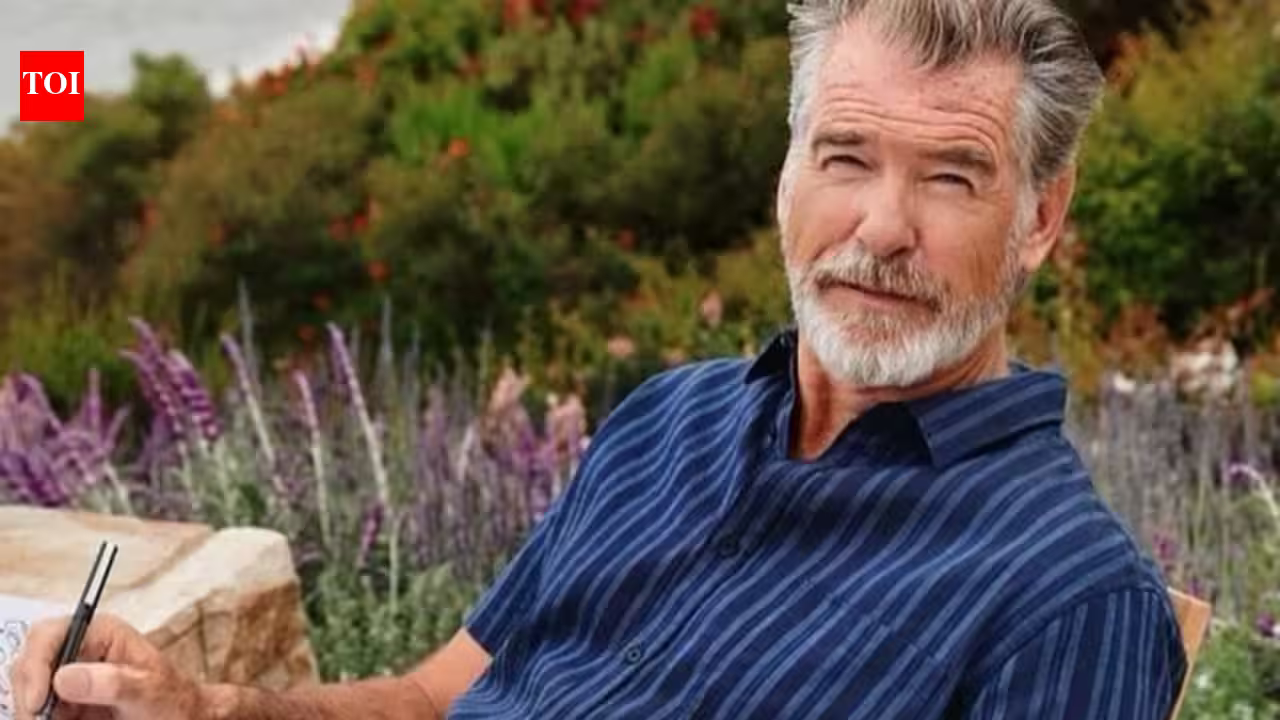
Their current daily life is a world away from the $100 million listing. They now inhabit a modest three-bedroom cottage at the end of the road in Kauai. There, the day-to-day involves tending to chickens and spending time in a quiet yurt where Brosnan can practice his painting.
“We have our own chickens,” he noted, sounding not like a Hollywood titan, but a man finding peace. “There are moments of, oh, this boat is not quite sinking, but [it might] if we don’t get a job soon. I think the two of us are somewhat reclusive.”
It is a gentle finale for the Orchid House. After 26 years, the couple is ready to close the chapter on the grandest project of their lives. While the mansion may soon find a new owner, the real success of the Orchid House isn’t its valuation or its celebrity status—it’s the fact that Pierce Brosnan managed to turn a dream of sustainable living into a reality, proving that even in the heart of Tinseltown, one can choose to live in a way that respects the Earth.
Disclaimer: This content is auto-generated for informational purposes only.
Source: Read Original News