









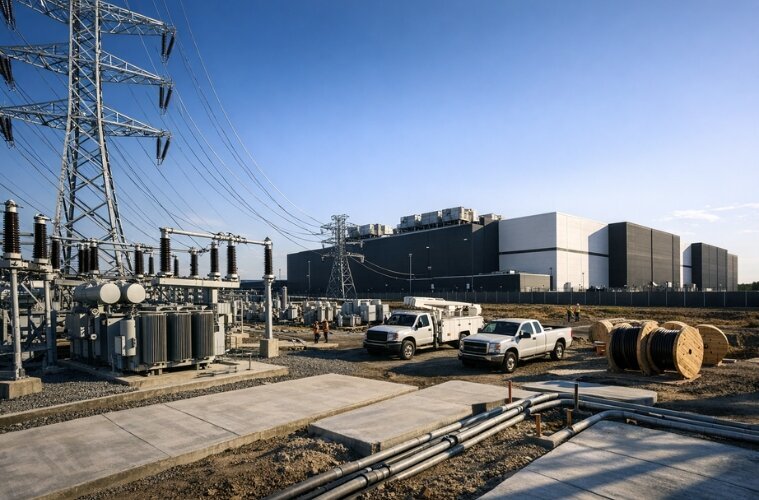
A bipartisan push to shield residential electricity consumers from the ballooning infrastructure costs associated with massive data center development is gaining momentum in Washington. H.R. 9340, a bill sponsored by Representatives Gabe Evans (R-Colo.) and Kathy Castor (D-Fla.), is slated for a vote in the House of Representatives the week of September 14, following a rare and unanimous 52-0 approval from the House Energy and Commerce Committee this past July.
The legislation seeks to amend the Public Utility Regulatory Policies Act (PURPA) of 1978 to create a federal framework requiring state regulators to reevaluate how they handle the financial burden of large-scale, energy-intensive projects. Rather than imposing a top-down federal rate, the bill empowers state utility commissions to ensure that “large-load customers”—defined as nonresidential facilities utilizing at least 100 megawatts at a single site for data storage and computing—shoulder the full incremental cost of the generation, transmission, and distribution upgrades required to power their operations.
The bill’s primary objective is to eliminate “speculative load” risks. Currently, when utilities invest in infrastructure to accommodate planned data centers, the financial burden of delayed or abandoned projects often falls on the average ratepayer. H.R. 9340 mandates that utilities secure financial assurances from these developers before breaking ground on new infrastructure, effectively shifting the risk from the public to the private companies driving the demand. States will be given a two-year window to integrate these standards into their regulatory processes, though jurisdictions that have already established similar cost-recovery rules will be exempt from duplicating their efforts.
This legislative effort arrives as federal regulators simultaneously move to address the systemic strain data centers place on the grid. In June, the Federal Energy Regulatory Commission (FERC) directed the six regional transmission organizations under its oversight to justify or reform their current interconnection protocols. FERC specifically identified the prevention of cost-shifting—where industrial loads pass their infrastructure costs onto residential users—as a priority for consumer protection.
While the federal government is moving to formalize these policies, the utility landscape is already shifting. According to recent data, 23 states have already implemented some form of cost-causation rules for massive industrial loads. Texas, in particular, has emerged as a bellwether for this transition, having introduced the “Batch Zero” framework through its grid operator, ERCOT. This system establishes a rigorous hierarchy for grid access and clearly delineates financial responsibility for the infrastructure required to support high-intensity computing.
In this context, H.R. 9340 serves as a broad policy baseline that mirrors, rather than pioneers, the trends already being set by regional utility commissions. The bill’s widespread support—boasting 41 co-sponsors and broad bipartisan consensus—signals a growing recognition in Washington that the rapid expansion of AI and cloud computing infrastructure cannot come at the expense of energy affordability for the average citizen.
However, financial allocation is only one facet of the challenge. Even if a developer agrees to fund every dollar of transmission infrastructure, they face significant hurdles regarding permitting delays, supply chain shortages for electrical equipment, and lengthy construction timelines. These systemic bottlenecks have led to an increase in on-site, behind-the-meter generation arrangements, as tech companies look for ways to bypass the congested public grid entirely.
As H.R. 9340 moves toward a floor vote, the focus will shift to the Senate. While Senator Jon Husted (R-Ohio) has introduced a companion bill, S. 5028, the legislation has yet to be granted a committee hearing. Whether the Senate will match the House’s urgency on the issue remains the central question for energy policymakers as they attempt to balance the nation’s digital infrastructure needs with the stability of the public power supply.
Disclaimer: This content is auto-generated for informational purposes only.
Source: Read Original News