








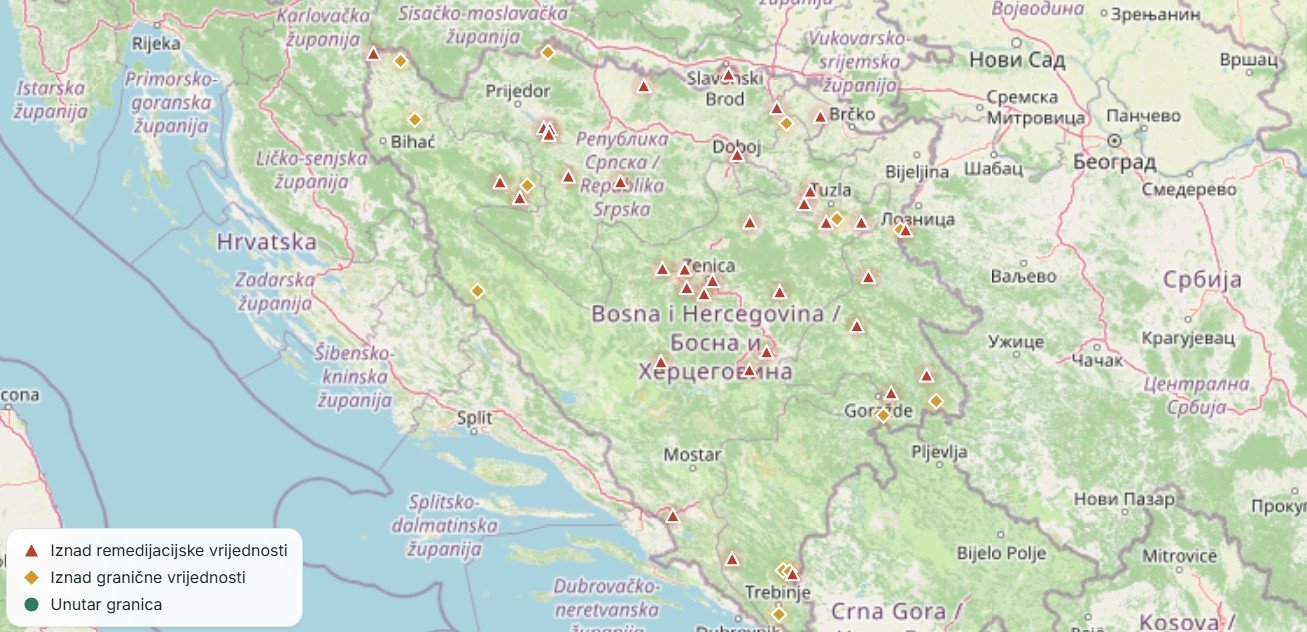
Bosnia and Herzegovina has reached a critical milestone in its environmental management strategy with the unveiling of a comprehensive map of environmental hotspots. Presented at the UN House in Sarajevo, the map provides a scientific inventory of 48 locations across the country that require urgent attention due to historical pollution, industrial mismanagement, and legacy waste.
The initiative, led by the Federal Ministry of Environment and Tourism in collaboration with the Republic of Srpska’s Institute for Protection and Ecology, marks a transition from passive observation to active intervention. The 48 identified sites are distributed equally between the country’s two entities, the Federation of BiH and the Republic of Srpska. These locations include abandoned industrial complexes, mining sites, former military facilities, and landfills that have long burdened local ecosystems.
Data analysis conducted for the project evaluated 117 potential sites before narrowing the focus to these 48 critical hotspots. According to the findings, 35 of these locations exceed the thresholds for required remediation, signifying high levels of contamination that pose direct risks to soil, water, and public health. The remaining 13 sites, while currently below the most severe remediation threshold, exceed legal standards for pollution and require strict monitoring and mitigation measures to prevent further degradation.
Federal Minister of Environment and Tourism Nasiha Pozder emphasized that the map is intended to serve as more than a static directory of hazards. “It is a practical toolkit that enables us to set priorities, assess ground conditions, and plan concrete measures,” Pozder said during the presentation. “Our goal is to move from identifying environmental hotspots to actively remediating them.”
To demonstrate the efficacy of this new framework, the Ministry, in partnership with the United Nations Development Programme (UNDP) in BiH, has already selected two pilot sites for immediate action: the Veovača flotation tailings pond-lake in the municipality of Vareš and the Ada landfill in Čapljina.
The approach for these sites is designed to create a scalable blueprint for future projects. In Vareš, approximately BAM 76,000 (EUR 39,000) has been allocated for a multidisciplinary team to perform comprehensive testing of soil and food samples. This baseline analysis is essential to define the full scope of risks before physical remediation begins. Simultaneously, BAM 300,000 (EUR 153,530) has been secured for the remediation and eventual closure of the Ada landfill, an area that has long required reclamation.
The development of the national map was supported by a contribution of BAM 100,000 (EUR 51,180) from the Federal Ministry, with additional financial and technical support provided by the governments of Sweden and Switzerland. The project underscores the importance of inter-entity cooperation and international partnerships in addressing the environmental legacies that continue to impact the Balkan nation.
The official launch was attended by key stakeholders, including representatives from the Ministry of Foreign Trade and Economic Relations of BiH, the UNDP, and the Ministry of Spatial Planning, Construction and Ecology of the Republic of Srpska. As the country moves forward, the lessons learned from the pilot projects at Vareš and Čapljina are expected to guide the long-term, systematic restoration of the remaining 46 hotspots. By institutionalizing this data-driven approach, Bosnia and Herzegovina is taking a significant step toward aligning its environmental standards with broader European benchmarks and improving the quality of life for its citizens.
Disclaimer: This content is auto-generated for informational purposes only.
Source: Read Original News