








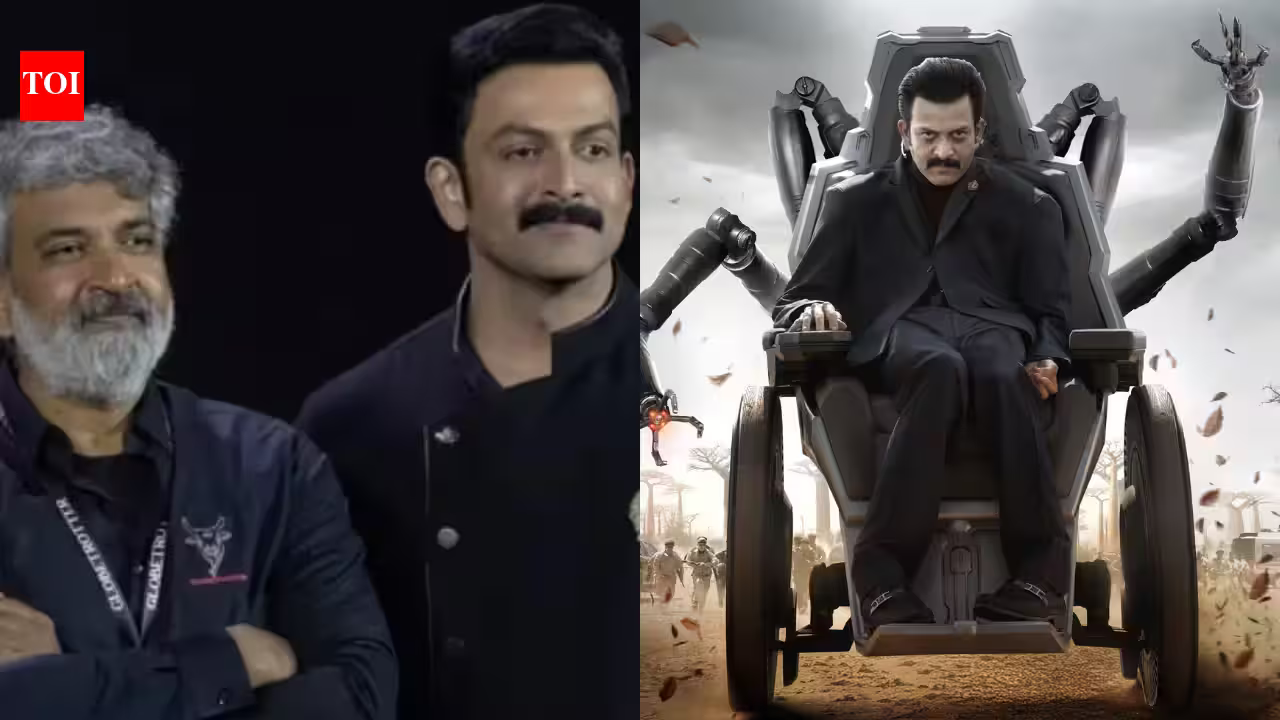
The landscape of Indian cinema is currently tilting on its axis, and at the center of the tremor stands a project that has fans and critics alike holding their breath: SS Rajamouli’s Varanasi. Following the global phenomenon of RRR, the visionary director has traded the historical spectacle for a globetrotting, time-bending odyssey. But if the scale of the production is what draws the headlines, it is the quiet, methodical process on set that has captivated the industry’s elite.
Prithviraj Sukumaran, the powerhouse Malayalam star stepping into the boots of the antagonist Kumbha, recently pulled back the curtain on what it’s actually like to stand before a filmmaker who has redefined the reach of Indian storytelling. Far from the rigid, autocratic caricature often painted of “legendary” directors, Prithviraj describes an environment defined by intellectual openness and a surprisingly democratic approach to the craft.
The Myth of the Rigid Auteur
There is a prevailing assumption in Hollywood and Indian cinema alike that directors of Rajamouli’s caliber—those who handle budgets that rival small nations and command visual effects armies—operate as iron-fisted dictators. The narrative often suggests they dictate every twitch of a muscle, every inflection in a voice, and every frame of movement. However, according to Prithviraj, the reality on the sets of Varanasi is significantly more nuanced.
Prithviraj notes that the collaboration begins long before the cameras roll. Instead of issuing commands, Rajamouli starts with a conversation. “Rajamouli sir will say, ‘This is the scene. How do you want to do this?’” Prithviraj shared. This is a radical departure from the “do exactly as I say” model of directing. By putting the ball in the actor’s court first, Rajamouli isn’t just seeking a performance; he is conducting a creative experiment to see if the actor’s instinct aligns with the soul of the character.
A Healthy Exchange of Ideas
In an industry where egos often collide, the “healthy exchange of ideas” that Prithviraj describes is a rarity. It’s a testament to Rajamouli’s confidence in his own vision—only a director who knows exactly what he wants can afford the luxury of listening to what others have to offer.
For an actor like Prithviraj, who is an accomplished director in his own right, this environment is a goldmine. It allows for a dialectic process: the actor proposes an interpretation, Rajamouli provides his perspective, and the result is a hybrid performance that is often stronger than either individual thought. It’s this collaborative spirit that explains why his actors, from Prabhas to Jr. NTR and Ram Charan, have consistently delivered career-best performances under his tutelage. In Varanasi, it seems the goal is to extract the most authentic, grounded performance from an ensemble that includes heavyweights like Mahesh Babu and Priyanka Chopra.
The Delicate Art of Surrender
However, the democratic nature of the set does not mean the absence of a captain. Prithviraj is careful to emphasize that while input is welcomed, the ultimate burden of the narrative rests on the director’s shoulders. There is a “surrender” that occurs, a necessary act of trust where the actor recognizes that the final mosaic is being assembled in the director’s mind, not theirs.
“You have to be willing to surrender to the director’s vision,” Prithviraj admitted. “You can have your ideas and point of view, but eventually, you have to trust the person who is making the film.” This duality—the ability to be both a creative partner and a disciplined vessel—is what elevates a performance. It allows actors to bring their full intelligence to the table while trusting that if a choice doesn’t serve the larger, epic scope of Varanasi, the director will steer them back to the course.
The Antagonist’s Perspective: Who is Kumbha?
While the plot of Varanasi remains a closely guarded secret, the mere casting of Prithviraj Sukumaran as the antagonist Kumbha has ignited intense speculation. Prithviraj has built a career in Malayalam cinema on playing complex, multi-layered characters—men who are rarely purely villainous and never one-dimensional.
Pairing him against Mahesh Babu’s Rudhra and Priyanka Chopra’s Mandakini suggests a high-stakes power struggle that will likely span both time and geography. If Rajamouli is treating his villain with the same collaborative depth as his leads, we are likely to see a performance from Prithviraj that avoids the tropes of the “evil overlord” and instead gives us a deeply motivated, perhaps even tragic, antagonist.
Why ‘Varanasi’ Is More Than Just a Blockbuster
As we look toward the scheduled release of April 7, 2027, the anticipation for Varanasi is fueled by more than just the curiosity of what a time-travel drama by Rajamouli looks like. It is the curiosity of seeing how he integrates global production standards with deeply human, performance-driven storytelling.
The film marks a new chapter for Indian cinema, serving as a bridge between the hyper-stylized action sequences that fans have come to expect and a narrative depth that requires nuanced performances. By empowering stars like Mahesh Babu, Priyanka Chopra, and Prithviraj to contribute to their character arcs, Rajamouli is ensuring that the spectacle doesn’t overshadow the soul.
When the film finally hits the silver screen, audiences might be dazzled by the visuals, but it will be the quiet, collaborative conversations on set—the moments of “healthy exchange” that Prithviraj describes—that will likely resonate in the finished frames. In the world of Varanasi, the biggest special effect might just be the sheer amount of trust between the man behind the camera and the actors in front of it.
Disclaimer: This content is auto-generated for informational purposes only.
Source: Read Original News