








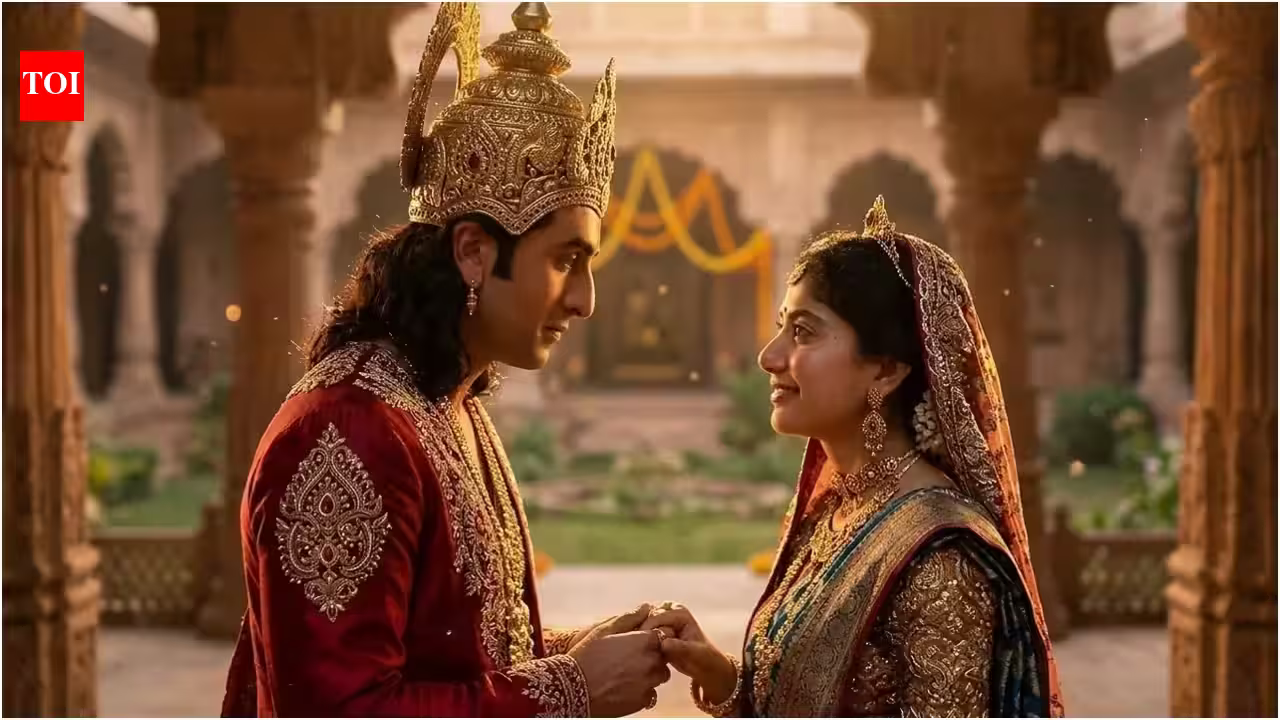
The air in the Indian film industry is thick with anticipation. When a project as ambitious as Nitesh Tiwari’s Ramayana is announced, the immediate reaction is usually a cocktail of extreme hype and cautious scrutiny. After all, translating one of the world’s oldest and most revered epics onto the silver screen is a gargantuan task that demands a delicate balance of reverence and cinematic spectacle. However, with the release of the film’s first major musical offering, “Mangal Rang,” the conversation has shifted from skepticism to genuine, wide-eyed wonder.
As we head toward the November 2026 release, the unveiling of this track has served as a masterclass in how to build momentum without giving away the entire plot. Featuring the lead pair, Ranbir Kapoor as Rama and Sai Pallavi as Sita, the song isn’t just a promotional tool—it’s a visual and auditory statement of intent.
A Symphony of Legends
The creative pedigree behind “Mangal Rang” is enough to turn even the most casual viewer into a believer. When you combine the ethereal, gravity-defying vocals of Arijit Singh and Shreya Ghoshal with the lyrical prowess of Kumar Vishwas, you have the ingredients for an instant classic. But the real coup lies in the music composition. Seeing the names A.R. Rahman and Hans Zimmer attached to a single project—let alone a single song—feels like a collision of musical universes.
Rahman’s ability to weave traditional Indian sensibilities with global soundscapes, paired with the cinematic weight of Zimmer’s orchestration, creates an atmosphere that feels both ancient and grand. The song serves as a sensory bridge, transporting the audience from the multiplex to the serene, divine landscapes of the Vanvaas period. It captures a sense of purity that is difficult to replicate, setting a tone of quiet, soulful majesty that defines this iteration of the epic.
The Chemistry That Stole the Spotlight
The internet, notoriously difficult to please when it comes to casting, has offered a surprisingly unanimous verdict on the lead pair. For weeks, fan theories about how Ranbir Kapoor would inhabit the stoic, divine nature of Rama were rampant. Would he be too “modern”? Too “urban”?
The release of “Mangal Rang” effectively silenced those whispers. Watching the song, it’s clear that Kapoor has dialed back his usual screen magnetism to adopt a softer, more grounded intensity. As one fan aptly noted on social media, Kapoor’s “emotion meter” is operating at a level that feels almost effortless. He isn’t just playing a deity; he is capturing the humanity of a man walking through a period of immense personal trial.
Sai Pallavi, meanwhile, is the heartbeat of the track. Her portrayal of Sita has been lauded as “heartwarming,” with viewers specifically pointing to her smile and the grace with which she carries herself. The duo’s on-screen connection—built on subtle glances and a quiet, domestic intimacy—has been labeled “cute” by the masses, a testament to the fact that the film is focusing on the emotional core of the couple before diving into the chaos of the eventual battle.
Visual Grandeur Meets Storytelling
Beyond the chemistry, “Mangal Rang” is a feast for the eyes. There is a “magical” quality to the cinematography that fans have been quick to praise, with many comparing the production quality favorably to the visual ambition of Brahmastra. The use of vibrant, divine colors creates an ethereal aura that makes the 3D and IMAX 3D versions of the film sound like non-negotiable experiences.
For an epic story like Ramayana, the setting is essentially a character in itself. The visuals here don’t just provide a backdrop; they establish a sense of time and space that feels both nostalgic and fresh. It is clear that Namit Malhotra’s Prime Focus Studios is aiming to create a benchmark for Indian visual effects, ensuring that the legendary status of the source material is matched by technical prowess.
The Road to November 5
As the release date of November 5, 2026, looms, Ramayana is shaping up to be more than just a movie—it is an event. The cast list is nothing short of a “who’s who” of Indian cinema, featuring powerhouses like Yash, Sunny Deol, and the legendary Arun Govil. With the added weight of producers like Yash’s Monster Mind Creations, the film is clearly aiming for a global footprint, bridging the gap between traditional storytelling and world-class production values.
The success of “Mangal Rang” has effectively reset the bar for the upcoming promotional campaign. By focusing on the emotional resonance of the story—the “pure” and “pavitra” feeling that fans have described—the team behind Ramayana has managed to tap into a deep sense of cultural connection.
In an era where big-budget spectacles often rely too heavily on mindless action and CGI-heavy sequences, Ramayana seems to be taking a risk by leading with heart, grace, and music. If the rest of the film manages to maintain the delicate balance established in this track, Nitesh Tiwari might just have a modern masterpiece on his hands. For now, the audience is hooked, waiting for the next glimpse into a world that feels like the “Ram Yug” has finally returned to the big screen. The wait until November is going to feel like a very long time indeed.
Disclaimer: This content is auto-generated for informational purposes only.
Source: Read Original News