









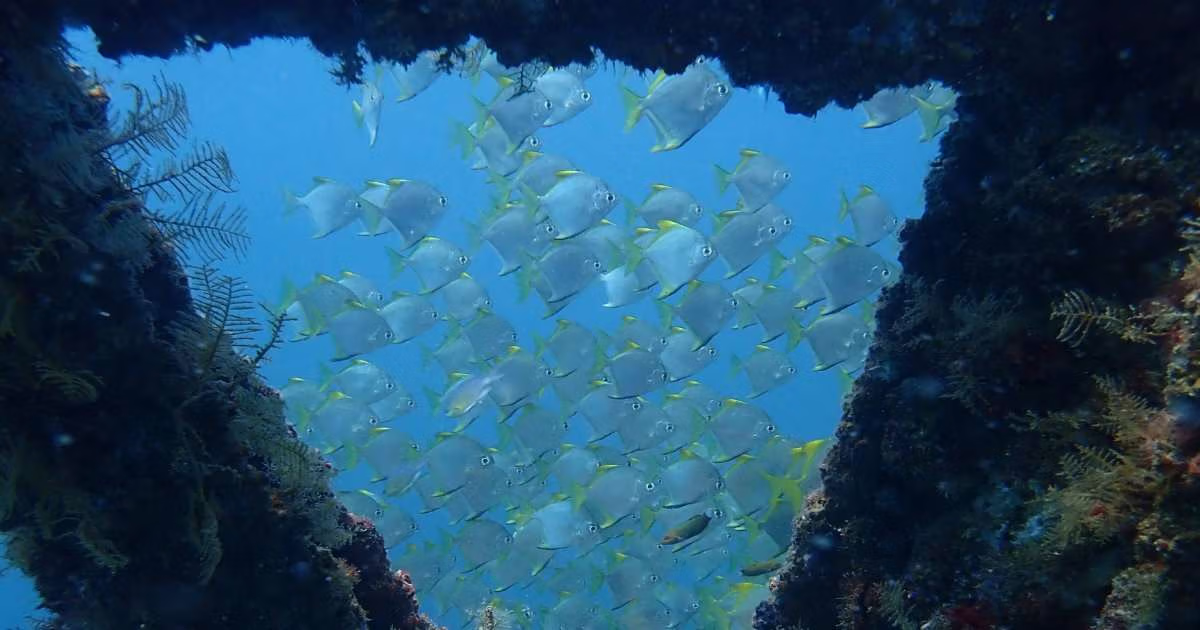
A landmark regional initiative aimed at safeguarding Southeast Asia’s vital coral reef ecosystems was officially launched in Malaysia this August. The Regional Coral Reef Monitoring and Management Project brings together a collaborative coalition of nearly 30 participants representing government agencies, academia, and non-governmental organizations from Malaysia, Indonesia, Vietnam, Brunei Darussalam, and the Philippines.
Supported by the Australian Government as part of the Southeast Asia Maritime Partnerships Program, the project seeks to bridge the gap between fragmented data collection and actionable conservation policy over the next four years. By fostering regional cooperation and enhancing technical capabilities, the initiative aims to transform how coral reef health is monitored, analyzed, and managed across the region.
At the heart of the project is the deployment of ReefCloud, an innovative, AI-powered digital platform developed by the Australian Institute of Marine Science (AIMS). Designed as an open-access tool, ReefCloud streamlines the monitoring process by accelerating the analysis of reef imagery, allowing scientists and managers to share and interpret data with unprecedented efficiency.
Dr. Manu Gonzalez Rivero, an AIMS research scientist and the lead for ReefCloud, emphasized that the health of Southeast Asian reefs is intrinsically linked to the economic, social, and cultural prosperity of the region.
“Assessing the condition of coral reefs through standardized, robust monitoring provides reef managers with the best available evidence to understand changes in reef condition that support effective management,” Dr. Gonzalez Rivero stated. “We’ve been working with national teams across the region to enhance monitoring efforts and build capacity. We’re pleased to help bring these conversations to a regional level.”
The initiative addresses long-standing challenges identified by regional experts, including the physical difficulty of reaching remote reef sites, a chronic lack of specialized technical expertise, and significant bureaucratic delays in data processing. According to Associate Professor Tan Chun Hong of Universiti Malaysia Terengganu, these barriers often result in a “time-lag” that prevents managers from responding quickly to environmental stressors like coral bleaching or pollution.
“Considerable reef monitoring data are already being collected in Malaysia and across Southeast Asia,” Associate Professor Tan noted. “The challenge is not only to collect more data, but also to make existing and future datasets more compatible, accessible, and useful across institutions and countries.”
However, the organizers are clear that digital innovation alone is not a panacea for the crisis facing marine biodiversity. The project emphasizes the necessity of developing comprehensive policy frameworks that facilitate the responsible sharing of data across national borders while respecting data sovereignty and individual national priorities. The recent launch workshop, which included representatives from key bodies such as the UNEP Coordinating Body of the Seas of East Asia (COBSEA), the Coral Triangle Initiative (CTI-CFF), and the ASEAN Centre for Biodiversity, focused on establishing these cross-border mechanisms.
By aligning regional priorities and co-designing a unified work plan, the project participants hope to move toward a future where decision-making is driven by robust, real-time evidence. Over the next four years, the project will work to integrate these disparate monitoring efforts into a cohesive regional strategy, ensuring that the precious coral reefs of Southeast Asia are monitored not just as local assets, but as a shared, globally significant natural heritage.
Disclaimer: This content is auto-generated for informational purposes only.
Source: Read Original News