







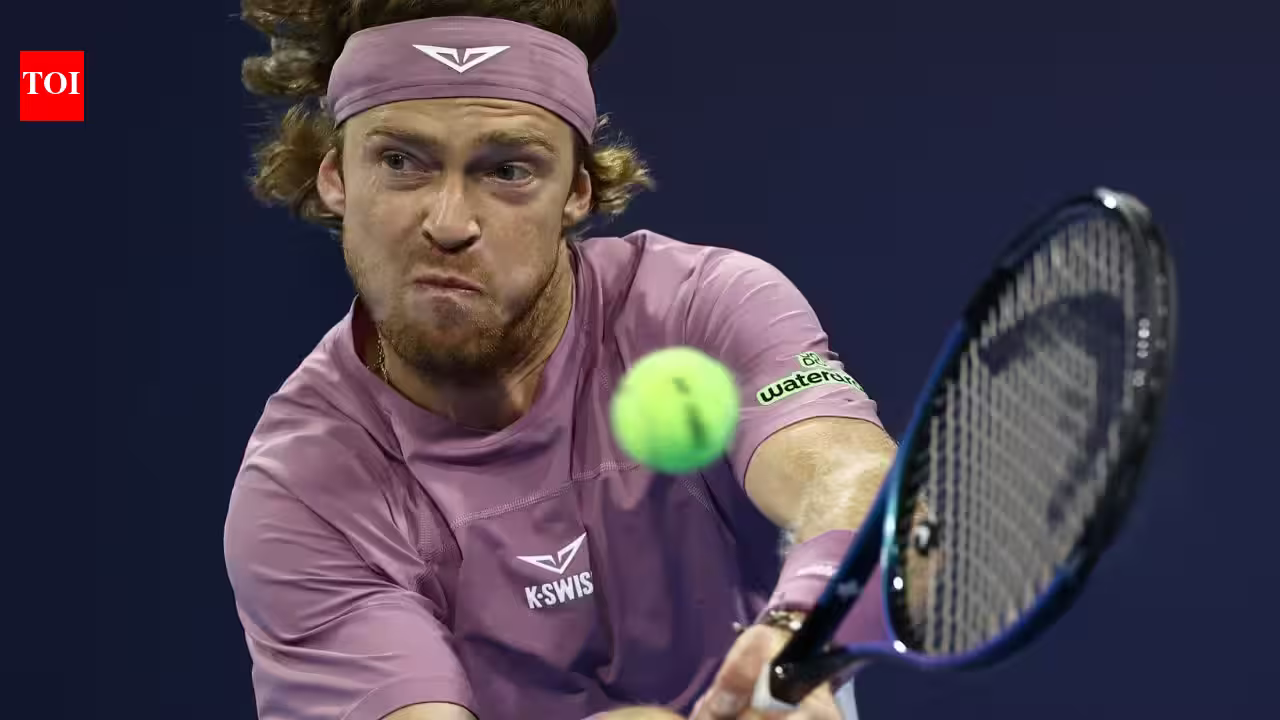
ALMATY — Andrey Rublev has spent the better part of a decade trying to perfect the version of himself that rocketed into the world’s top five. But standing at the precipice of his late twenties, the mercurial Russian has arrived at a stark, sobering realization: the very traits that brought him to the pinnacle of professional tennis are the same ones now threatening to stifle his further ascent.
At 28, Rublev is no longer interested in the steady, albeit stagnant, path of his former self. With his ranking currently sitting at No. 23—having dipped outside the top 20 for the first time since January 2020—the man who once defined consistency by finishing five consecutive seasons in the top 10 is choosing to dismantle his own foundation.
A High-Stakes Evolution
The transition is far from cosmetic. For a player who has reached ten Grand Slam quarter-finals without ever cracking the final four, the hunger for something more is palpable. However, Rublev acknowledges that abandoning the instincts that fueled his rise is a nerve-wracking gamble.
“It’s not easy to change something that you know for all your life,” Rublev admitted while speaking as the No. 4 seed at the Almaty Open. “It’s not easy to switch that—what brought you to No. 5 in the world—for something else that you don’t really trust yet.”
His legendary forehand, long considered one of the most destructive weapons in the ATP circuit, is the focal point of this reconstruction. Under pressure, Rublev’s muscle memory is calibrated to hit with relentless, high-octane aggression. Now, he is attempting to temper that instinct, aiming for a more multifaceted game that can dismantle elite opponents who have spent years learning to neutralize his power.
“I’m trying to change, on and off the court, mentally—things that have become a habit, that have already taken me to the limit,” he said. “Now, it’s the second part of my career where I try to do something different completely.”
The Cost of “Staying the Course”
Rublev’s decision to pivot is driven by an existential indifference to mere survival on the tour. He has no desire to become a perennial gatekeeper of the top 30, content to simply draw a paycheck and maintain his status.
“With the game I used to have, it will go down little by little until I cannot play anymore,” he noted bluntly. “To be just top 30 for the next five or six years, for me, it makes no difference.”
This internal audit has been catalyzed by a transformative 18-month partnership with former world No. 1 Marat Safin. Known for his own fiery temper and mercurial brilliance during his playing days, Safin has provided Rublev with a roadmap for navigating the volatile intersection of elite athleticism and mental health.
Beyond the Baseline: Finding Peace
The most profound change in Rublev is not tactical, but personal. For years, the Russian was defined by on-court meltdowns, rackets destroyed in fits of rage, and a self-flagellating intensity that often bled into physical self-harm. Rublev now speaks candidly about the shadows that lingered beneath his public persona.
“From the past, before Marat, I was very depressed,” Rublev revealed, his voice steady. “Taking antidepressant pills so I wouldn’t feel the depression. Basically, it was a bit of drama that was happening to me, and I didn’t know how to escape. I was at the bottom of my darkest days.”
That darkness became the catalyst for change. Rather than collapsing under the weight of his own expectations, he reached a fork in the road: continue the cycle of “drama” and inevitable decline, or fundamentally alter the way he views his craft and his life.
“I choose to try to fix it,” he said. When asked about his current state, his answer is strikingly simple: “I’m enjoying my life much more. I’m much more at peace with myself.”
The Road Ahead
Reinvention in professional sports is rarely a linear progression. Rublev understands that there is no guarantee this “new” version of himself will hoist a major trophy or reclaim his spot in the top five. Yet, the uncertainty is a risk he is willing to embrace.
“Maybe it’s going to make the second part of my career better than my first part, or maybe not,” Rublev said, offering a glimpse of a newfound maturity. “But at least I know I did something. I gave myself a chance.”
He looks to his contemporaries—men like Daniil Medvedev and Alexander Zverev—not with envy, but as proof of concept. Their ability to adapt and sustain success in the modern era serves as a beacon for what he knows he is capable of achieving.
As Rublev prepares for the matches ahead in Almaty, he does so with a lighter heart and a heavier burden of expectation—not from his fans or the media, but from himself. Whether he succeeds in rewriting his legacy remains to be seen, but one thing is certain: Andrey Rublev is no longer chasing the ghost of the player he was. He is building something entirely new, and for the first time in his career, he seems perfectly comfortable with the construction noise.
Disclaimer: This content is auto-generated for informational purposes only.
Source: Read Original News