







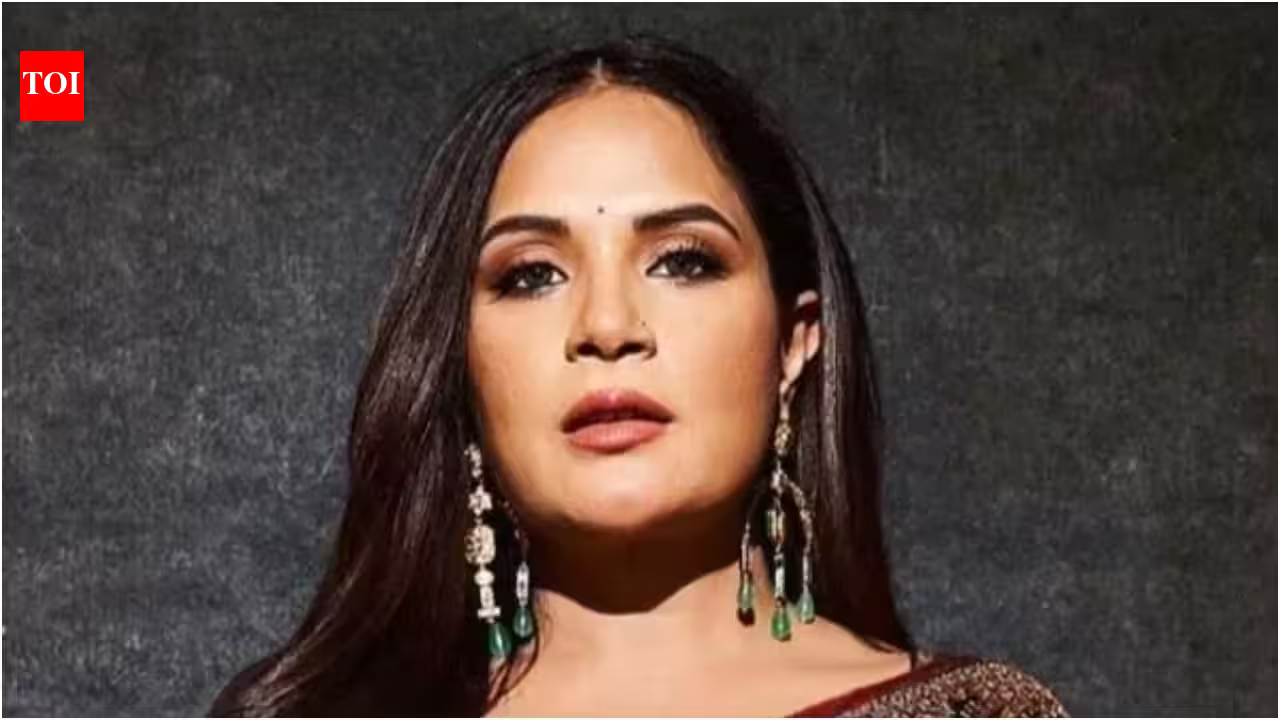
The glare of the spotlight has always been unforgiving for women in Bollywood, but in recent years, the theater of scrutiny has shifted from the glossy pages of gossip magazines to the unfiltered, vitriolic corridors of social media. The latest target? The postpartum bodies of some of India’s biggest stars. But as the internet dissects the “bounce-back” journeys of icons like Katrina Kaif, Aishwarya Rai Bachchan, and Kareena Kapoor Khan, actor and producer Richa Chadha has decided she has seen enough.
In a candid, no-holds-barred conversation that has sent ripples through the entertainment circuit, Chadha—who welcomed her own child in 2024—refused to mince her words. She turned the camera back on the trolls, painting a portrait of the “common man” that is far less flattering than the images they feel entitled to critique.
The Myth of the ‘Industry Standard’
For decades, the narrative has been that the film industry is a predatory machine, constantly demanding that its leading ladies snap back to pre-pregnancy weights within weeks of giving birth. While the pressure to maintain an aesthetic image is undeniably high in show business, Chadha argues that we have been pointing our fingers in the wrong direction.
“I don’t think women should listen to anybody commenting on their body,” Chadha asserted in an interview with India Today. She draws a clear line between the professional environment and the digital mob. According to Chadha, the film industry has been, and remains, deeply respectful of women who balance the monumental task of motherhood with their careers. She cites a lineage of powerhouse performers—from Madhuri Dixit and Juhi Chawla to Rani Mukerji—as proof that the industry celebrates women at every stage of their lives.
The real villain, she suggests, isn’t the director on set or the producer in the boardroom; it’s the anonymous keyboard warrior hiding behind a screen.
Unmasking the Keyboard Warrior
Chadha’s most stinging rebuke was reserved for the segment of the public that feels emboldened to judge the physical appearance of global icons. Her description of the stereotypical troll is stark and intentionally provocative: “It’s the common man of India who is ugly and balding and has a disgusting paunch who thinks that commenting on Katrina Kaif or Aishwarya Rai is somehow making his life better.”
It is a refreshing, if blunt, redirection of the blame. By highlighting the irony of men—who often fall short of the very physical standards they demand of women—critiquing the likes of Miss World and Miss Universe winners, Chadha exposes the deep-seated misogyny and projected insecurities fueling these comments. To her, these people aren’t just critics; they are “beggars in their own lives” who use social media to feel a fleeting sense of power by tearing down the unattainable.
The Power of Disengagement
Perhaps the most significant takeaway from Chadha’s stance is her refusal to grant the trolls the one thing they crave: attention. She likens the obsession with celebrity post-baby bodies to “useless things from losers,” and questions why anyone would dedicate mental energy to the opinions of strangers.
“It’s up to you, what pressure you take,” she says, emphasizing that the burden of the “bounce-back” culture is only as heavy as we allow it to be. She acknowledges the different paths women take—whether it’s hitting the gym, opting for medical assistance like Ozempic, or simply focusing on recovery. Her point is clear: it is a deeply personal journey that should be exempt from public commentary. When the noise becomes too loud, the solution isn’t to justify one’s appearance; it’s to render the critics irrelevant by ignoring them entirely.
From ‘Heeramandi’ to ‘Musafiri’: A Creative Evolution
Beyond the social commentary, Chadha’s life is currently defined by a massive creative evolution. Having stepped into the role of a producer with the critically acclaimed Girls Will Be Girls, she has proven that she isn’t just a voice for change in front of the camera, but a force behind the scenes as well.
Her recent output reflects a desire to push boundaries. From her commanding performance in the sprawling historical epic Heeramandi to the release of Taps, a poignant queer love story, Chadha is clearly operating in a space where creative satisfaction matters more than commercial vanity. Her latest endeavor, the web series Musafiri, is currently making waves on YouTube, signaling her transition into more accessible, documentary-style, and character-driven storytelling.
As she navigates the dual roles of a new mother and a producer, Chadha’s perspective on the world is clearly shifting. She speaks about how motherhood has made her more intentional, more selective about the content she consumes, and more protective of the narratives she helps create. She has expressed a keen desire to take Musafiri beyond the boundaries of Bombay, suggesting an ambition to engage with audiences that aren’t just trapped in the echo chamber of big-city cynicism.
The Future of Public Discourse
Richa Chadha’s intervention into the conversation surrounding postpartum body-shaming serves as a wake-up call for the digital age. By calling out the toxicity of anonymous online commentary, she isn’t just defending her peers; she is challenging the societal entitlement that has allowed body-shaming to become a normalized form of “entertainment.”
The industry may have its flaws, but as Chadha points out, the real ugliness often lies not in the stars under the lights, but in the shadows of the comments section. As for the women who are currently under the microscope? Her advice is simple: keep working, keep mothering, and let the losers shout into the void. Their opinions, after all, have never really mattered.
Disclaimer: This content is auto-generated for informational purposes only.
Source: Read Original News