






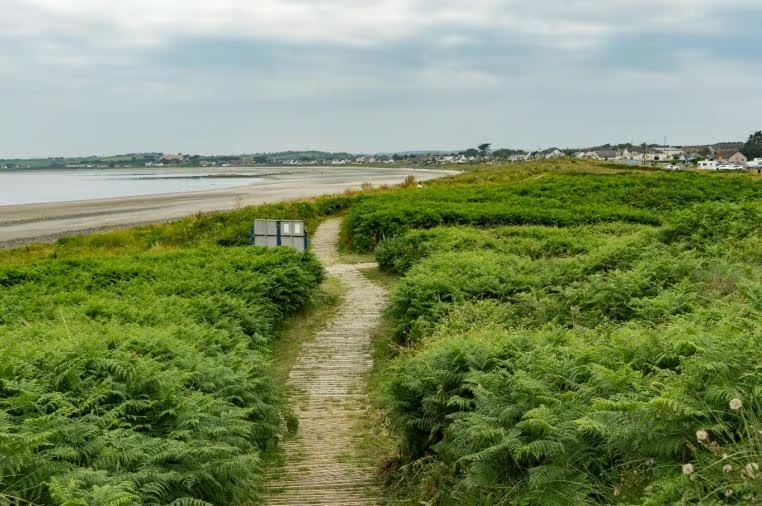
A fierce environmental row has erupted within Ards and North Down Borough Council, as opponents challenge a DUP-led push to introduce mechanical beach-cleaning equipment across the region’s coastlines. Critics claim the initiative is both prohibitively expensive and ecologically damaging, arguing that the drive to “prettify” beaches will come at the cost of vital local biodiversity.
The controversy centres on the proposed purchase of a mobile biosecurity wash-down unit and a mechanical beach cleaner, with an estimated initial capital cost of £125,000. Council officers have formally advised against the move, noting that no budget for such capital expenditure currently exists. Furthermore, experts have cautioned that the project faces significant legislative and environmental hurdles.
In an October report to the Environment Committee, council officers recommended a “phased, nature-based management approach” instead, citing the sensitivity of the four targeted locations: Millisle, Cloughey, Seapark, and Portavogie. All four sites are either within or affected by protected marine, coastal, or bird designations. Officers warned that any mechanical intervention would be subject to rigorous regulatory oversight, including marine licensing and habitat regulation assessments. Consultation with the Northern Ireland Environment Agency (NIEA) reinforced these concerns, with officials stating that environmental designations would likely make obtaining approval for regular cleaning difficult, if not impossible, to achieve.
Despite these warnings, DUP Alderman Robert Adair has spearheaded the move to acquire the machinery. Alderman Adair argues that the council is failing in its duty to maintain the coastline, asserting that residents and tourists alike are demanding cleaner beaches. “What we are asking for is not something new,” Adair stated during the October meeting, drawing comparisons to practices in other council areas. He warned that without action, the borough’s beaches would fall into “wrack and ruin.”
The proposal has faced stiff opposition from across the political spectrum. UUP Councillor Peter Wray expressed concerns regarding the practicality of the investment, suggesting that strict regulations might render the expensive equipment unusable for much of the year. Alliance Alderman Lorna McAlpine echoed these sentiments, questioning whether the machinery would simply end up sitting idle. “We need to think of other ways of doing what we need done,” she said, stressing the council’s role as custodians of the environment.
Other councillors highlighted the ecological risks of disturbing natural coastal processes. Independent Councillor Tom Brady pointed out that removing seaweed and dune vegetation—often perceived as “mess”—is actually counterproductive to fighting coastal erosion, as this organic material serves as a vital natural defence.
The debate has also focused on the financial prudence of the project. Green Party Councillor Lauren Kendall expressed strong opposition to the expenditure, particularly during a time of economic hardship. “As we move into winter, I hear from community groups and charities that they are going to be struggling to help people with their heating and eating, and then I am told we will be spending £125,000 on a beach cleaner,” she said.
The committee vote was deeply polarized, ending in a six-to-six deadlock. The tie was ultimately broken by the committee chair, DUP Councillor Alastair Cathcart, who voted in favour of the motion. While the proposal currently holds an “in-principle” agreement, the final decision rests with a vote at the full council meeting later this month. Should opposing parties maintain their unified stance, the plan to introduce mechanical cleaning could still be overturned, leaving the future of the Ards and North Down coastline a point of contention between aesthetic management and environmental preservation.
Disclaimer: This content is auto-generated for informational purposes only.
Source: Read Original News