









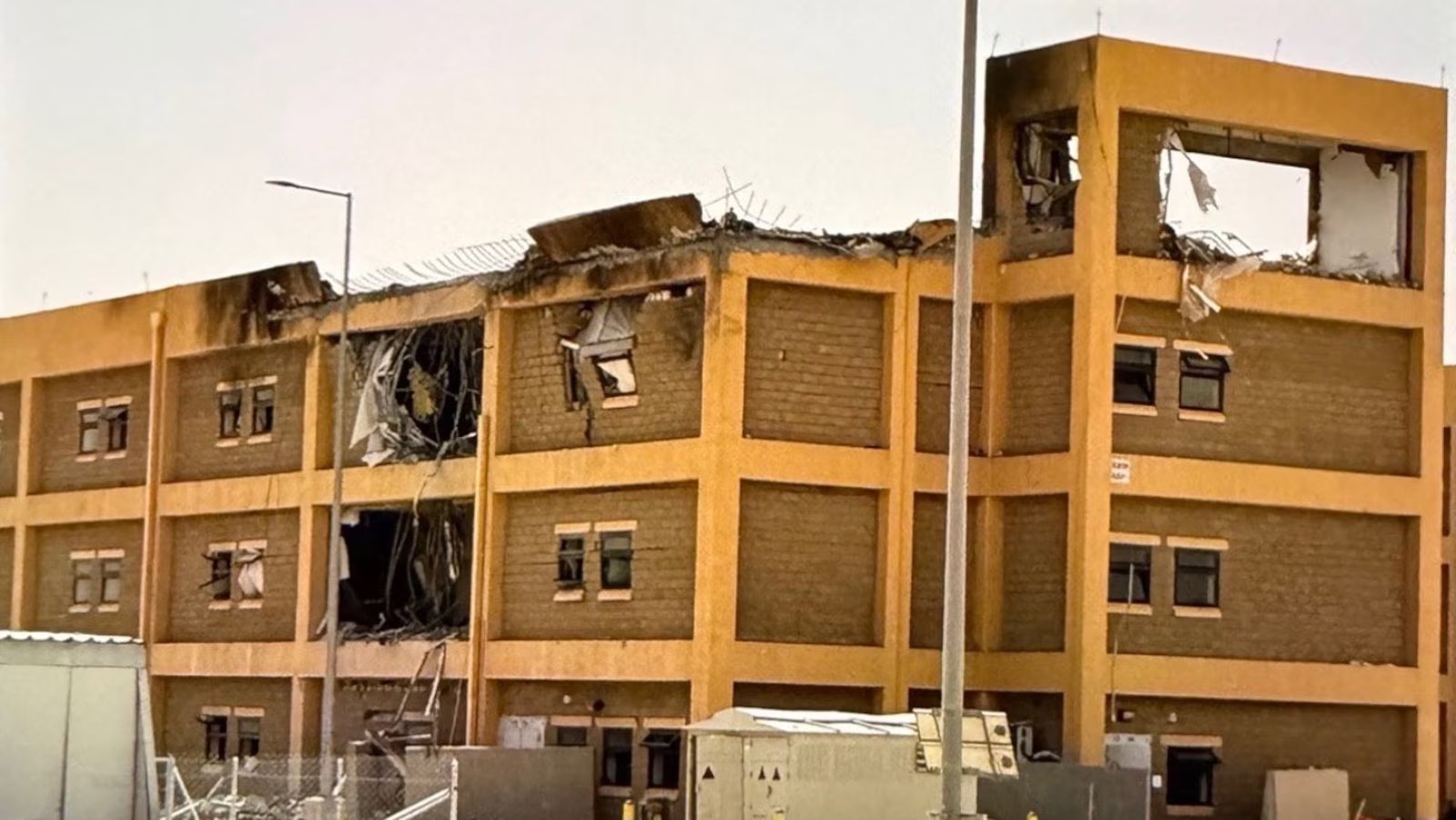
Newly obtained images and videos have exposed the significant and potentially long-term damage sustained by U.S. military installations across the Middle East following a series of Iranian attacks. The visual evidence, which captures the ongoing impact of a conflict now stretching past its six-month mark, highlights structural destruction at three U.S. bases in Kuwait and a key facility in Saudi Arabia.
Despite official Pentagon efforts to downplay the extent of these offensive operations, the severity of the damage suggests a monumental recovery challenge. A senior U.S. service member, speaking on the condition of anonymity, provided a sobering assessment of the situation, stating that the damage to these facilities is so profound that it would take “decades” to fully repair.
“I believe the American people are unaware of the extent of the damage that American bases are taking in the region right now,” the service member told ABC News. “These bases have been irreparably damaged. If we choose to rebuild them, it’s going to be a decades-long undertaking. This is not something that’s going to be fixed in six months; we’re talking about years and years of construction to reestablish what’s been destroyed.”
Satellite imagery and internal reports confirm the scale of the crisis. A recent Pentagon inspector general report revealed that “hundreds of buildings and structures” have been damaged across various U.S. outposts in Kuwait, Bahrain, Qatar, the UAE, Saudi Arabia, Iraq, Oman, and Jordan. While the Pentagon estimates the cost of this conflict at roughly $33 billion, the nonpartisan Congressional Budget Office projects the figure could be as high as $38 billion.
The cost of the war is measured not only in infrastructure but in human lives. According to the Defense Department, 18 service members have been killed and 824 wounded since hostilities commenced on February 28. The deadliest single incident occurred on the second day of the conflict, when six U.S. soldiers were killed in an attack on a largely unfortified location at Port Shuaiba in Kuwait.
Among the recently surfaced photos is an image of an E-3 Sentry—a sophisticated surveillance aircraft valued at $270 million—damaged while stationed at Prince Sultan Air Base in Saudi Arabia. This destruction comes despite Defense Secretary Pete Hegseth’s previous assertions that force protection remains a top priority, though he acknowledged that Iran’s powerful weapons are occasionally capable of penetrating U.S. defenses.
The conflict continues to fluctuate, marked by intermittent exchanges of fire since a ceasefire in April. The U.S. has focused largely on maritime targets near the Strait of Hormuz, while Iranian forces continue to launch strikes against land-based assets in Jordan, Iraq, and beyond. As the situation persists, the service member who spoke with ABC News warned that the reality on the ground remains largely hidden from the public, noting that drone and ballistic missile strikes continue to land on U.S. bases “every day.”
Disclaimer: This content is auto-generated for informational purposes only.
Source: Read Original News