








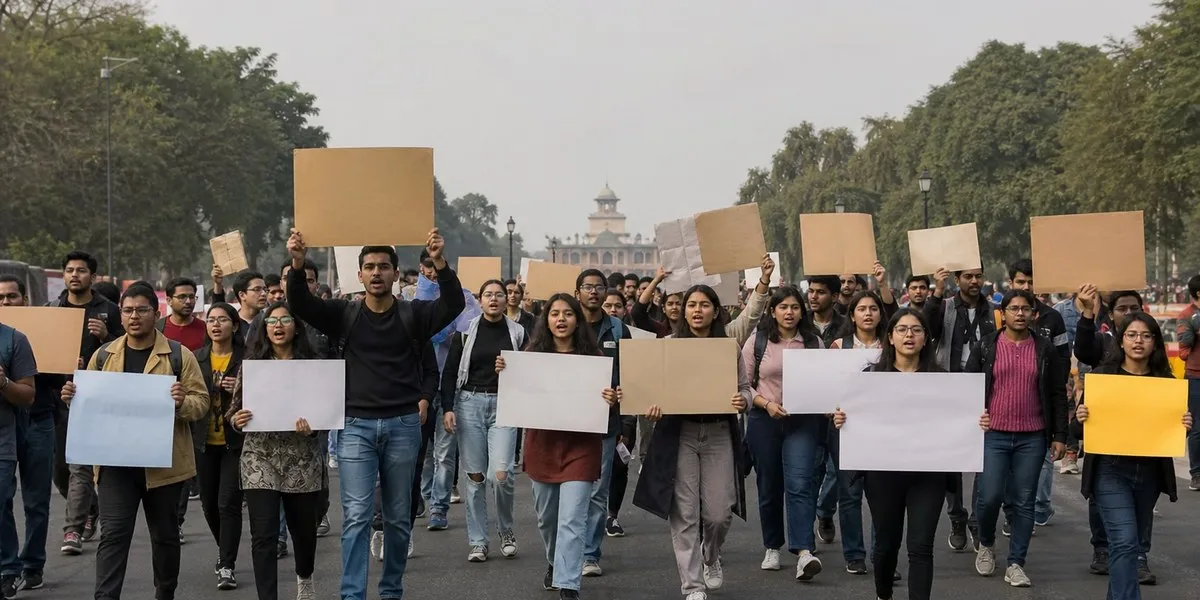
Delhi Streets Erupt in Protest as New Wave of Sexual Violence Sparks National Outrage
The streets of India’s capital are once again echoing with the chants of angry protesters, as a harrowing series of sexual violence cases has reignited a desperate national debate over women’s safety. Hundreds of students gathered in central Delhi on Wednesday, marching to demand urgent legislative and security action following the alleged gang-rape of a 17-year-old girl by three men posing as police officers in a public park.
This latest atrocity has struck a raw nerve, drawing immediate parallels to the horrific 2012 Delhi bus gang-rape case—a tragedy that once forced the nation to confront its failure to protect its daughters and led to landmark overhauls of the Indian penal code.
A Crisis of Numbers
The grim reality behind the protests is reflected in the statistics. Official records indicate that India averages 80 registered rape cases every single day in 2024, a significant rise from the 68 cases reported daily in 2012. However, these figures are widely regarded by human rights activists as a conservative estimate. Due to the deep-seated stigma prevalent in India’s patriarchal social structure, a vast number of sexual crimes remain buried, with victims too terrified or shamed to approach law enforcement.
The recent spike in violence has been particularly chilling. Beyond the park assault, authorities are investigating the rape and murder of a 16-year-old whose decomposed body was recovered recently, as well as the attack on another 17-year-old girl who was allegedly raped by a bus driver and conductor after they offered her shelter during a torrential downpour. From Delhi to Bihar, where a disturbing video of violence against a minor recently surfaced, the pattern suggests a systemic breakdown in safety.
The Gap Between Law and Reality
In the aftermath of the 2012 uprising, the government moved swiftly to demonstrate its commitment to change. Laws were significantly tightened: the definition of sexual assault was expanded to include specific provisions on consent and penetration, and penalties were increased to a minimum of 20 years for gang rape, with the death penalty now a possibility for repeat offenders.
Despite these legislative milestones, experts argue that the policy landscape is failing to translate into justice. The central bottleneck remains the enforcement mechanism. Legal experts point out that the conviction rate for sexual assault cases remains stalled at roughly 25% of cases that reach a courtroom. The judicial system is severely overburdened, with current data from 2024 showing that fewer than 10% of more than 200,000 pending rape cases have reached a resolution.
Beyond Legislation
Legal advocates and women’s rights leaders are now calling for a shift in focus. Shilpi Jain, a lawyer who has spent years representing survivors, warns that the system is buckling under the weight of overcrowded courts and an overstretched police force.
Activists like Yogita Bhayana and Poonam Muttreja argue that tougher laws act only as a band-aid on a much deeper wound. They contend that sustainable safety can only be achieved through a radical shift in public attitudes. According to these advocates, the fight against sexual violence must move beyond the courtroom and into the classroom, the family unit, the digital sphere, and, perhaps most critically, the internal culture of the police system itself.
For the students marching through Delhi, the message is clear: laws on paper are meaningless without a societal and structural overhaul to ensure that the fear currently defining the lives of Indian women is replaced by justice and security.
Disclaimer: This content is auto-generated for informational purposes only.
Source: Read Original News