









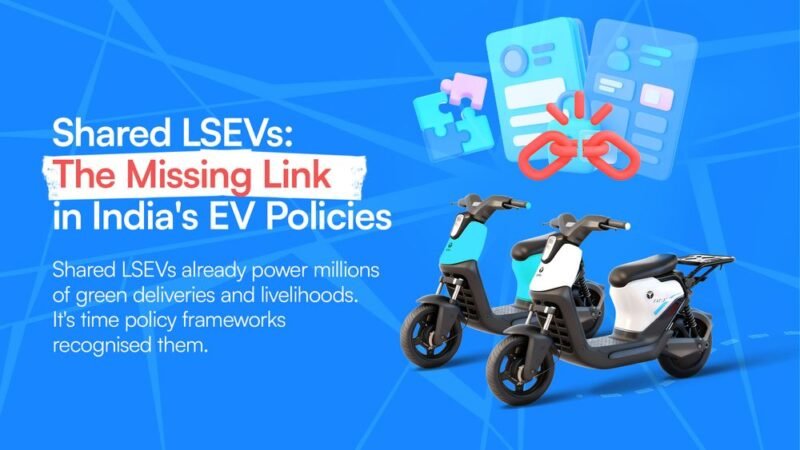
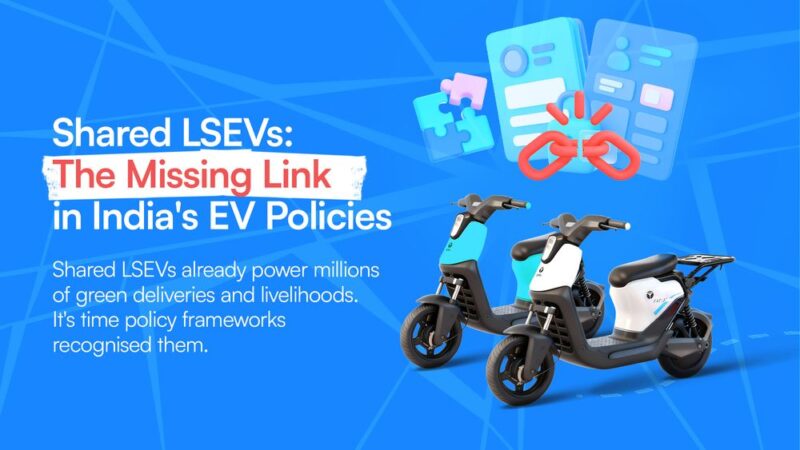
Shared EV platforms are breaking down barriers to affordable, convenient, and sustainable mobility while delivering meaningful environmental and social benefits for cities. Yulu, for instance, with a fleet of 50,000 EVs, facilitates over 2.4 million kilometres of rides and helps avoid nearly 65,000 kg of CO₂ emissions every day. It also enables more than 20 million green deliveries every month and has supported more than 5 lakh gig workers till date, enabling them to enhance their delivery earnings through accessible and reliable mobility. At a broader level, shared EV services are playing an important role in accelerating India’s transition towards its 2070 net-zero emissions goal.
Yet when it comes to fleet electrification targets, incentives, and compliance reporting, shared LSEVs remain largely outside the policy lens. If India wants to accelerate EV adoption meaningfully in the urban mobility mix, this has to change.
The Policy Gap in Fleet Electrification
India’s EV policies have rightly focused on accelerating electrification across urban logistics and last-mile delivery. However, the emphasis has typically been on subsidising EV purchases rather than promoting shared EV usage, which often delivers higher utilisation and greater sustainability benefits.
For example, Delhi’s draft EV Policy focuses primarily on mainstream EV adoption and commercial fleets. Similarly, Haryana’s new Motor Vehicle Policy rightly promotes EV fleet adoption, but does not explicitly recognise shared LSEVs despite more than 15,000 delivery riders across NCR already relying on them for last-mile deliveries.
In space-constrained cities, LSEVs help reduce congestion, improve utilisation of urban infrastructure and provide affordable access to clean mobility. Despite this, most EV policy frameworks continue to measure progress primarily through vehicle ownership rather than sustainability outcomes such as green deliveries enabled, fossil-fuel kilometres displaced or emissions reduced. As a result, deliveries completed using shared LSEVs often remain outside fleet electrification calculations even though they achieve the same zero-emission outcome.
In effect, policy measurement is lagging behind how urban mobility actually functions today.
Powering Inclusion and Livelihoods
A stronger policy push for shared EVs will also advance the government’s goals around economic inclusion and livelihood creation.
Behind India’s quick commerce and delivery economy is a vast workforce of riders, many of whom cannot afford vehicle ownership or face barriers such as financing, maintenance costs and operational downtime. Shared LSEV platforms remove these barriers by providing affordable access to purpose-built electric vehicles, battery-swapping infrastructure and integrated operational support.
Importantly, shared mobility expands access to groups that are often excluded from traditional vehicle ownership models, including first-time earners, lower-income workers and women seeking independent mobility options. At the same time, LSEVs offer significantly lower operating costs than conventional vehicles and standard EV two-wheelers, improving earnings for delivery partners while creating better economics for businesses.
India’s urban mobility future will increasingly depend on access rather than ownership. Shared mobility platforms solve multiple barriers simultaneously, including affordability, vehicle access, energy infrastructure support and operational uptime.
If a delivery is completed using a shared electric vehicle, it should contribute towards green mobility compliance regardless of who owns the vehicle. Hence, recognising shared LSEVs within fleet electrification frameworks would provide a more accurate picture of the environmental progress already being achieved on the ground.
Building Policy Around How Cities Actually Move
Urban mobility in India is evolving rapidly. Quick commerce, hyperlocal logistics and on-demand services have fundamentally changed how vehicles operate within cities.
Policy frameworks must evolve alongside these realities and evaluate mobility systems based on measurable sustainability outcomes rather than ownership alone. After all, cities do not simply need more EVs; they need high-utilisation mobility infrastructures that combine accessibility, clean energy and operational efficiency at scale.
This article was originally published by Yulu.