








AUCKLAND — The Eden Park outfield was a hive of controlled intensity this week as the Indian cricket team touched down and immediately went to work. With a five-match ODI series against New Zealand looming, the squad’s opening training session wasn’t focused on heavy hitting or seam movement, but rather the fundamental art of ground fielding.
Under the watchful eye of fielding coach Subhadeep Ghosh, players were divided into quartets, tasked with sprinting between cones to intercept deliveries fired with precision by the support staff. The drill, which lasted half an hour, was deceptively simple but tactically vital: players were mandated to communicate with clear, loud calls and, most importantly, to intercept the ball while running in a perfectly straight line.
### Mastering the Eden Park Geometry
For a team accustomed to the standardized bowls of major subcontinental stadiums, Auckland presents a unique environmental challenge. Eden Park is notorious for its irregular dimensions and tricky floodlight patterns, which often play tricks on the eyes of outfielders. The “deeper pockets” of the ground offer prime opportunities for batters to stretch singles into twos, turning every fielding lapse into a potential match-deciding error.
Former Indian fielding coach R. Sridhar, who guided the team through previous tours of New Zealand, highlighted “cutting the angles” as the primary objective for the tourists.
“Cutting the angle means running in straight lines. Simple. You assess the speed of the ball and the dimensions, and then you run towards the ball in a straight line,” Sridhar told reporters. “Awareness and the ability to take off quickly—these are the real tests at a venue like this. It’s not just about speed; it’s about geometry and reading the flight of the ball against the stadium’s backdrop.”
### The Catching Efficiency Crisis
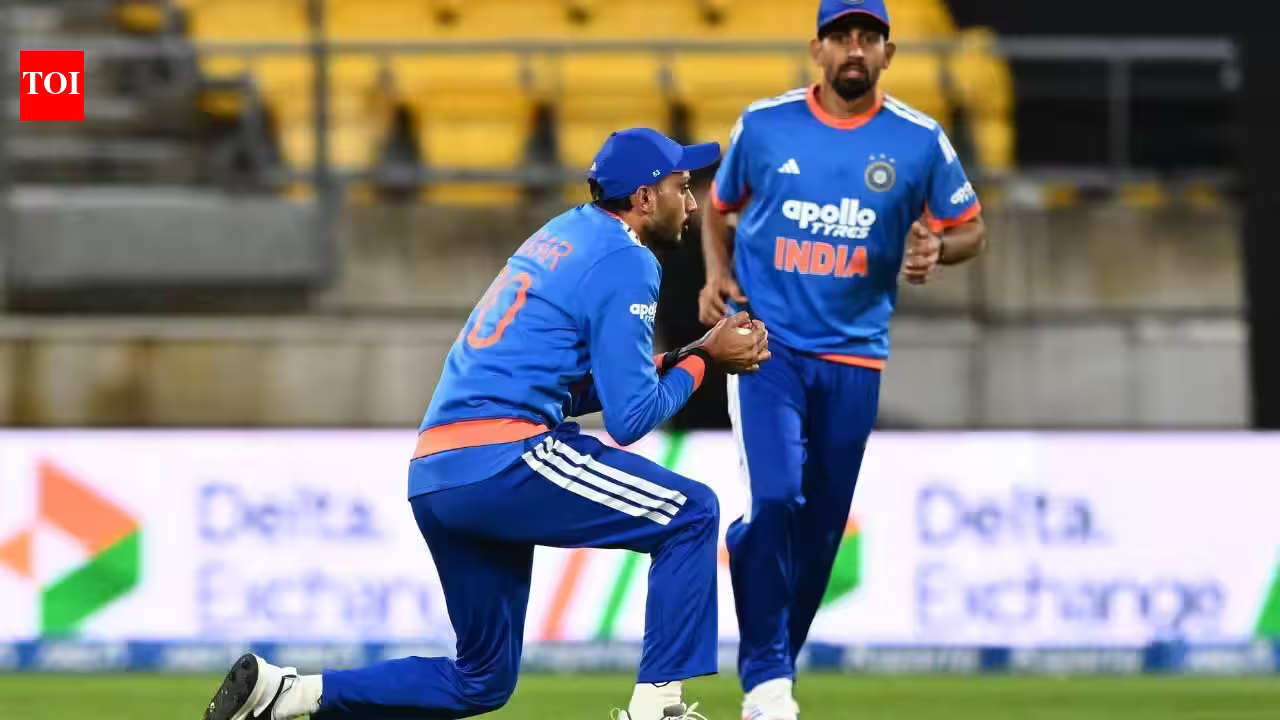
While the intensity of the drill suggested a renewed focus, the stakes are undeniably high. India’s fielding standards, once the envy of the cricketing world, have shown signs of fraying. Recent statistics reveal a concerning trend in the 50-over format: since the change in captaincy, India has dropped 27 catches in just 18 ODIs, yielding a lackluster catching efficiency of 77.5%.
The internal data tells a story of mixed fortunes. KL Rahul and spinner Kuldeep Yadav have faced criticism for their spill rates, with Kuldeep recording five drops in 11 matches and Rahul four in 16. On the other side of the ledger, skipper Rohit Sharma remains a beacon of consistency, securing 15 catches with only two misses in the same period.
The team management is clearly aiming to tighten these margins before the series begins on Wednesday. In a five-match series, where fine margins often dictate the trajectory of the scoreboard, “catching efficiency” is no longer just a metric—it is a survival requirement.
### Navigating the Tour’s Variables
The series will be a tour of contrasting conditions. After the opening clash at the peculiar Eden Park, the caravan moves to Wellington, a city famous for its swirling, unpredictable winds, and then on to the traditional Seddon Park in Hamilton. The marathon series concludes at the picturesque Bay Oval in Mount Maunganui.
Sridhar, however, believes that the current squad possesses the requisite depth and experience to handle the transition between these venues.
“Each venue has its own set of challenges,” Sridhar explained. “There is wind in Wellington and the massive, distinct dimensions in Auckland. But then you have places like Bay Oval, where conditions are a bit more uniform. The players are seasoned professionals. We have the likes of Rohit, Virat [Kohli], and [Shubman] Gill—all of whom have seen these grounds before. They know exactly how to adjust.”
### Personalized Preparation
When asked if a high-volume approach to fielding practice would cure the recent lapses, Sridhar cautioned against a cookie-cutter methodology. According to the former coach, the needs of a veteran like Virat Kohli are vastly different from those of the younger generation.
“There is no one-size-fits-all approach to preparation,” Sridhar emphasized. “The volume of practice depends entirely on the player’s mental state and their specific needs at that moment. You cannot go in blindly and demand the same volume from everyone. That simply doesn’t work. We rely on the experience of our senior group to set the standard, and I am confident that as the series progresses, that experience will shine through.”
With only one training session under their belts before the Wednesday opener, the pressure is on the Indian contingent to translate the cone drills into on-field proficiency. In the windy, wide-open spaces of New Zealand, the difference between a series win and a disappointing exit may well be found in the milliseconds it takes for a fielder to calculate their line and secure a catch.
Disclaimer: This content is auto-generated for informational purposes only.
Source: Read Original News