







When the Ganglands of Mirzapur Met the Critic’s Naptime
In the world of Indian streaming, few properties carry the sheer, unadulterated weight of the Mirzapur franchise. It is a beast of a brand—a gritty, gun-toting, expletive-laden odyssey through the heart of Uttar Pradesh that turned Amazon Prime Video into a household name in India. But when the dust settled on three explosive seasons, the creators decided to pull a fast one on the audience: they moved the chaos from the small screen to the silver screen.
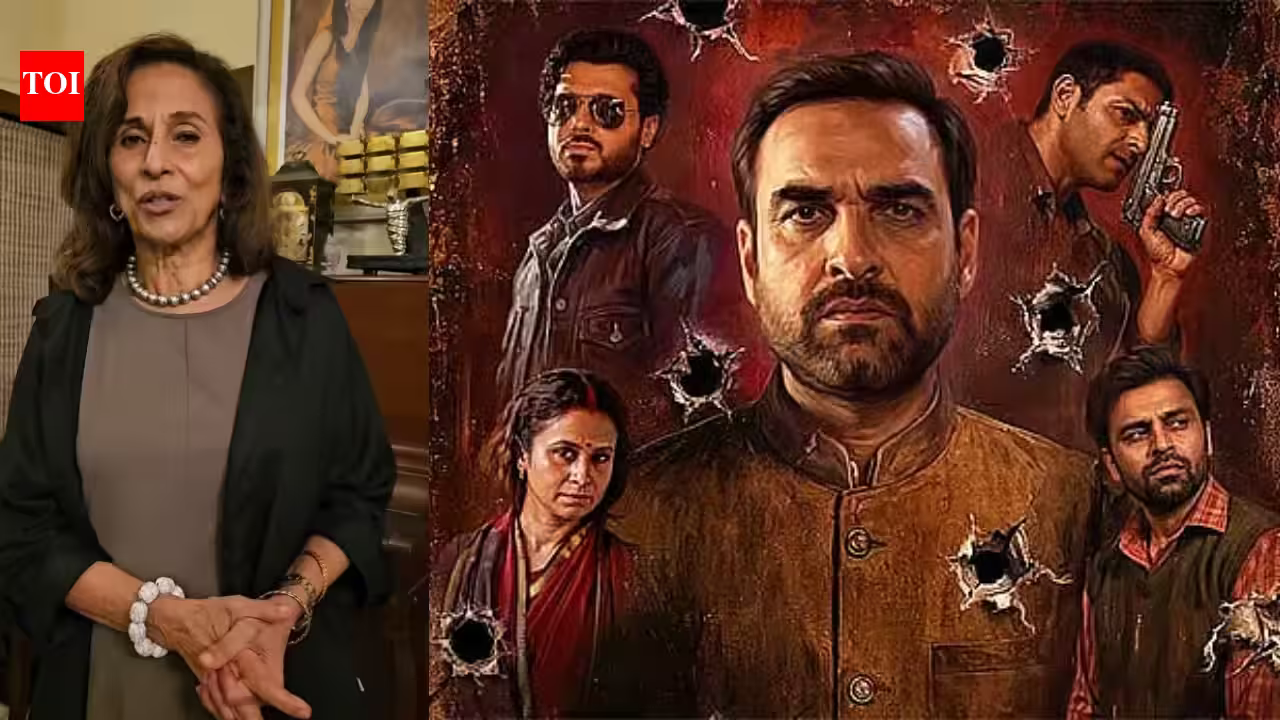
Enter Mirzapur: The Movie, a theatrical behemoth that promised to scale up the stakes. But for veteran columnist and social commentator Shobhaa De, the transition wasn’t just underwhelming—it was, by her own admission, a four-hour endurance test that ultimately resulted in a mid-movie nap.
A Critic’s Cold Shower: The Rs 1,160 Question
Most cinematic reviews focus on cinematography, pacing, or thematic depth. De, however, chose to frame her critique through the lens of a disgruntled consumer. In a social media post that has sent ripples through the Mirzapur fandom, she tallied up the cost of her cinematic excursion: Rs 900 for a ticket and Rs 260 for a bowl of bhel.
The math, according to De, simply didn’t add up. After four hours of watching what she described as “multiple set pieces randomly strung together,” the veteran journalist found herself questioning the very existence of the project. It wasn’t just a critique of the plot; it was a critique of the sheer excess. When a film demands a four-hour commitment from an audience, it usually promises an epic. De, however, walked away feeling that the epic was, in fact, an empty exercise in violence.
The Performance Paradox: Praise Amidst the Pout
It would be a mistake to dismiss De’s critique as a blanket dismissal of the talent involved. In fact, her review provides a nuanced—if stinging—look at the performances that carry the film. She didn’t hold back in acknowledging the prowess of the leading men, Ali Fazal and Ravi Kishan.
Fazal, reprising his iconic role as the volatile Guddu, earned high marks from the critic for a performance she deemed “unbelievably good.” Similarly, Ravi Kishan’s turn as the antagonist Babban Babua Yadav was branded “brilliant.” It is clear that while De found the structure of the film wanting, she remained susceptible to the raw magnetism of the cast.
However, the real controversy in her assessment was reserved for the man who is synonymous with the Mirzapur brand: Pankaj Tripathi.
Is Kaleen Bhaiya Losing His Edge?
For years, Pankaj Tripathi’s portrayal of Kaleen Bhaiya has been the bedrock of the franchise—a stoic, menacing, and impossibly calm puppet master. But even icons can suffer from the law of diminishing returns. De was pointed in her assessment, suggesting that “Mr. Tripathi playing Mr. Tripathi has become a bit too monotonous.”
She argued that the character’s delivery and expressions, which were once fresh and terrifying, have begun to feel repetitive. Perhaps more shocking was her reaction to the intimate scenes between Tripathi and Rasika Dugal’s character, Beena Tripathi. De, who referred to Tripathi as “Mr. Goodie-Goodie,” seemed caught off guard by the actor’s foray into explicit territory. Her reading of Beena—comparing her to a “Lady Macbeth” figure—adds a layer of complexity to the critique, even if she found the execution of their storyline to be lacking the necessary punch to justify the runtime.
The Gender Divide and the Snoring Section
Perhaps the most stinging indictment of Mirzapur: The Movie was De’s observation that she wasn’t alone in her slumber. Claiming to have fallen asleep for roughly 15 minutes, she noted that the women seated behind her were audible in their own exhaustion, snoring through the carnage.
“Maybe, it’s meant for men,” she mused. It is a provocative statement that cuts to the heart of the Mirzapur demographic. The franchise has always leaned heavily into hyper-masculine tropes—blood, betrayal, and bro-code. By suggesting that the film failed to bridge the gap to a broader, more diverse audience, De is highlighting a potential fatigue within the genre. When the violence becomes “violence of every conceivable kind for no reason,” as she put it, the novelty wears thin for anyone not already intoxicated by the brand’s specific brand of testosterone-fueled storytelling.
Randomness vs. Narrative: The Final Verdict
The questions raised in De’s Instagram caption—the presence of a dwarf, the odd inclusion of camel’s milk, and a villain who stitches lingerie for his love interest—speak to a broader concern about the film’s tonal consistency. When a franchise moves to the big screen, there is often a temptation to throw everything at the wall to see what sticks. De’s review suggests that Mirzapur: The Movie suffered from this “everything-but-the-kitchen-sink” approach.
Whether one agrees with her assessment or finds her critique too harsh, the review acts as a mirror for the current state of franchise cinema in India. As big-budget sequels and spin-offs continue to dominate, the conversation about what constitutes a “theatrical experience” is shifting. For Shobhaa De, the experience ended not with a bang, but with a nap, a bill for over a thousand rupees, and a lingering question that the film simply couldn’t answer: Why was this made?
In the battle between the massive box-office hype and the discerning critic, it seems that Mirzapur: The Movie has found itself caught in a crossfire that no amount of gunfire or grit can easily resolve. While the franchise remains a powerhouse, De’s words serve as a stark reminder that even the most loyal fanbases can be pushed to the brink when the story, quite literally, goes nowhere.
Disclaimer: This content is auto-generated for informational purposes only.
Source: Read Original News