







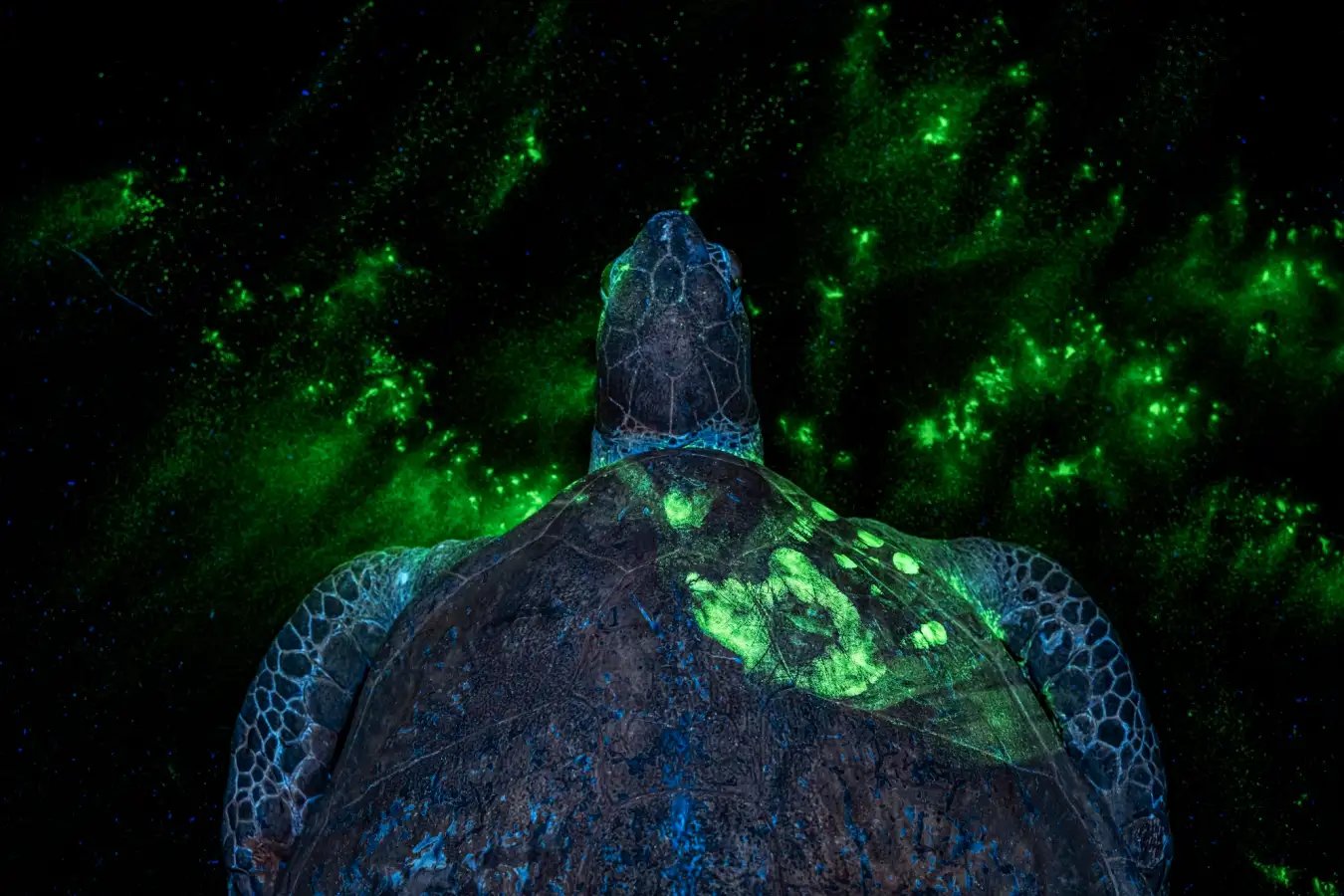

The winning photograph, Handprint on Sea Turtle by Britta Jaschinski
Britta Jaschinski/Environmental Photography Award 2026
The illegal trade in live and dead animals funds crime and political corruption and threatens biodiversity. Sadly, prosecutions are rare.
Alexandra Thomas and Louise Gibson at the Zoological Society of London (ZSL) Wildlife Forensic Lab are working on techniques to change that.
This image of a green sea turtle (Chelonia mydas) shows a glowing handprint, revealed by a special fluorescent powder dye photographed under ultraviolet light, which may serve as forensic evidence to help catch poachers and animal traffickers. Under UV, certain chemicals can also reveal blood and other bodily fluids, and gunpowder residues.
The image, taken by Britta Jaschinski, is the overall winner in this year’s Prince Albert II of Monaco Foundation’s Environmental Photography Award.
Jaschinski says the dead turtle was confiscated at London’s Heathrow Airport and transported to ZSL, but that details about how the handprint was left on the turtle, and by whom, are “highly confidential”.
“Many species, from well-known animals like elephants and rhinos to lesser-known ones like pangolins, are pushed toward extinction by illegal hunting, causing lasting damage to global biodiversity,” says Jaschinski. “Beyond environmental harm, the illegal wildlife trade fuels organised crime and poses risks to people. It is one of the world’s largest illegal industries, often linked to corruption and criminal networks. It also contributes to the spread of diseases that can jump from animals to humans, increasing the risk of pandemics.”
Sergio Pitamitz, a conservation photographer who chaired the prize, said in an announcement about Jaschinski’s win that her approach when documenting crimes against wildlife “avoids graphic or sensational imagery, instead producing photographs that communicate clearly and effectively to a wide audience”.

Shearwater’s Dilemma, by Henley Spiers
Henley Spiers/Environmental Photography Award 2026
The competition’s ocean category was won by Henley Spiers for his shot of a wedge-tailed shearwater (Ardenna pacifica) plunging into a football pitch-sized school of lanternfish, shown above.
The bird surfaced without catching anything and circled back for another dive. Lanternfish are thought to be the most numerous vertebrates on Earth, accounting for up to 65 per cent of deep-sea fish biomass.
The prize for the polar regions category went to Vadim Makhorov for his photograph of a group of Pacific walruses (Odobenus rosmarus divergens), below. These are the largest of the two species of walrus, with males reaching up to 4 metres in length and weighing as much as 1.5 tonnes.

The Gathering by Vadim Makhorov
Vadim Makhorov/Environmental Photography Award 2026
Makhorov’s photograph was captured on Ratmanov Island, or Big Diomede, the easternmost part of Russia. The island’s entire southern coastline is occupied by walruses, most of them males. Female walruses only come ashore during the breeding season.
Runner-up in the changemaker category is Maud Delaflotte’s image of black soldier flies (Hermetia illucens), shown below. Feeding insect protein to farmed animals could be a more environmentally friendly alternative to traditional sources like fishmeal and soya.

Insects, Architects of a Sustainable Future by Maud Delaflotte
Maud Delaflotte/Environmental Photography Award 2026
Topics: