









The Evolution of Automated Vulnerability Research
The cybersecurity landscape has reached a significant inflection point with the introduction of an agentic pipeline designed by OpenAI to automate the discovery and remediation of software flaws. In a demonstration of advanced machine learning capabilities, the organization utilized a specialized cyber-focused artificial intelligence model to identify, analyze, and patch 948 local privilege escalation (LPE) vulnerabilities within the Linux kernel. This represents a massive shift in how security research is conducted, moving from manual, labor-intensive code auditing to high-speed, automated pipeline execution.
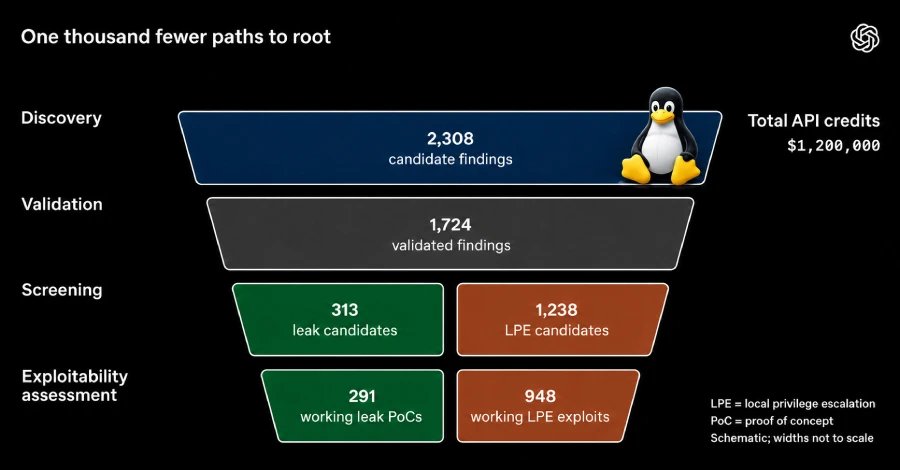
The pipeline processes these vulnerabilities through a multi-stage architecture. Initially, AI agents scan the codebase to identify high-value targets, specifically focusing on areas accessible to low-privileged users. Once a potential weakness is identified, the system moves to a dynamic validation phase. In this step, the agents recreate the vulnerability in a controlled, sandboxed environment to confirm its existence and capture runtime data. Following validation, the system assesses the exploitability of the defect, creating a proof-of-concept (PoC) to demonstrate the risk. Finally, the pipeline generates a functional patch, which then undergoes a critical human review process to ensure the fix is secure and compatible before being submitted to software maintainers.
Inside the 30-Hour Discovery Marathon
The efficiency of this automated approach is highlighted by the scale of the recent testing cycle. In a single execution run spanning only 30 hours, the AI pipeline processed over 2,300 candidate Linux kernel findings. Of those, the system successfully reproduced 1,724 actual vulnerabilities. By the conclusion of the process, the AI had produced 948 working LPE exploits and 291 proofs-of-concept for information leak vulnerabilities.
This rapid turnaround was achieved with an API cost of approximately $1.2 million, resulting in a breakdown of roughly $1,279 per confirmed exploit. Beyond the sheer volume of discovered bugs, the model demonstrated a high degree of technical sophistication. OpenAI reported that the agents identified at least 10 previously unknown Linux exploitation techniques. These include novel methods for kernel cache manipulation, advanced page grooming to increase the success rate of exploits, and several data-only techniques capable of bypassing existing security controls to gain elevated system privileges.
The Dual-Edged Nature of Frontier AI
While the ability to automatically generate patches is a significant boon for system administrators and software maintainers, the underlying technology presents a clear challenge for global security. The same AI capabilities that allow researchers to proactively close security gaps are available to threat actors who may utilize them to discover and weaponize zero-day vulnerabilities. Security analysis firms have already begun to categorize this type of AI-assisted discovery as a primary risk vector.
The impact of this technology is already visible in the global threat intelligence ecosystem. Data indicates that the frequency of vulnerability disclosures has surged, with the number of reported flaws more than doubling over the course of 2026. Furthermore, the subset of vulnerabilities classified as high-risk has grown by 167% within the same period. This trend suggests that the barrier to entry for performing complex, large-scale software auditing has been dramatically lowered, granting attackers the ability to find and exploit weaknesses with minimal technical background.
Redefining the Patching Lifecycle
The rise of automated vulnerability discovery has forced a reconsideration of the traditional patching window. According to the United Kingdom’s National Cyber Security Centre (NCSC), the widespread deployment of these AI tools effectively compresses the time between the existence of a zero-day vulnerability and its weaponization by malicious entities. While defenders can use these same tools to accelerate the deployment of updates, many organizations are currently failing to configure their internal infrastructure to handle this increased velocity of discovery.
The current consensus among security experts is that the traditional approach to system maintenance is becoming inadequate. When vulnerabilities can be identified and exploits generated in hours, legacy patching cycles that span weeks or months leave systems exposed. Organizations must now evolve their internal testing and deployment processes to align with the speed of AI-driven research, or risk falling victim to automated attacks that view unpatched software as a simple path to unauthorized root access.
Strategic Outlook for Future Security
Looking ahead, the integration of AI into the software development life cycle appears inevitable. OpenAI emphasizes that the primary goal is to reach a state where automated discovery is matched by equally rapid, reliable patch generation. By leveraging human expert-guided iterations, AI-generated patches can maintain functional integrity and adhere to strict coding standards while providing robust protection against potential attack variants.
For the immediate future, the reality of the threat landscape remains clear: for any system that is not updated to the latest security specifications, an unprivileged account should be treated as equivalent to total system compromise. As frontier models continue to improve in reasoning and technical execution, the focus must shift toward scaling these defensive capabilities to make it cost-prohibitive for adversaries to develop and sustain their own exploitation chains. The race is no longer just about finding vulnerabilities; it is about establishing a defensive architecture that can iterate and adapt faster than the automated agents used by malicious actors.
Disclaimer: This content is auto-generated for informational purposes only.
Source: Read Original News