








Unreal Engine 5 and the Hardware Burden
The arrival of Ace Combat 8: Wings of Theve signals a significant shift in the technical demands of flight simulators. Built upon the latest iteration of Unreal Engine 5, the title leverages advanced rendering technologies that prioritize visual fidelity and atmospheric immersion. Central to this transformation is the integration of Nanite, Epic Games’ virtualized geometry system, which allows for the rendering of complex, high-polygon environments without the traditional limitations of geometric density. Coupled with Lumen, a real-time global illumination solution, the engine creates realistic lighting, reflections, and shadows that react dynamically to the environment.
While these technologies provide unprecedented graphical clarity, they impose a rigorous computational load on consumer-grade hardware. The sheer density of environmental detail and the complexity of global lighting calculations mean that even modern graphics cards struggle to maintain high frame rates at elevated resolutions. As demonstrated by recent benchmark testing on Windows 11 24H2 with DirectX 12, the transition to high-fidelity, photorealistic gaming requires a massive leap in processing power, pushing modern GPUs to their absolute thermal and computational limits.
Benchmark Methodology and Performance Testing
To provide an accurate assessment of how current hardware handles this demanding engine, recent performance testing was conducted under strict, controlled conditions. The test rig utilized an AMD Ryzen 7 9800X3D processor, selected specifically for its high-performance characteristics to ensure that the CPU would not create a bottleneck for the graphics hardware. All tests were executed at a native 4K resolution (3840×2160) without the intervention of upscaling techniques like DLSS or FSR. By disabling these scaling features, the raw processing power of the GPU is laid bare, revealing the true capability of each card to handle the heavy geometry and lighting pipelines native to the Unreal Engine 5 environment.
The resulting data highlights a clear hierarchy of performance. While entry-level and mid-range cards struggle to provide a playable experience at these settings, the upper echelon of the market demonstrates the extreme hardware overhead required for high-resolution 4K flight simulation.
The Flagship Battle: RTX 5090 Versus the Field
Among the tested hardware, the NVIDIA GeForce RTX 5090 stands as the sole solution capable of delivering a consistently smooth experience in native 4K. With a recorded performance of 54 frames per second at the lower end and 60 frames per second on average, it represents the current peak of enthusiast-grade computing. This hardware is uniquely positioned to handle the vast draw distances and intricate volumetric effects required by Ace Combat 8, where fluid movement and consistent frame timing are essential for the overall experience.
In contrast, the previous generation’s king, the RTX 4090, demonstrates how rapidly high-end requirements are escalating. While it remains a highly capable card, it yields lower frame rates—averaging 48 frames per second—under the same conditions. This comparison illustrates that the architectural advancements in the 50-series are not merely iterative; they are essential for keeping pace with the increasing geometric and lighting complexity found in contemporary game development.
The Endurance of RDNA 3 and Current Market Dynamics
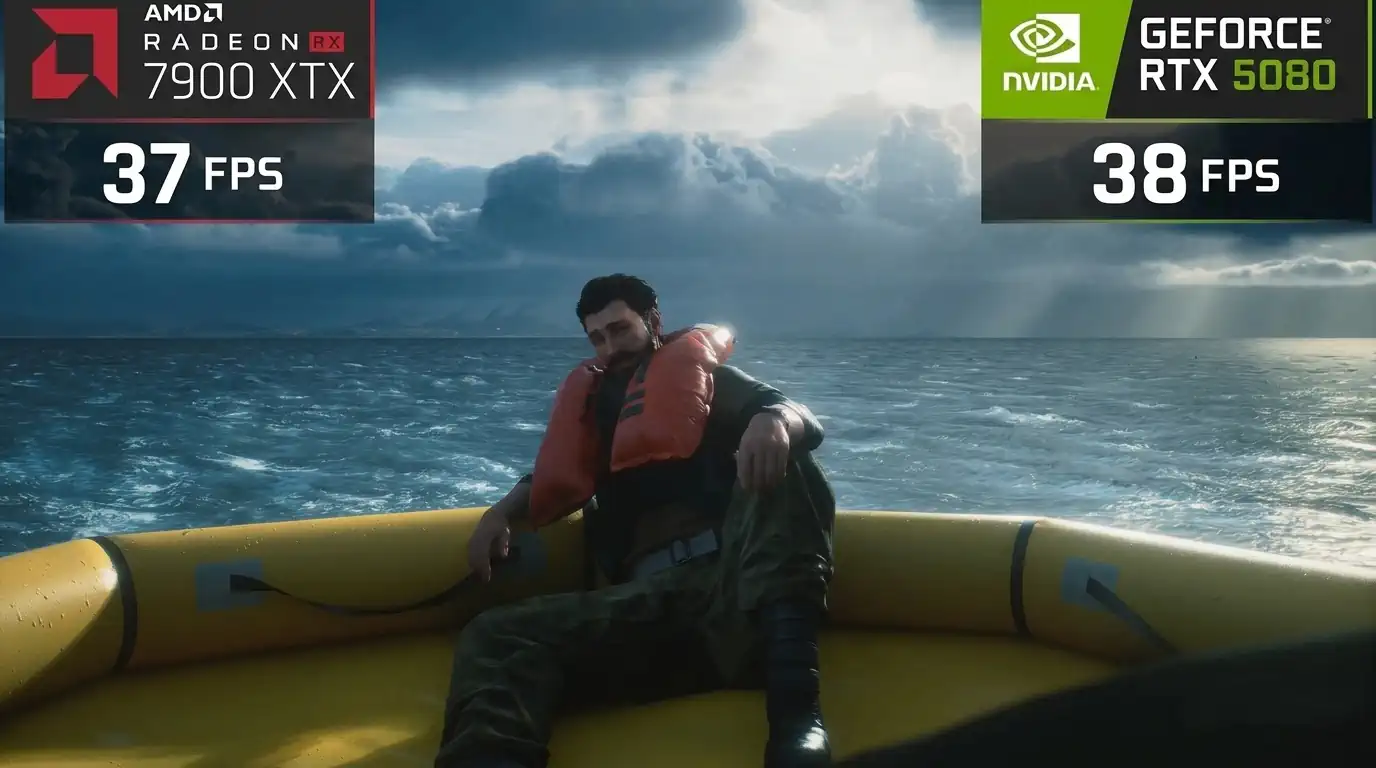
One of the more surprising findings from the recent benchmark data involves the performance of the AMD Radeon RX 7900 XTX. Despite being part of the previous generation, the card demonstrated remarkable resilience, holding its own against newer competition. It achieved 33 minimum and 37 average frames per second, trailing the new GeForce RTX 5080 by a negligible margin of only one frame per second. This data serves as a testament to the efficiency of the RDNA 3 architecture when handling highly complex, modern rendering pipelines.
Furthermore, the RX 7900 XTX managed to outperform the newer Radeon RX 9070 XT, which utilizes the RDNA 4 architecture. Achieving 29 minimum and 32 average frames per second, the newer, mid-tier RDNA 4 card highlights the widening gap between mainstream hardware and the specialized demands of high-end simulators. The fact that the 7900 XTX also outperformed both iterations of the GeForce RTX 4080—which recorded an average of 36 frames per second—confirms that architectural maturity still plays a vital role in real-world performance, even in the face of cutting-edge software like Unreal Engine 5.
Future Implications for Hardware Adoption
The data from Ace Combat 8 indicates a clear trajectory for the gaming industry: as Unreal Engine 5 becomes the standard for major releases, the bar for acceptable performance is rising sharply. Mid-range cards, such as the GeForce RTX 4070 or RTX 3060, are increasingly being relegated to lower resolutions or significantly reduced quality presets. The performance figures—where the RTX 3060 struggles at 12 frames per second and the RTX 4070 peaks at 22—demonstrate that hardware enthusiasts must now prioritize high-memory bandwidth and raw compute throughput more than ever.
For players, this shift reinforces the necessity of choosing hardware that is not only current but capable of handling the specific demands of next-generation engines. The reliance on advanced features like Nanite and Lumen is not merely a graphical trend; it is a structural change in how video games process data. As software continues to leverage these capabilities, the hardware landscape will continue to favor cards that can process massive geometry streams and complex illumination in real time. Ultimately, this ensures that the gap between high-end hardware and mainstream units will continue to widen as long as the demand for cinematic, photorealistic gaming continues to grow.
Disclaimer: This content is auto-generated for informational purposes only.
Source: Read Original News