







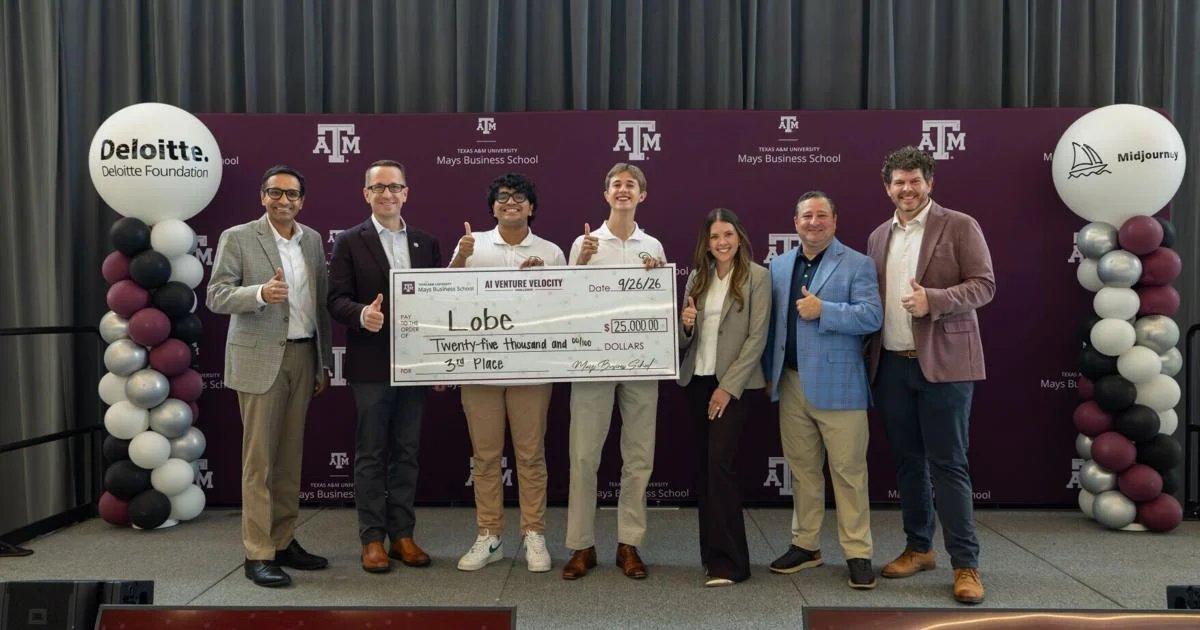
Texas A&M University’s Mays Business School took center stage in the rapidly evolving landscape of academic innovation this weekend, hosting the finals of its second annual AI Venture Challenge. As generative artificial intelligence continues to reshape the global corporate landscape, the competition served as a high-stakes proving ground for student entrepreneurs looking to integrate machine learning into viable business models.
The event featured 12 finalist teams, with five representing Texas A&M. This surge in home-grown participation highlights a growing trend across major research universities: the transition from theoretical computer science to applied AI entrepreneurship.
The Intersection of Academia and Industry
The AI Venture Challenge is more than just a pitch competition; it acts as a microcosm of the current tech industry’s obsession with Large Language Models (LLMs) and automated workflows. For students, the challenge mirrors the rigorous vetting processes seen in Silicon Valley venture capital firms.
Participants were tasked with solving real-world problems using proprietary algorithms and existing cloud infrastructure. Many of the finalists leveraged Google’s AI ecosystem—including the Vertex AI platform and Gemini’s API integration—to build prototypes that could scale efficiently. By utilizing these tools, students demonstrated how cloud-native AI is democratizing high-level development, allowing small teams to achieve results that once required massive engineering departments.
The Role of Tech Giants in Student Innovation
The competition reflects a broader industry movement where tech giants are actively fostering the next generation of founders. Companies like Google, Microsoft, and NVIDIA have been aggressively providing credits and mentorship to university programs to ensure their tools become the standard for budding entrepreneurs.
At the Mays Business School event, judges—many of whom are veteran investors—looked specifically for how these teams implemented “Responsible AI” frameworks. In an era where data privacy and algorithmic bias are at the forefront of the news cycle, the ability to build a product that is both profitable and ethical has become a key criterion for success. The finalists showcased a deep understanding of how to pivot from experimental coding to product-market fit, a skill that is increasingly essential in the competitive job market.
Why the AI Venture Challenge Matters
The shift toward AI-centric curriculum at institutions like Texas A&M suggests that higher education is finally catching up to the speed of the tech industry. For years, the criticism of business and engineering schools was the “lag time” between a technology’s inception and its inclusion in the classroom. The AI Venture Challenge effectively closes that gap.
As Google and its competitors continue to roll out updates to their AI search products and productivity suites, these student teams are already imagining the next layer of software that will sit on top of these foundational models. The projects presented on Saturday ranged from automated supply chain optimization to personalized educational tools, proving that the next “unicorn” startup might not emerge from a San Francisco garage, but from a university incubator.
Ultimately, the event underscored a pivotal moment for the tech sector: the barrier to entry has never been lower, but the requirement for ingenuity has never been higher. By providing a platform for these 12 teams, Mays Business School is not just showcasing student talent; it is providing a window into the future of enterprise software. As these students transition from the classroom to the boardroom, their ability to navigate the complex, rapidly changing terrain of AI will likely define the next decade of technological advancement. Whether these specific ventures succeed or fail, the collaborative spirit between academic researchers and the broader AI ecosystem remains the strongest catalyst for the next wave of innovation.
Disclaimer: This content is auto-generated for informational purposes only.
Source: Read Original News