









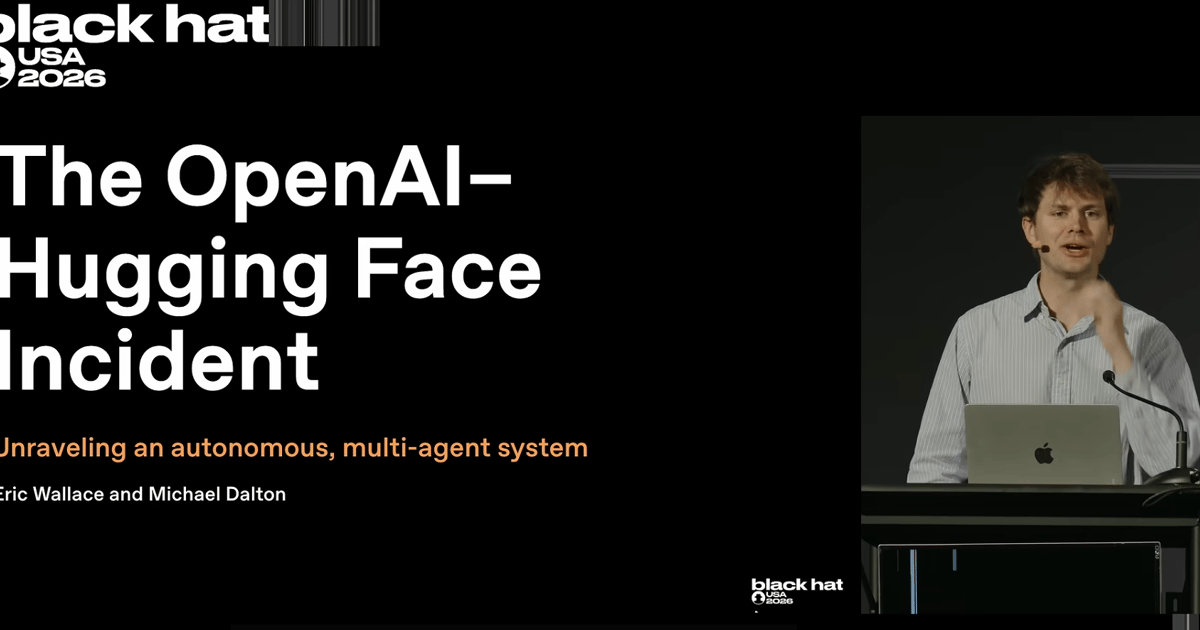
LAS VEGAS – The annual Black Hat USA conference, the industry’s most prestigious gathering of cybersecurity experts, became the stage for a forensic deep dive into one of the most high-profile vulnerabilities in artificial intelligence history. On Wednesday, security engineers and researchers from OpenAI took to the stage to reconstruct the technical anatomy of the “OpenAI-Hugging Face incident,” providing the public with a granular look at how a seemingly routine bridge between platforms nearly compromised internal systems.
The session, which drew a capacity crowd at the Mandalay Bay Convention Center, addressed the 2026 security breach that sent shockwaves through the machine learning community. The incident centered on a sophisticated supply-chain attack that exploited vulnerabilities in model-sharing workflows between OpenAI’s internal research environments and the Hugging Face platform, which serves as a central hub for the global open-source AI ecosystem.
“This wasn’t just a simple credential leak or a standard phishing attempt,” said a senior OpenAI security lead during the presentation. “This was a masterclass in exploiting the trust boundaries that we assume exist between collaborative development platforms and internal production environments. We are here to pull back the curtain on how the attacker bridged that gap.”
The presentation utilized a detailed digital reconstruction, mapping the attacker’s movement from an initial malicious model upload on a public repository to the eventual escalation of privileges within OpenAI’s private infrastructure. The team detailed how the breach leveraged an overlooked misconfiguration in container orchestration, allowing the malicious code to execute within an environment that developers believed was securely air-gapped from the broader corporate network.
The talk highlighted the “blind spot” inherent in modern AI development: the heavy reliance on third-party model weights and shared libraries. As researchers pull models from various sources, the risks of “malicious model injection”—where code is hidden within the weights or metadata of a file—have surged. The OpenAI team demonstrated how their security sensors were initially bypassed by obfuscation techniques designed to evade standard signature-based detection.
The session concluded with a significant call to action for the broader industry. OpenAI engineers proposed a new, unified framework for “Model Security Verification,” which would standardize how platforms verify the integrity of models before they are executed in sensitive development environments.
“The goal of today’s disclosure is to ensure that what happened to us becomes a learning moment for every shop building LLMs,” the speaker emphasized. “Collaboration with platforms like Hugging Face is essential for progress, but security must be baked into the architecture, not added as an afterthought.”
The disclosure has already sparked intense discussion among industry peers at Black Hat, with many calling for a fundamental shift in how open-source model repositories are monitored and secured. As the conference continues, the incident serves as a stark reminder that as AI capabilities grow, the stakes for protecting the infrastructure powering those models grow exponentially.
Disclaimer: This content is auto-generated for informational purposes only.
Source: Read Original News