









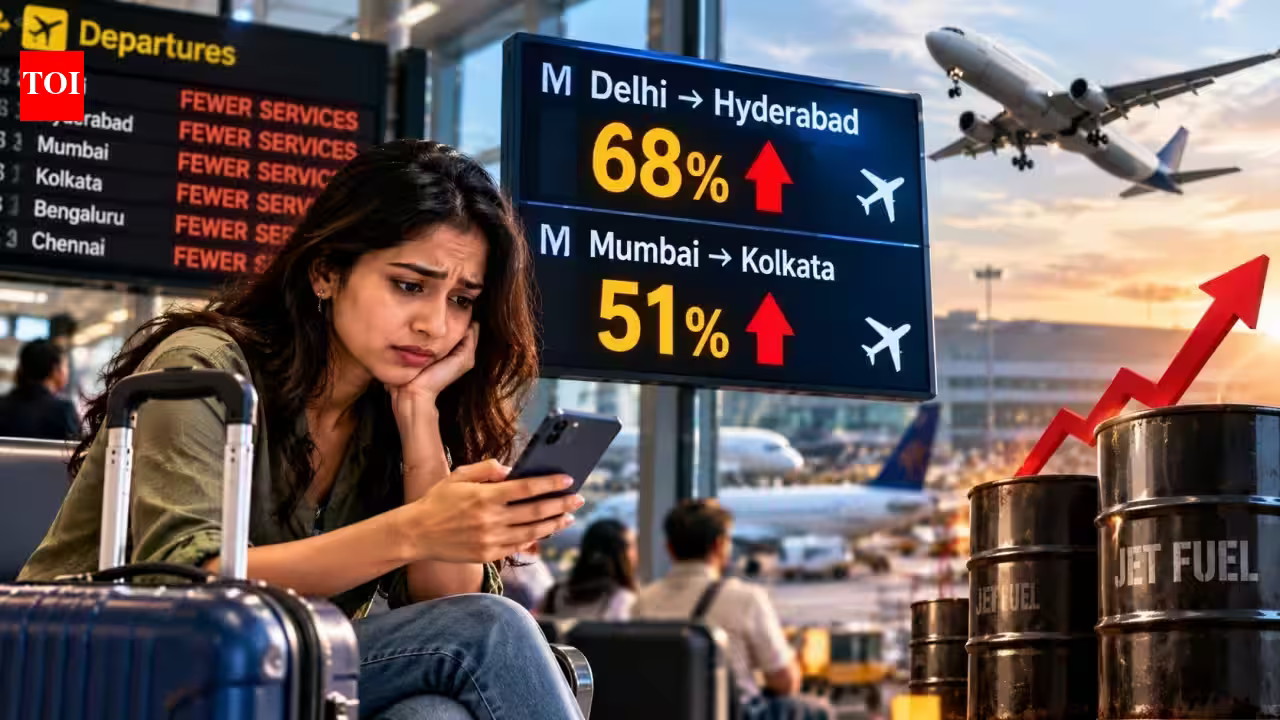
The Indian aviation sector is currently navigating a period of significant price volatility, driven by a convergence of supply-side constraints and macroeconomic pressures. For travelers planning journeys during the October-December festive quarter, the cost of air travel has registered a marked increase. Analysis of current market data reveals that airfares on several high-traffic domestic routes have escalated by as much as 68% compared to the previous year. This inflationary trend is not merely a result of seasonal demand; it reflects deeper structural shifts in how airlines manage capacity, fuel exposure, and operational expenses in an increasingly unpredictable global environment.
The Mechanics of Rising Airfares and Capacity Management
The primary driver behind the current price escalation is the strategic reduction in flight frequencies coupled with climbing input costs. Aviation analytics firm OAG reports that domestic flight schedules for the final quarter of the year have been cut by 5% compared to the same period last year. While total seat capacity has only decreased by 1.2%, suggesting a transition toward larger aircraft to maximize efficiency, the reduction in flight frequency has diminished the variety of departure windows for passengers.
In the airline industry, frequency is a critical component of value. When an airline reduces the number of flights on a specific route, it effectively limits the number of lower-priced inventory buckets available to early bookers. As demand remains robust during the festive season, these lower-priced seats are exhausted rapidly, forcing consumers into higher fare brackets. Routes like Delhi-Hyderabad and Mumbai-Kolkata have seen dramatic price hikes of 68% and 51% respectively, illustrating that even when overall seat capacity remains somewhat stable, the lack of frequency on popular sectors creates artificial scarcity, driving prices upward.
Aviation Turbine Fuel and Operating Expenses
A significant portion of the current airfare inflation is directly linked to the volatility of Aviation Turbine Fuel (ATF). Fuel represents a major line item for Indian carriers, typically accounting for 30% to 40% of their total operating expenditure. Recent data indicates that domestic ATF prices experienced successive monthly increases through the latter half of the year, driven largely by geopolitical tensions in the Middle East.
IndiGo, the dominant player in the Indian market, responded to these sustained price hikes by implementing a tiered fuel surcharge. By indexing these charges to the distance traveled—ranging from Rs 100 to Rs 350 for domestic sectors—the airline has sought to insulate its margins against a 14% month-on-month rise in fuel costs. This move is significant, as it marks a recurring adjustment mechanism that airlines are now deploying with greater frequency. Because Indian carriers also grapple with dollar-denominated costs such as aircraft leasing and heavy maintenance, the depreciation or volatility of the rupee against the US dollar adds an additional layer of expense, further necessitating the pass-through of costs to the end consumer.
Regional Disparities in Aviation Capacity
The aviation market in India is not monolithic; capacity management varies drastically by route and operator strategy. While some sectors face a supply crunch, others are experiencing a capacity surplus due to infrastructure expansion. The introduction of new airport facilities, such as those near Mumbai, has led to a dramatic increase in seat availability on specific routes like Delhi-Navi Mumbai, where capacity has expanded significantly compared to the previous year.
Conversely, established routes are witnessing capacity contractions. Ahmedabad-Kolkata and Hyderabad-Jaipur have seen sharp declines in available seats, which serves to exacerbate price competition on those corridors. This dichotomy creates a complex landscape for travelers: while a business or leisure trip to a secondary hub served by new infrastructure might be more accessible, traditional inter-city connectivity is becoming increasingly expensive. For airlines, the challenge lies in balancing the operational cost of running these aircraft against the price sensitivity of the Indian consumer, who has historically been sensitive to ticket costs but is currently demonstrating resilience in booking behavior despite the inflationary environment.
The International Travel Shift
While domestic travel costs are surging, international travel demand is also evolving, influenced by visa liberalizations and shifting preferences. Interestingly, international flight schedules for the final quarter show a 3% growth in flights, outstripping the domestic sector’s performance. Destinations that offer ease of access, such as Vietnam (Hanoi), Indonesia (Bali), and Sri Lanka (Colombo), have seen a surge in interest. This indicates that Indian travelers are increasingly viewing mid-haul international trips as a viable alternative to domestic holiday destinations, particularly when domestic airfare spikes narrow the price gap between a regional getaway and an overseas vacation.
However, international travel is not immune to cost pressures. Airlines have adjusted international fuel surcharges to account for global crude oil trends, with long-haul routes to Europe now attracting significantly higher surcharges. While the total volume of international bookings remains steady, the cost profile for these travelers has shifted. The ability of airlines to successfully manage these international routes, specifically by deploying capacity to high-growth regions like Saudi Arabia and Canada, reflects a strategic pivot designed to capture higher-margin, long-haul traffic while managing the domestic sector through fleet optimization.
Future Outlook for the Indian Traveler
The current environment suggests that the “festive premium” on air travel is becoming a permanent fixture of the quarterly cycle. With oil marketing companies maintaining high ATF prices and airlines prioritizing yield management over market share expansion, the days of low-cost, last-minute travel on busy routes appear to be receding. Travelers are advised to adopt advanced booking strategies, as analysts anticipate that prices on high-demand routes could escalate by an additional 15% to 20% as departure dates approach.
Looking ahead, the resilience of the Indian aviation market will depend on the stability of fuel prices and the effectiveness of airline capacity planning. While the introduction of high-speed rail alternatives, such as the Vande Bharat sleeper trains, provides a competitive check on air travel for medium-haul distances, the aviation sector remains the preferred mode for time-sensitive travel. For stakeholders in the Indian economy, the rise in airfares serves as a barometer for broader inflationary pressures. As long as supply remains constrained and input costs remain elevated due to global factors, the upward trajectory of ticket prices is likely to persist, compelling both leisure and corporate travelers to re-evaluate their annual travel budgets and planning cycles.
Disclaimer: This content is auto-generated for informational purposes only.
Source: Read Original News