





India Overtakes China as World’s Top Sulphur Dioxide Emitter
India has officially surpassed China to become the world’s leading emitter of sulphur dioxide (SO2), the primary pollutant responsible for acid rain. While Western nations have successfully mitigated this environmental threat through decades of stringent regulations and technological upgrades, India’s emissions trajectory has reached an all-time high, highlighting a growing divide in how emerging markets and developed economies handle industrial pollution.
A Global Shift in Emissions
Data compiled by the Community Emissions Data System (CEDS) reveals that India’s sulphur dioxide emissions hit 11.3 million tonnes in 2022, accounting for 15% of the global total. This figure is two and a half times higher than the nation’s output in 2000. While India officially overtook China in 2021, independent satellite analysis from Greenpeace and NASA had flagged the trend as early as 2019, consistently identifying coal combustion as the primary culprit.
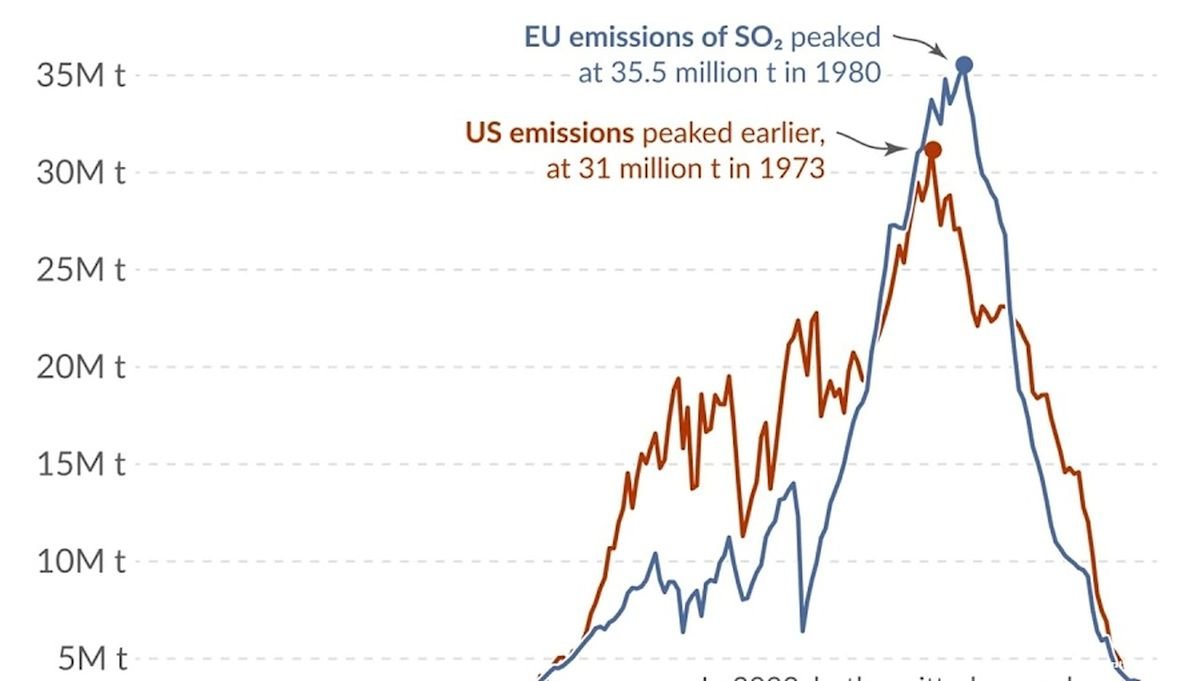
In stark contrast, the United States and the European Union have virtually eliminated the SO2 crisis that plagued their environments in the late 20th century. Both regions have slashed their emissions by approximately 94% from their historical peaks. The US saw its output drop from a 1973 peak of 31.1 million tonnes to roughly 2 million tonnes by 2022, a feat mirrored by the EU-27. This drastic reduction was achieved primarily through the installation of “scrubbers” in power-plant chimneys, a transition to lower-sulphur coal, and a general shift away from coal-fired power generation.
Divergent Paths: China vs. India
China’s experience offers a roadmap for emissions control that India has yet to mirror. After peaking at 38.1 million tonnes in 2006, China implemented mandatory desulphurisation requirements across its power sector, leading to a 73% reduction in emissions by 2022.
India’s regulatory environment, however, has recently moved in the opposite direction. In 2025, the government opted to scrap mandates requiring flue-gas desulphurisation units at 79% of its coal-fired power plants, restricting the requirement primarily to facilities situated near major urban centers like New Delhi.
The Broader Impact of Emerging Markets
The rise in SO2 emissions is a broader challenge across several emerging economies where industrial growth remains tethered to coal. Indonesia has seen its emissions triple since 2000, and there are growing concerns that existing pollution-control technology at its power plants is not being operated consistently. Similarly, Vietnam has seen a fourfold increase, while Pakistan’s emissions have more than doubled over the same period.
While Russia remains the world’s third-largest emitter, its current levels are significantly lower than its Soviet-era peak, largely due to industrial restructuring rather than targeted environmental policy. Meanwhile, in the Western Balkans, coal plants continue to operate well beyond international pollution standards, frequently emitting SO2 at levels several times higher than legal limits.
As global emissions continue to fall—dropping 48% from their 1979 peak of 141 million tonnes to 73.5 million tonnes in 2022—the concentration of the problem in specific, coal-reliant nations becomes increasingly pronounced. The data serves as a stark reminder that while the industrialized West has largely moved past the “acid rain” era, the battle for cleaner air in the developing world is only intensifying.
Disclaimer: This content is auto-generated for informational purposes only.
Source: Read Original News