






Burning Issues: Punjab’s Stubble Crisis Amidst Political Pre-Poll Maneuvering
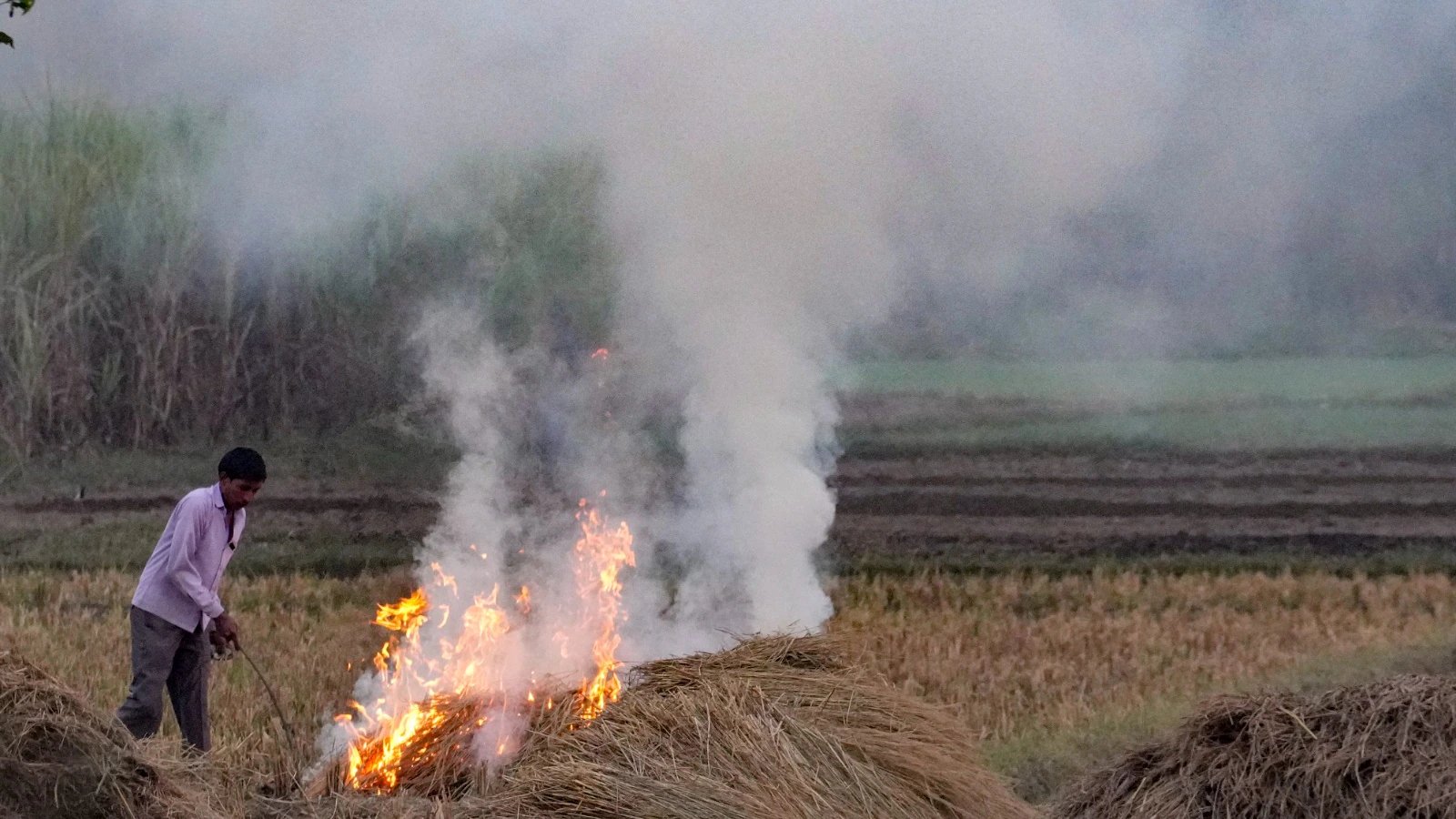
Chandigarh: As the annual cycle of late September and early October begins, the fields of Punjab witness a familiar, chaotic rhythm. For farmers, this period is a desperate race against the clock to sow winter crops. For state administrators, it is a high-stakes surveillance operation involving satellite imagery and FIR filings. And for news crews, it is a seasonal migration from Delhi to document the plumes of smoke rising from the state’s agrarian heartland.
However, as the countdown to the 2027 state elections begins, the political atmosphere in Punjab is shifting. While the fires continue to burn, the enforcement of punitive measures against farmers is expected to soften, signaling that in an election year, political survival may take precedence over environmental compliance.
The Shrinking Numbers and Growing Tension
Official data paints a picture of a dramatic decline in farm fires. Records show a reduction from 36,663 incidents in 2023 to 10,909 in 2024, and further down to 5,114 by 2025—an 86 percent drop from the peak. Authorities credit this to stricter enforcement, the distribution of over 1.46 lakh in-situ management machines, and enhanced monitoring.
Yet, these statistics offer little comfort to the rural population bearing the brunt of the pollution. Collaborative studies by the Central Pollution Control Board and AIIMS indicate a 30 to 35 percent spike in respiratory issues across the state during the harvest season. Medical data shows a measurable decline in lung capacity among rural residents, with children and the elderly suffering from chronic bronchitis, asthma, and persistent wheezing.
Economic Constraints vs. Environmental Mandates
For farmers, the practice of setting fields ablaze is rarely an act of defiance, but rather a calculation of survival. Union leaders, including BKU (Ekta Ugrahan) president Joginder Singh Ugrahan, argue that farmers are being unfairly penalized for systemic failures. The window for harvesting is dangerously short, and the operational costs of machinery—including fuel and maintenance for tools like Happy Seeders—often exceed the razor-thin margins of paddy farming.
“Farmers are being asked to provide a public good—clean air—while struggling with soaring input costs,” Ugrahan noted. The demand remains consistent: a direct cash incentive of Rs 2,000 to Rs 3,000 per acre to offset the costs of residue management.
A Political Chessboard
The debate has transformed into a high-stakes standoff between the Punjab government and the Centre. Chief Minister Bhagwant Singh Mann has openly opposed the criminalization of farmers, questioning why the management of crop residue has become a “crime” rather than an agricultural challenge. The state government has pushed for a joint compensation package—Rs 2,500 per acre, split between the Union and the State—a proposal the Centre has repeatedly rejected in favor of focusing on machinery subsidies.
The politics of the issue have become increasingly fluid. Historically, the Aam Aadmi Party (AAP) framed Punjab’s fires as a “Delhi crisis” when they were in opposition. Now, in power, the narrative has shifted to blaming the Union government’s refusal to provide fiscal support. Meanwhile, the BJP has countered by pointing to the successful implementation of incentives in neighboring Haryana, accusing the Punjab administration of failure in governance and field-level execution.
As the 2027 polls draw near, the stubble burning issue remains an unresolved conflict. With farmers demanding both financial support and the withdrawal of thousands of existing police cases, the smoke rising from Punjab’s fields is likely to cloud the political horizon, serving as a reminder that the crisis is as much about economic policy as it is about environmental health.
Disclaimer: This content is auto-generated for informational purposes only.
Source: Read Original News